Do Heat Pumps Work in Cold Weather? Capacity Matters More Than the Label
Compare a heat pump’s cold-temperature output with your home’s heating load. Learn what the cold-climate label proves and what to ask an installer.
A heat pump can be running on a very cold day and still fall short of the heat a particular house needs. Those are separate questions: can it operate, and can its output meet the load? Ask an installer to answer both with the proposed equipment combination and your home in mind.
Heat pumps move heat from outside to indoors for heating, as ENERGY STAR’s air-source explanation describes. Cold-weather models improve low-temperature performance. That does not make every heat pump interchangeable or every existing installation adequate for the coldest local conditions.
Four numbers answer different questions
| Field | What it helps you assess |
|---|---|
| Manufacturer’s heating operating range | Whether the exact equipment is intended to operate at that outdoor temperature. It does not state how much heat it delivers there. |
| Heating capacity at that temperature, in Btu/h | The rate of heat output to compare with the home’s heating requirement at the same conditions. |
| Coefficient of performance, or COP | Heat delivered divided by electricity consumed at stated conditions. This is an efficiency ratio, not capacity. |
| HSPF2 | A standardized seasonal heating-efficiency measure; it is not the heat output on a particular cold night. |
Keep the indoor and outdoor model combination together. A brochure’s headline output at milder test conditions is not a substitute for its low-temperature performance data. Likewise, thermal Btu/h is not an electrical wattage figure to enter into a battery calculator.
What a cold-climate designation verifies
ENERGY STAR’s published criteria require a cold-climate heat pump to demonstrate a COP of at least 1.75 at 5°F and heating capacity at 5°F of at least 70% of its capacity at 47°F, under the specified Appendix M1 tests. The criteria also require verification that the native controls achieve the low-temperature performance.
These are meaningful test requirements, but 70% is a ratio to that system’s milder-weather capacity—not 70% of your home’s needs. A tested point at 5°F also does not establish output at every temperature below it. Ask for the exact model’s data at the temperature used in the house design.
A worked comparison: the same outdoor point
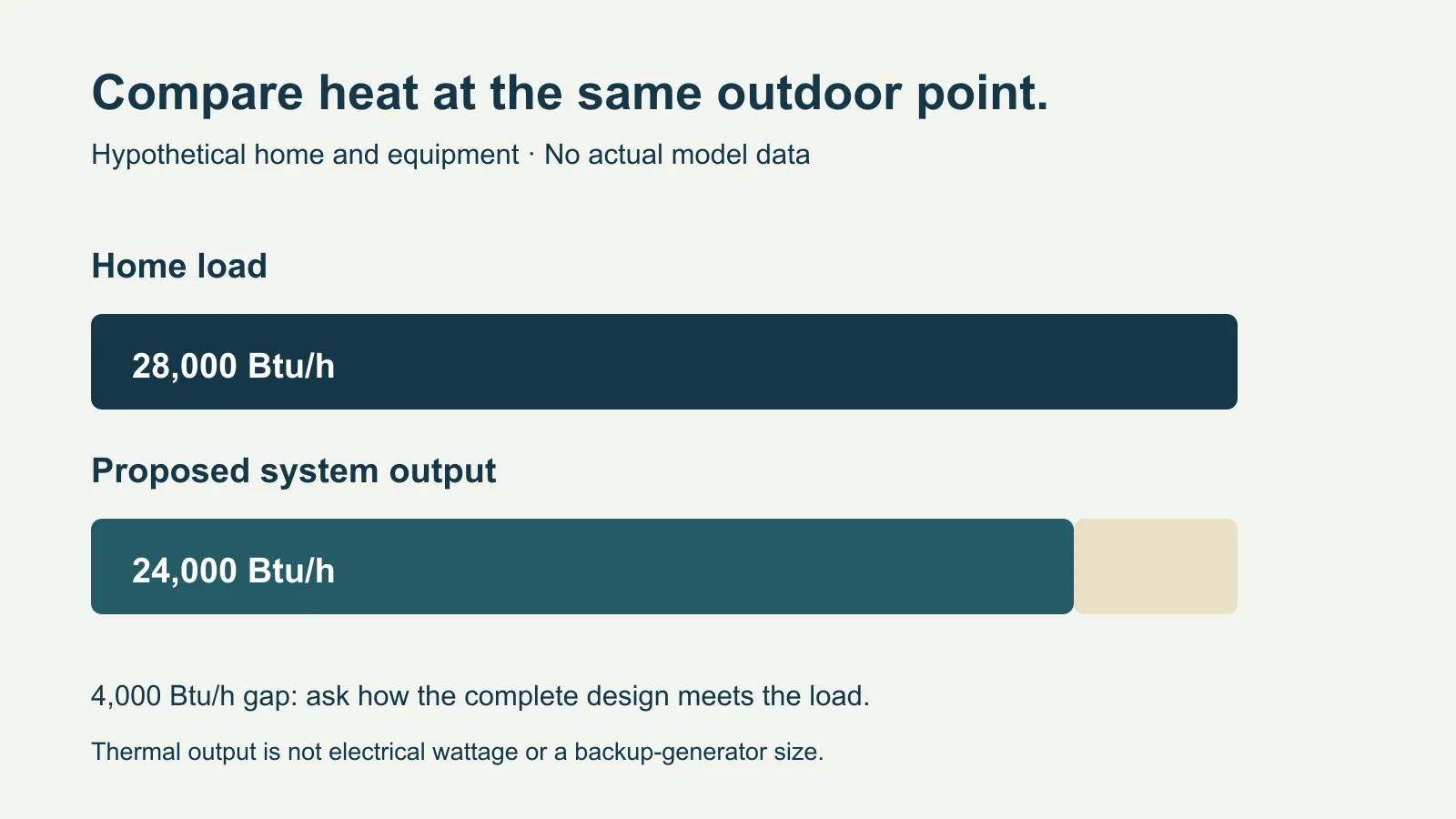
Consider a hypothetical home whose calculated requirement is 28,000 Btu/h at its local winter design temperature. The proposed matched system’s documented capacity at those same conditions is 24,000 Btu/h.
28,000 − 24,000 = 4,000 Btu/h to account for in the design.
A cold-climate label cannot close that gap by itself. The contractor needs to explain how the completed system meets the requirement, including any supplemental source and its controls. This example does not select a unit, calculate your load or convert the shortfall into backup-generator watts.
Cold-weather comparison record
ENERGY STAR recommends a contractor’s Manual J calculation to size equipment for the home. Request a written comparison containing:
- Home conditions: local design temperature, indoor design target and the calculated heating load.
- Equipment identity: full indoor/outdoor model combination and the performance document used.
- Same-point output: heating capacity and efficiency at the relevant outdoor conditions, with any assumptions the installer used.
- Delivery: whether the proposed ductwork or indoor units can deliver the required heat to the rooms concerned.
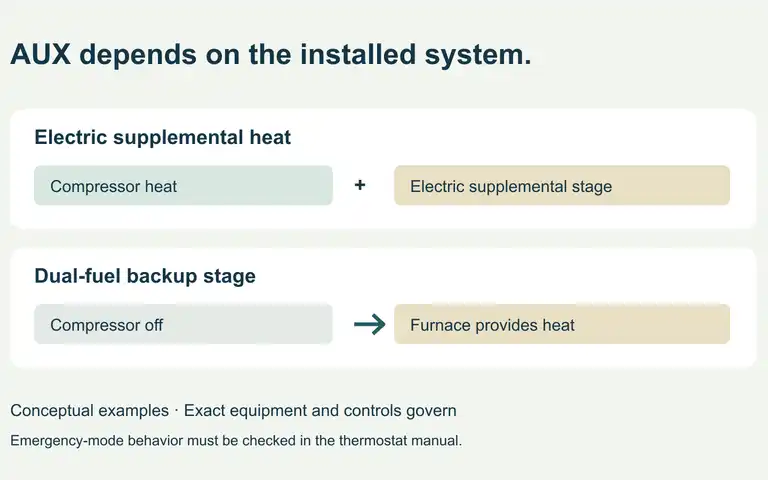
- Supplemental operation: source, capacity, control sequence and what happens if the compressor is unavailable.
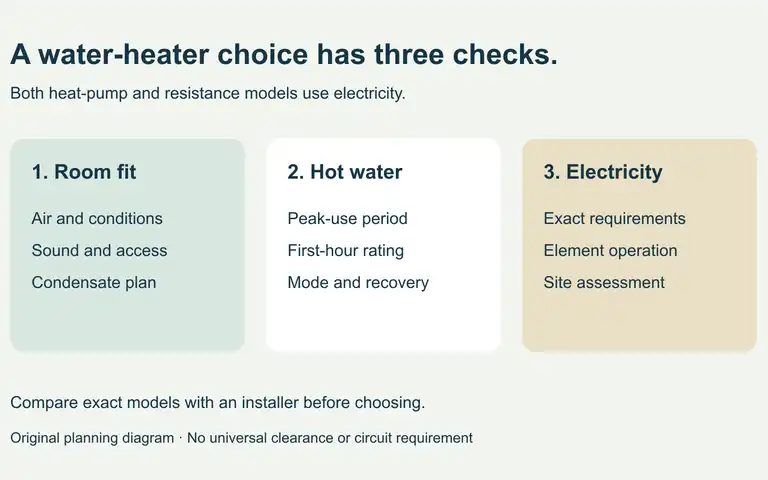
- Electrical needs: the exact system’s requirements, assessed separately from its thermal output.
Ask the installer to explain a missing field rather than filling it with nominal tonnage or an online rule based on floor area. If the proposal includes auxiliary or emergency modes, use the thermostat-stage comparison to prepare the control questions.
The building matters too. Before an assessment, use the winterizing guide to record comfort problems and planned envelope work. Give that information to the contractor so the design reflects the home you intend to heat.