Heat-Pump Water Heater vs. Electric Resistance: Check Space and Recovery
Compare heat-pump and resistance water heaters by room fit, hot-water delivery, operating modes and electrical requirements before an installer visit.
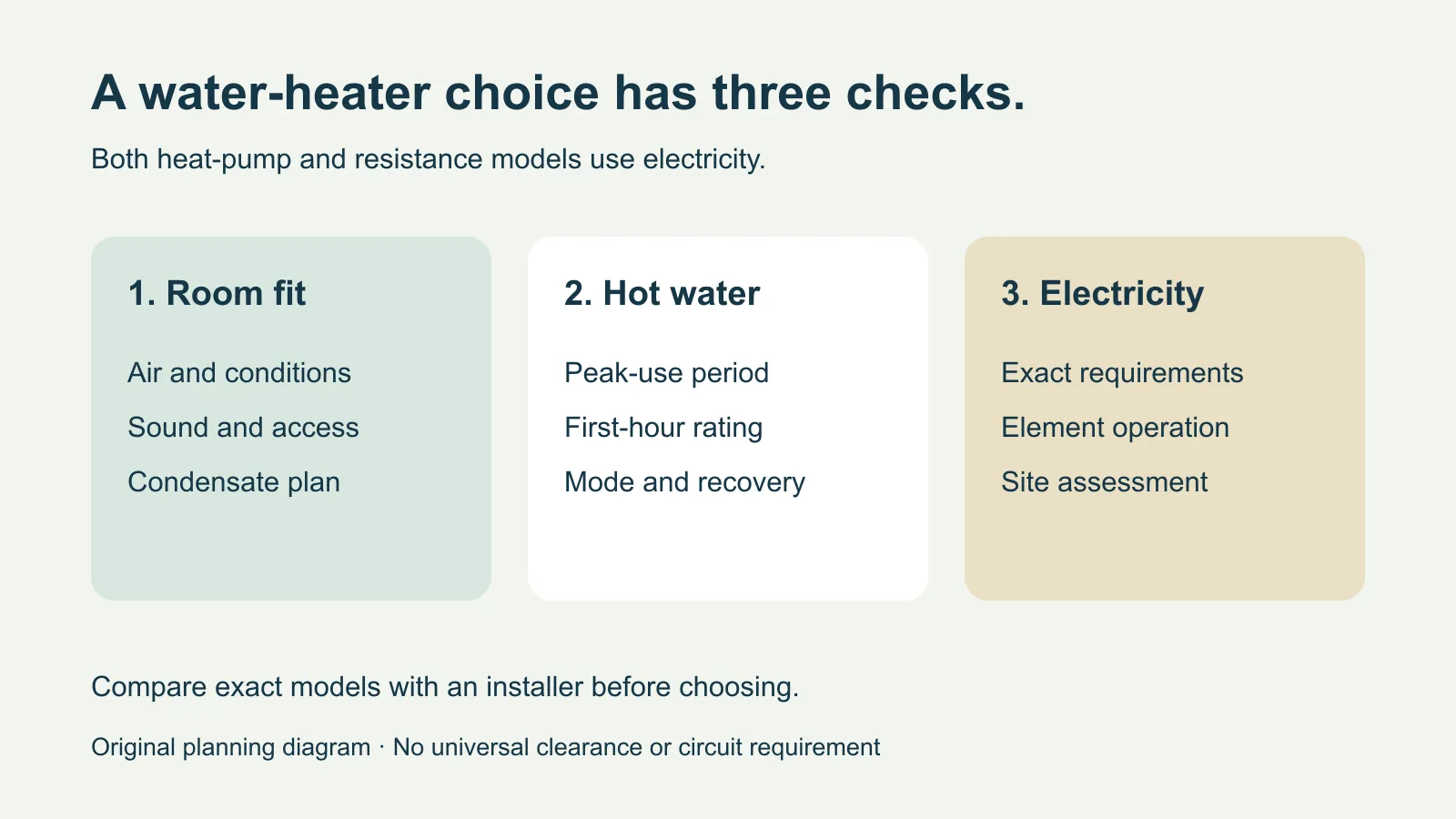
If the current electric water heater is due for replacement, a heat-pump model deserves a look. The deciding question is whether it can serve your household well in the place you have, during the busiest hot-water period. A lower energy-use estimate is useful only after those checks.
The difference is where the heat comes from
A resistance storage water heater uses electric elements to heat its tank. A heat-pump water heater uses electricity to move heat from nearby air into the water. Many products called hybrid electric combine a heat pump with resistance elements, so this is not a choice between electric and non-electric equipment.
ENERGY STAR’s buying guidance notes that a heat-pump water heater can cool its surroundings and that colder conditions can increase use of backup resistance heating. The room is part of the comparison, especially if it is already cold or beside a frequently occupied space.
| Decision | Resistance storage | Heat-pump / hybrid storage |
|---|---|---|
| Space | Check the exact tank’s dimensions, access and service clearances. | Also assess the air supply, room conditions, fan/compressor sound and condensate route. |
| Hot-water delivery | Compare rated delivery with peak household demand. | Compare delivery and recovery in the operating modes you expect to use. |
| Electricity | Use the exact voltage, circuit and equipment requirements. | Check all applicable modes and element requirements; lower annual energy use does not establish a smaller circuit. |
| Cost | Compare installed price and expected use at the applicable tariff. | Include site changes and maintenance as well as the model’s energy estimate. |
Room fit is more than the tank fitting through the door
Measure the available space and describe its winter and summer conditions for the installer. Note nearby bedrooms or work areas, existing drainage and whether the heater is inside conditioned living space.
Do not turn a general room-volume recommendation into a pass/fail rule for every model. ENERGY STAR’s design guidance explains that manufacturer air-volume requirements differ and directs designers to the installation guide. A small closet may require a different approved configuration; it is not solved merely by choosing a tank of the same diameter.
Ask the installer how the proposed location handles the cooled air, sound, service access and condensate. This is a site-assessment question, not a reason to cut openings, route drains or alter ventilation yourself.
Recovery and mode choice can change the comparison
Tank gallons alone do not tell you how a replacement will handle back-to-back showers or other clustered use. Ask about first-hour rating: the estimated maximum hot-water volume, in gallons, supplied in an hour that starts with a fully heated tank under rating-test conditions, and the model’s recovery performance for your expected conditions. Describe the household’s actual busy period rather than only its daily total.
Rheem’s ProTerra mode explanation provides a useful named-family example: Heat Pump mode leaves the resistance elements off, Energy Saver can call an element, and High Demand can combine heat-pump and element operation. Electric mode disables the heat pump. Those distinctions show why the word “hybrid” alone cannot predict electricity demand or recovery time. Confirm the proposed model’s manual and ratings rather than copying another model’s mode settings.
Water-heater comparison card
Ask for the following on each written proposal:
| Item | What to record |
|---|---|
| Exact model | Capacity, dimensions and manual revision |
| Location assessment | Available air, seasonal room conditions, clearances, sound and condensate plan |
| Peak-use fit | First-hour rating, recovery information and the operating mode assumed |
| Electrical assessment | Exact requirements, existing service suitability and any necessary work |
| Owner care | Filter or other maintenance, access, service provider and manual instructions |
| Full cost | Installed price, site changes, model energy estimate and the tariff assumptions |
Keep current incentive eligibility separate from the equipment decision; a dated online offer is not evidence that your installation qualifies. If a proposal relies on a particular annual saving, ask for the usage, mode and electricity-price assumptions behind it.
Once you know which model fits, add its electricity dependence and outage instructions to the water-heater power-outage record. A hybrid model’s electric backup elements do not provide heat when the required electrical supply is absent.