Auxiliary Heat vs. Emergency Heat: What the Thermostat Means
Learn why AUX and emergency heat are different, how dual-fuel systems change the comparison, and what to record before asking your HVAC technician.
In this guideJump to a section
An AUX message on a cold morning and an Emergency Heat option in a menu can look like two names for the same thing. They often use the same backup equipment, but they describe different control decisions. Identify the system before deciding that something is wrong—or selecting a different mode.
The distinction is how the backup is called
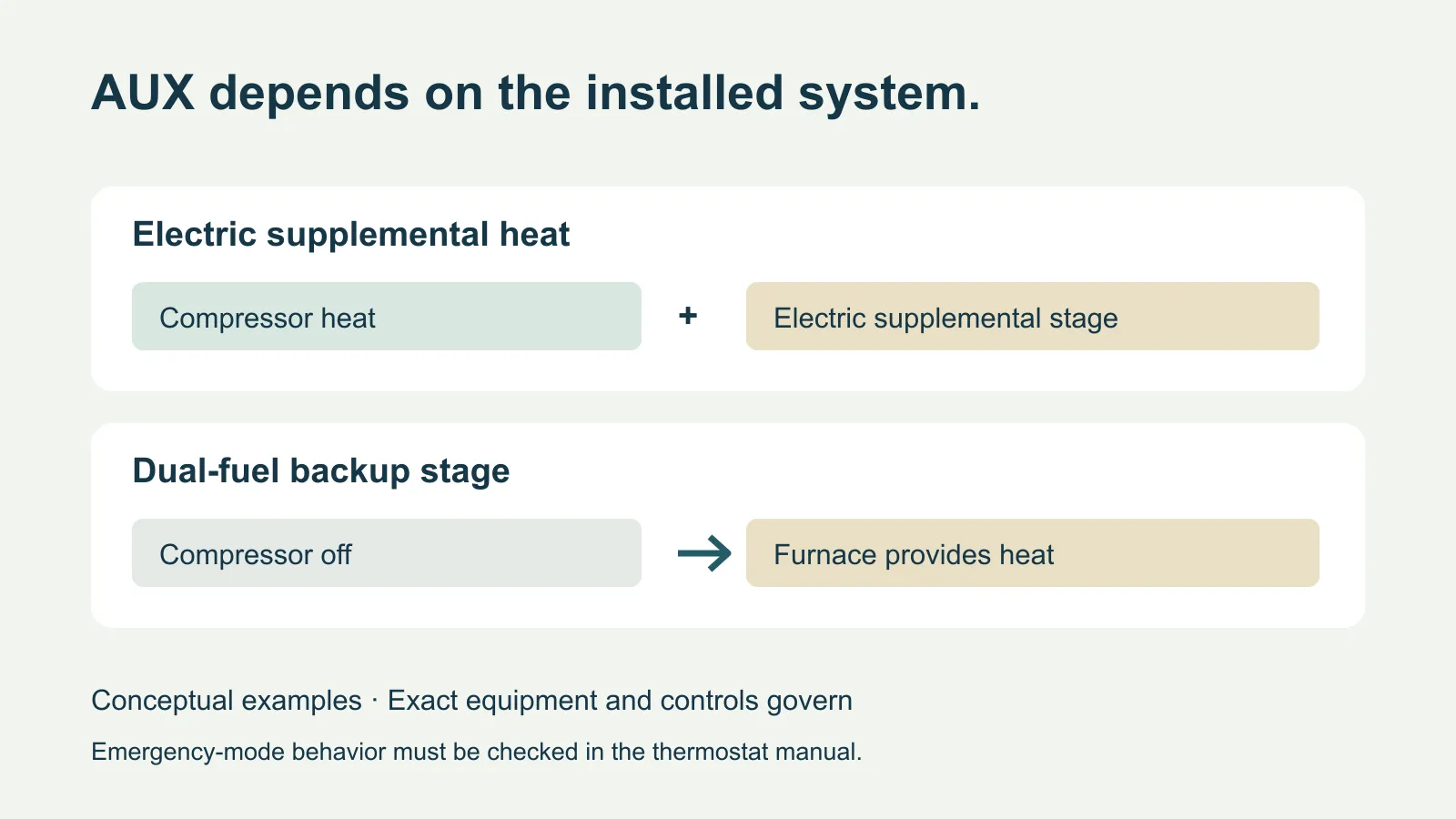
Honeywell Home explains that auxiliary heat helps maintain the set temperature; the compressor and backup may run together. In the thermostat context described there, selecting Em Ht excludes the compressor and runs the backup alone. That backup can be electric heat strips or a fossil-fuel heat source.
AUX is therefore an indication of a stage being used, while Emergency Heat is commonly a selectable operating mode. Neither label says that the home has a source of heat independent of electricity. An electrically controlled furnace or electric strip heater still needs power.
| Installed arrangement | What the additional stage can mean |
|---|---|
| Heat pump with electric supplemental heat in the air handler | The electric stage can assist while the compressor continues heating. |
| Dual fuel: heat pump plus a fuel-burning furnace | The controls can stop compressor heating and use the furnace instead. |
| Emergency mode on the Honeywell-described system | The backup heats without the compressor. Confirm the equivalent mode in your own manual. |
The first two rows reflect Lennox’s explicit distinction between electric and dual-fuel staging. This is why “AUX always means compressor plus strips” is an unreliable general rule.
A temperature or icon is not a diagnosis
There is no single outdoor temperature in this comparison at which every system should change stages. Equipment capacity, installed backup, heat demand and configured controls matter. A message alone cannot establish whether the system is operating as intended.
Even the displayed terminology varies. Trane Home describes auxiliary stages that may appear as Heating Stage 2 or 3, and says HVAC technicians must configure its equipment-dependent lockouts. Copy the exact words or icon from your thermostat rather than translating it into an assumed fault.
If the home is not maintaining temperature, record the room reading, set temperature, outdoor conditions and how long the situation has continued. Ask the service provider to compare those observations with the installed design. Do not enter a service menu, change wiring or adjust lockouts to force a different result.
Thermostat observation card
Have these details ready for the technician or manufacturer:
| Record | Useful question |
|---|---|
| Thermostat model and exact displayed message | Is this a status indication, selected mode or fault on this control? |
| Indoor/outdoor equipment models from existing records or accessible labels | What is the actual backup heat source? |
| Current mode, set temperature, room reading and time | Is the system meeting demand as configured? |
| Recent weather and when the indication appeared | What conditions are expected to call the additional stage? |
| Any previous service or control replacement | Does the documented configuration match the installed equipment? |
Keep the answer with the system manual so the next cold-weather message has context. Avoid using an energy-cost multiplier from another home: the backup fuel, tariff, equipment and run time can all differ.
If heat becomes unavailable or the home is becoming too cold to remain in safely, move to the emergency heating plan for the separate shelter-and-backup decision. A thermostat-mode explanation is not an outage heat source.