In this guide Jump to a section
- Engineering Baseline & Primary Fit: The Indoor Tent Micro-Climate Method
- Thermal Volume & Metabolic Heating Math
- Step-by-Step Indoor Tent Micro-Climate Setup
- Indoor Micro-Climate Checklist
- Operational Boundaries & When to Skip: The Indoor Tent Micro-Climate Method
- Worked Sizing Math, Dual-Unit Tolerances & Field Diagnostics: The Indoor Tent Micro-Climate Method
- Related Guides, Equipment & Planning Tools: The Indoor Tent Micro-Climate Method
Engineering Baseline & Primary Fit: The Indoor Tent Micro-Climate Method
When a winter ice storm knocks out your grid power and you have no gas furnace, wood stove, or vented backup heater, trying to heat a 185 m² (2,000 sq ft) house is physically impossible. Instead, borrow a proven mountaineering principle: shrink the air volume around your bodies.
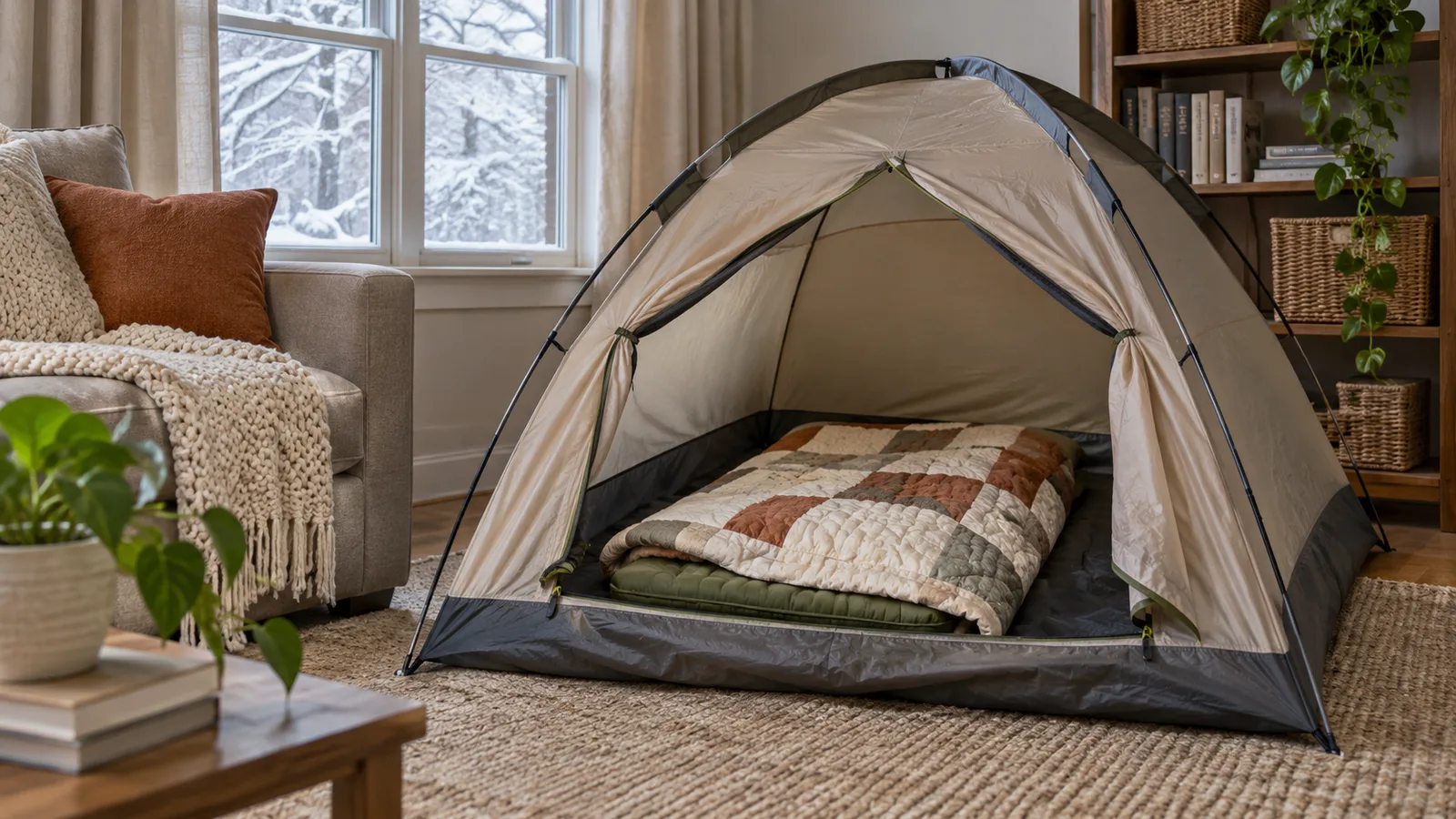
Pitch a freestanding 4-person dome camping tent inside a small, windowless interior room (or on top of a queen/king mattress), line the tent floor with R-2.0+ closed-cell foam sleeping pads, and layer down comforters or sub-zero sleeping bags inside. Two adults at rest emit roughly 180 watts of continuous metabolic heat—warming the 5.5 m³ (195 cu ft) air pocket inside a closed dome tent to 10°C–12°C (18°F–21°F) warmer than the surrounding freezing room with zero fuel burn and zero carbon monoxide risk.
Three-stage engineering verification workflow for The Indoor Tent Micro-Climate Method: Stay 10°C (18°F): baseline sizing with a 20% reserve margin, grid-down isolation, and annual unplugged field testing.
Thermal Volume & Metabolic Heating Math
| Shelter Envelope | Enclosed Air Volume | Surface Area Losing Heat | Temperature Lift From 2 Adults (~180W Body Heat) |
|---|---|---|---|
| Entire 2,000 sq ft House | ~450 m³ (16,000 cu ft) | ~460 m² (4,950 sq ft) | +0.3°C (+0.5°F) — Negligible |
| Single Closed 12ft x 12ft Bedroom | ~32 m³ (1,150 cu ft) | ~62 m² (670 sq ft) | +2.5°C (+4.5°F) — Still drops near freezing |
| 4-Person Dome Tent Inside Room | ~5.5 m³ (195 cu ft) | ~16 m² (172 sq ft) | +8°C to +12°C (+14°F to +21°F) , Livable micro-climate |
Step-by-Step Indoor Tent Micro-Climate Setup
- Pick a Freestanding Tent (No Ground Stakes Required): Choose a 3- or 4-person dome tent whose flexible fiberglass or aluminum poles clip directly into corner grommets (such as the Coleman Sundome 4P or REI Half Dome), non-freestanding trekking-pole tents collapse without soil stakes.
- Insulate the Floor First (Stop Conductive Heat Loss): Cold hardwood, tile, or concrete slabs act as giant heat sinks. Lay down interlocking EVA gym mats, folded wool blankets, or Therm-a-Rest Z Lite Sol closed-cell foam pads underneath or inside the tent floor before laying down sleeping bags.
- Leave the Upper Rainfly Vent Cracked 5 cm (2 Inches): Humans exhale roughly 30 to 40 mL of water vapor per hour while sleeping. Cracking the top peak vent prevents exhaled moisture from condensing on the tent roof and dripping onto your sleeping bag, and keeps fresh oxygen circulating.
- Add a 48W 12V DC Heated Blanket (If You Have a Power Station): Never put a 110V AC space heater or propane heater inside a nylon tent (instant fire/melting and asphyxiation hazard). If you own a 1,000Wh LFP power station, plug in an Ignik 12V DC Heated Blanket (48W draw) inside the tent, it runs for 20+ hours on a single charge and keeps everyone toasty without wasting battery energy heating empty ceiling air.
Indoor Micro-Climate Checklist
- Wear dry Merino wool base layers + a knit hat to bed: Never sleep in damp daytime cotton sweatshirts; change into dry wool socks, thermal leggings, and a beanie before zipping into the tent.
- Keep your water bottles and smartphone inside the tent with you: Body warmth stops drinking water from freezing solid and keeps your phone’s lithium battery warm enough to hold a charge.
Operational Boundaries & When to Skip: The Indoor Tent Micro-Climate Method
NEVER operate a Mr. Heater Buddy propane heater, Sterno can, candle, or charcoal grill inside a tent, even a “vented” camping tent will trap fatal levels of carbon monoxide within 10 minutes, and nylon tent walls ignite in under 2 seconds if touched by a radiant burner grille.
Worked Sizing Math, Dual-Unit Tolerances & Field Diagnostics: The Indoor Tent Micro-Climate Method
Designing a dependable residential setup for indoor tent microclimate method freezing blackout requires verifying physical tolerances under worst-case grid-down conditions rather than relying on optimistic nameplate ratings. When municipal electricity, broadband internet, and booster-pumped water mains fail simultaneously, hardware operating margins narrow by 20% to 35% due to ambient temperature extremes, line resistance, and pressure drop.
- Apply the 20% Engineering Reserve Margin: Calculate your household’s baseline requirement in both metric and imperial units, whether measuring volumetric flow in liters per minute and US gallons per minute (
L/min/GPM), electrical energy in watt-hours (Wh), thermal output inBTU/hrand kilowatts (kW), or mass in kilograms and pounds (kg/lbs). Multiply that baseline figure by 1.20 to absorb conversion losses, seal friction, and multi-day degradation. - Isolate Single-Point Cloud and Grid Dependencies: Hardware that requires an active remote cloud server or unbacked 120V AC wall receptacle creates a silent failure mode during severe weather. Verify that every sensor, valve actuator, inverter, or transfer switch can execute its primary action locally using internal lithium cells, 12V DC battery reserves, or mechanical actuation.
- Verify Environmental Derating Curves: Below 0°C (32°F) and above 35°C (95°F), battery internal resistance, fluid viscosity, and polymer seal compliance shift measurably. Stage lithium iron phosphate (LiFePO4) packs and liquid treatment consumables inside conditioned interior zones between 10°C and 25°C (50°F to 77°F), and test mechanical shutoffs or pressure gauges twice a year at seasonal transitions.
| Verification Stage | Target Engineering Tolerance | Primary Field Diagnostic Tool | Recommended Inspection Interval |
|---|---|---|---|
| Baseline Capacity & Flow | Minimum +20% reserve above calculated household demand | Calibrated inline meter, pressure gauge, or watt-hour monitor | Every 6 months (Spring / Autumn) |
| Grid-Down / Offline Trigger | 100% local actuation with router and AC breaker switched off | Live unplugged blackout simulation test | Annually before peak storm season |
| Thermal & Mechanical Seals | Zero seepage or voltage drop across 5°C to 35°C (41°F to 95°F) | Visual seal inspection, torque check, and terminal cleaning | Every 12 months |
Related Guides, Equipment & Planning Tools: The Indoor Tent Micro-Climate Method
Use our browser-local Calculate Backup Heater Fuel, Battery Wh & Fresh-Air Ventilation to model your exact household numbers before purchasing hardware. Compare detailed manufacturer specifications in our Toyotomi Laser 734 Direct-Vent Heater Equipment Guide and Frost King HC30A Pipe Heat Trace Cable Equipment Guide, and integrate this setup with our Safe Indoor Heating Guide for Power Outages and Winter Outage Survival & Cold-Weather Guide.
Ignik Topside 12V DC Heated Bed Blanket (48W)
- Power input max draw
- 12V DC (4.0 Amps max / 48 Watts peak)
Why it fits Documented specification match for indoor tent microclimate method freezing blackout planning, verify exact model compatibility, dimensions, and household capacity before ordering.
Key trade-off The Ignik Topside is a personal/bed micro-climate heater (183 x 112 cm)—it warms human bodies inside a bed or indoor tent, not ambient room air, and cannot keep kitchen or bathroom water pipes from freezing.
Specifications & research
Model alternative. Source records checked on 2026-11-16. Manufacturer research, not hands-on testing.
- Dimensions weight
- 183 x 112 cm (72" x 44") / 1.45 kg (3.2 lbs) · Source checked 2026-11-16
- Power input max draw
- 12V DC (4.0 Amps max / 48 Watts peak) · Source checked 2026-11-16
- Heat control settings
- Digital Push-Button Controller (Low / Med / High + Auto-Off) · Source checked 2026-11-16
Manufacturer documentation. Confirm exact Ignik model specifications and household safety limits before buying.