In this guide Jump to a section
- Engineering Baseline & Primary Fit: UL-Listed Self-Regulating Pipe Heat Trace
- Pipe Heating Cable Technology Comparison
- Proper Installation Rules (Why Foil Tape & Insulation Matter)
- Heat Trace Readiness Checklist
- Operational Boundaries & When to Skip: UL-Listed Self-Regulating Pipe Heat Trace
- Worked Sizing Math, Dual-Unit Tolerances & Field Diagnostics: UL-Listed Self-Regulating Pipe Heat Trace
- Related Guides, Equipment & Planning Tools: UL-Listed Self-Regulating Pipe Heat Trace
Engineering Baseline & Primary Fit: UL-Listed Self-Regulating Pipe Heat Trace
Wrapping vulnerable crawlspace, garage, or well-house water pipes in electric heat trace cable prevents freezing down to -40°C (-40°F)—provided you choose the right cable technology. Never wrap cheap constant-wattage heat tape spirally around plastic PEX pipes or let two strands touch each other; constant-wattage wires pump fixed heat along their entire length and will melt through PEX or ignite foam insulation wherever the wire overlaps.
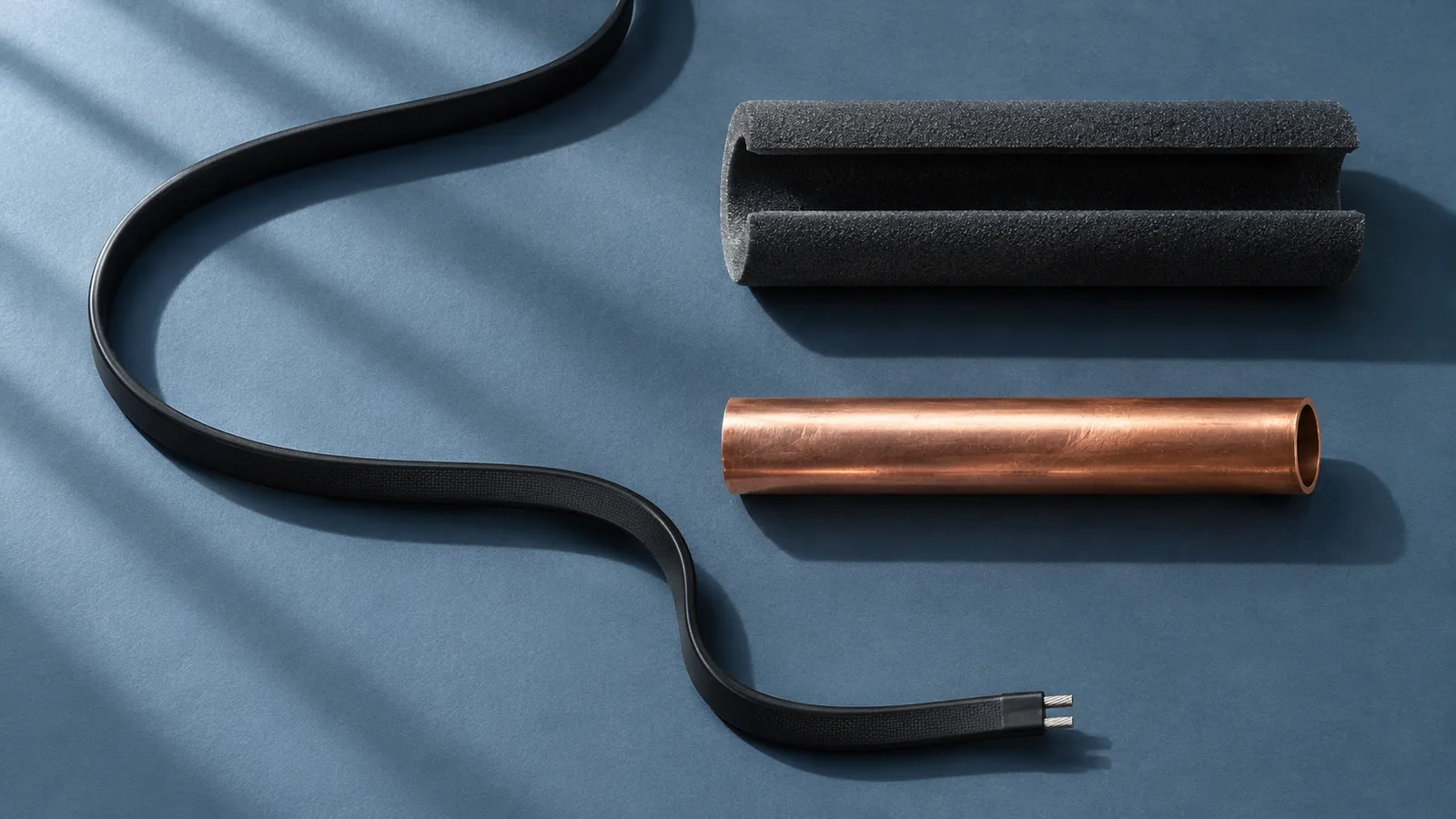
Choose a UL-listed Self-Regulating Pipe Heating Cable, led by the Raychem FrostGuard series. Self-regulating cables embed two parallel bus wires inside an irradiated conductive polymer matrix that physically expands as it warms (cutting electrical output) and contracts as the pipe chills (boosting wattage up to 6W–8W per foot)—making them 100% safe on PEX, PVC, and copper pipes, safe to spiral or overlap on valves, and compatible with thick fiberglass pipe insulation.
Three-stage engineering verification workflow for 5 Best UL-Listed Self-Regulating Pipe Heat Trace Cable: baseline sizing with a 20% reserve margin, grid-down isolation, and annual unplugged field testing.
Pipe Heating Cable Technology Comparison
| Cable Model & Type | Core Technology | Safe on PEX / CPVC Plastic? | Safe to Overlap / Spiral on Valves? | Output Wattage | Built-In Thermostat? |
|---|---|---|---|---|---|
| Raychem FrostGuard (12ft–100ft) | Self-Regulating Polymer | Yes (UL Listed for PEX) | Yes (Zero burn-out risk) | 6W/ft @ 4°C (40°F) | No (Add Thermo Cube TC-3 to save power) |
| EasyHeat SR Series | Self-Regulating Polymer | Yes | Yes | 5W/ft @ 4°C (40°F) | No (Pair with thermostatic plug) |
| BriskHeat SpeedTrace Extreme | Self-Regulating Industrial | Yes | Yes | 8W/ft @ 4°C (40°F) | No (Heavy-duty sub-arctic well lines) |
| Frost King HC30A (3ft–30ft) | Constant-Wattage Nichrome | Yes (Straight run only) | NO (Fire/melt hazard if overlapped) | 7W/ft fixed | Yes (Bimetallic bulb turns on at 3°C / 38°F) |
| EasyHeat AHB Series | Constant-Wattage Nichrome | Metal pipes preferred | NO (Never overlap) | 7W/ft fixed | Yes (Turns on at 3°C / 38°F) |
Proper Installation Rules (Why Foil Tape & Insulation Matter)
- Wrap Plastic PEX Pipes in Aluminum Foil Tape First: Plastic PEX is a thermal insulator compared to copper. Before strapping a heat cable onto PEX or CPVC tubing, wrap the bare plastic pipe lengthwise with 2-inch HVAC aluminum foil tape—the metal foil spreads heat evenly around the entire pipe circumference instead of leaving the back side of the pipe frozen.
- Strap Lengthwise Along the Bottom (5 o’Clock / 7 o’Clock Position): Run the heat cable straight along the lower quadrant of horizontal pipes (where cold water settles) using fiberglass application tape or UV-rated zip ties every 30 cm (12 inches).
- Cover With Fiberglass or Closed-Cell Foam Insulation: Heat trace cables alone cannot fight a -25°C (-13°F) wind chill in an unheated crawlspace; always slide 13mm to 25mm (1/2-inch to 1-inch) closed-cell foam or fiberglass pipe insulation completely over both the pipe and the cable.
- Plug Strictly Into a GFCI-Protected Outlet: National Electrical Code (NEC Article 427) requires all pipe heating cables to be plugged into a Ground Fault Circuit Interrupter (GFCI) receptacle to prevent shock or fire if rodents chew the jacket.
Heat Trace Readiness Checklist
- Plug self-regulating cables into a Thermo Cube TC-3: Because Raychem FrostGuard draws low standby power even at 15°C (60°F), plugging it into a 18 USD Thermo Cube TC-3 cuts power completely whenever ambient crawlspace temps exceed 7°C (45°F).
- Test GFCI and amp draw every October: Press the
TEST/RESETbuttons on the GFCI plug and feel the cable under the insulation on a crisp morning to confirm gentle warmth before deep winter arrives.
Operational Boundaries & When to Skip: UL-Listed Self-Regulating Pipe Heat Trace
Electric heat trace cables depend on 110V power, if a winter storm knocks out grid electricity for 48 hours and you do not have a generator or 2,000Wh LFP battery to power your crawlspace heat cable (~144W for a 24-foot cable), shut off the main water valve and drain the exposed pipe run before it freezes.
Worked Sizing Math, Dual-Unit Tolerances & Field Diagnostics: UL-Listed Self-Regulating Pipe Heat Trace
Designing a dependable residential setup for best self regulating pipe heating cables thermostats requires verifying physical tolerances under worst-case grid-down conditions rather than relying on optimistic nameplate ratings. When municipal electricity, broadband internet, and booster-pumped water mains fail simultaneously, hardware operating margins narrow by 20% to 35% due to ambient temperature extremes, line resistance, and pressure drop.
- Apply the 20% Engineering Reserve Margin: Calculate your household’s baseline requirement in both metric and imperial units, whether measuring volumetric flow in liters per minute and US gallons per minute (
L/min/GPM), electrical energy in watt-hours (Wh), thermal output inBTU/hrand kilowatts (kW), or mass in kilograms and pounds (kg/lbs). Multiply that baseline figure by 1.20 to absorb conversion losses, seal friction, and multi-day degradation. - Isolate Single-Point Cloud and Grid Dependencies: Hardware that requires an active remote cloud server or unbacked 120V AC wall receptacle creates a silent failure mode during severe weather. Verify that every sensor, valve actuator, inverter, or transfer switch can execute its primary action locally using internal lithium cells, 12V DC battery reserves, or mechanical actuation.
- Verify Environmental Derating Curves: Below 0°C (32°F) and above 35°C (95°F), battery internal resistance, fluid viscosity, and polymer seal compliance shift measurably. Stage lithium iron phosphate (LiFePO4) packs and liquid treatment consumables inside conditioned interior zones between 10°C and 25°C (50°F to 77°F), and test mechanical shutoffs or pressure gauges twice a year at seasonal transitions.
| Verification Stage | Target Engineering Tolerance | Primary Field Diagnostic Tool | Recommended Inspection Interval |
|---|---|---|---|
| Baseline Capacity & Flow | Minimum +20% reserve above calculated household demand | Calibrated inline meter, pressure gauge, or watt-hour monitor | Every 6 months (Spring / Autumn) |
| Grid-Down / Offline Trigger | 100% local actuation with router and AC breaker switched off | Live unplugged blackout simulation test | Annually before peak storm season |
| Thermal & Mechanical Seals | Zero seepage or voltage drop across 5°C to 35°C (41°F to 95°F) | Visual seal inspection, torque check, and terminal cleaning | Every 12 months |
Related Guides, Equipment & Planning Tools: UL-Listed Self-Regulating Pipe Heat Trace
Use our browser-local Calculate Backup Heater Fuel, Battery Wh & Fresh-Air Ventilation to model your exact household numbers before purchasing hardware. Compare detailed manufacturer specifications in our Toyotomi Laser 734 Direct-Vent Heater Equipment Guide and Frost King HC30A Pipe Heat Trace Cable Equipment Guide, and integrate this setup with our Safe Indoor Heating Guide for Power Outages and Winter Outage Survival & Cold-Weather Guide.
Farm Innovators Thermo Cube TC-3 Thermostatically Controlled Outlet (35°F On / 45°F Off)
- Cut out temperature off
- 7°C ± 2°C (45°F ± 4°F)
Why it fits Documented specification match for best self regulating pipe heating cables thermostats planning, verify exact model compatibility, dimensions, and household capacity before ordering.
Key trade-off The TC-3 measures ambient air temperature right at the wall outlet—not remote pipe temperature 6 meters away. If your wall outlet sits inside a warm heated garage while the pipe runs outside in -15°C (5°F) air, the TC-3 at the warm wall outlet will never turn on; mount the outlet inside the same cold thermal zone as the equipment it protects.
Specifications & research
Model alternative. Source records checked on 2026-11-16. Manufacturer research, not hands-on testing.
- Cut in temperature on
- 2°C ± 2°C (35°F ± 4°F) · Source checked 2026-11-16
- Cut out temperature off
- 7°C ± 2°C (45°F ± 4°F) · Source checked 2026-11-16
- Electrical load rating
- 120V AC, 15 Amps, 1,800 Watts Max · Source checked 2026-11-16
Manufacturer documentation. Confirm exact Farm Innovators model specifications and household safety limits before buying.