In this guide Jump to a section
- Engineering Baseline & Primary Fit: Canadian Prairies & Northern Winter Home R
- Extreme Canadian Cold Engineering Matrix (-40°C / -40°F)
- Three Essential Northern Winter Protocols
- Northern Winter Readiness Checklist
- Operational Boundaries & When to Skip: Canadian Prairies & Northern Winter Home R
- Worked Sizing Math, Dual-Unit Tolerances & Field Diagnostics: Canadian Prairies & Northern Winter Home R
- Related Guides, Equipment & Planning Tools: Canadian Prairies & Northern Winter Home R
Engineering Baseline & Primary Fit: Canadian Prairies & Northern Winter Home R
Across the Canadian Prairies (Alberta, Saskatchewan, Manitoba) and Northern Ontario—where January cold snaps regularly lock temperatures at -35°C to -45°C (-31°F to -49°F) for a week straight—household resilience centers on managing extreme indoor-to-outdoor moisture gradients, grid-free secondary combustion heat, and cold-soak vehicle starting.
When grid electricity drops during a prairie blizzard, shut down or damper your Heat Recovery Ventilator (HRV) immediately so frigid outdoor air doesn’t freeze the core, rely on a WETT-certified wood stove (fed with <20% moisture seasoned birch/maple) or a direct-vent propane/oil heater, and automate vehicle block heaters using a 18 USD Thermo Cube TC-3 so your evacuation vehicle starts instantly without wasting electricity all afternoon.
Three-stage engineering verification workflow for Canadian Prairies & Northern Winter Home Resilience: H: baseline sizing with a 20% reserve margin, grid-down isolation, and annual unplugged field testing.
Extreme Canadian Cold Engineering Matrix (-40°C / -40°F)
| Household System | Failure Mode at -40°C (-40°F) | Canadian Cold-Climate Engineering Standard |
|---|---|---|
| HRV / ERV Ventilation Core | Warm 21°C indoor exhaust condenses and freezes into solid ice inside core plates | Enable Recirculation Defrost Mode or install a 1kW electric intake preheat coil; shut off in blackouts |
| Secondary Off-Grid Heat | High-efficiency gas furnaces lock out without 110V blower electricity | WETT-certified wood stove with dedicated 4-inch outdoor combustion air intake kit |
| Vehicle Cold-Cranking | Engine oil thickens to molasses; lead-acid battery loses 60% cranking power | Block heater + battery blanket on a Thermo Cube TC-3 + high-CCA AGM battery |
| Attic Hatch & Rim Joists | Warm humid indoor air leaks into -40°C attic, forming massive frost (“attic rain” at thaw) | Weatherstrip attic hatch with closed-cell foam gasket + latch down tightly |
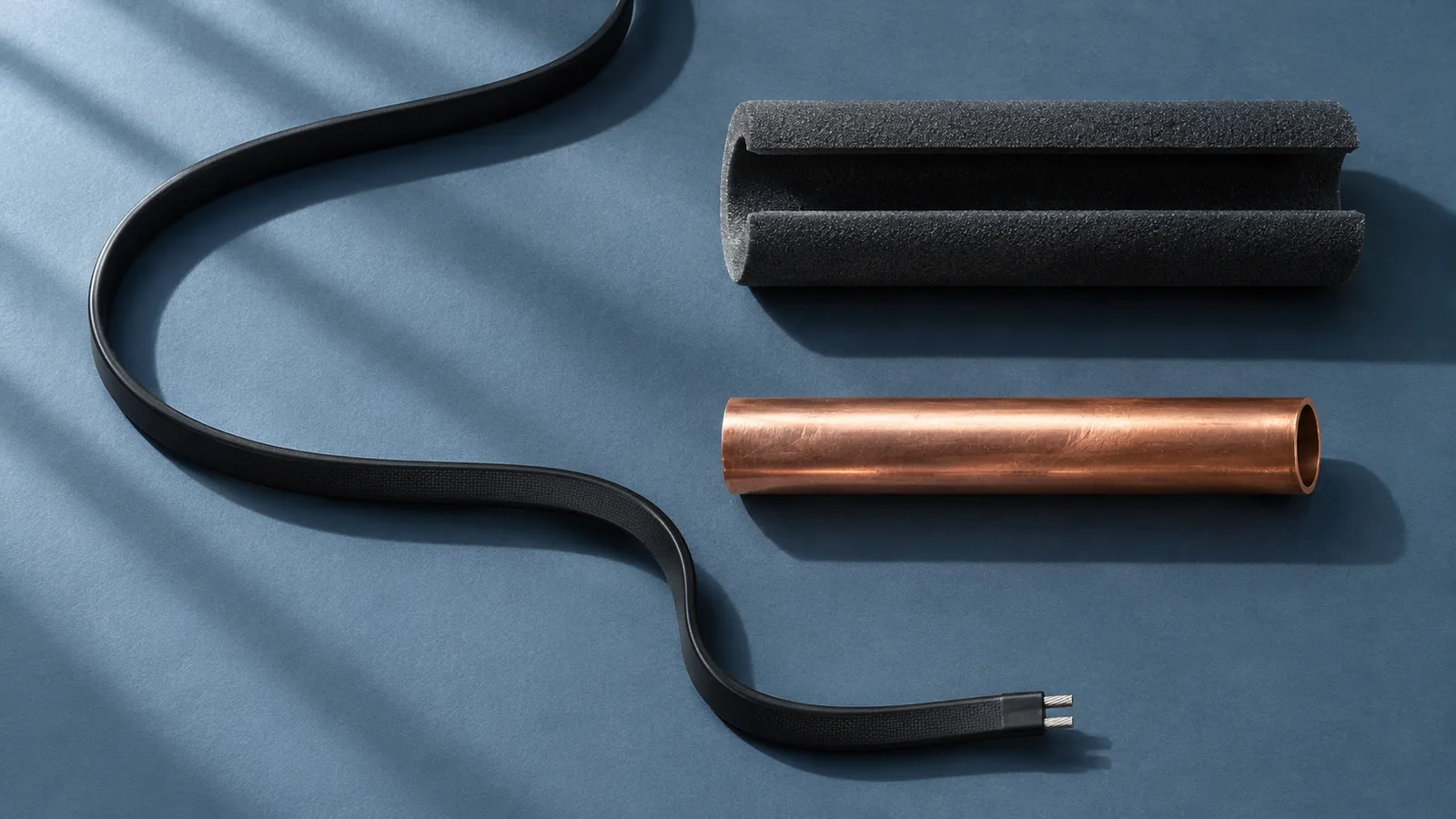
| Well-Head & Pressure Tank | Exposed pitless adapter or pump house freezes within 6 hours of power loss | Insulate well house to R-20 + Thermo Cube TC-3 + self-regulating heat trace cable |
Three Essential Northern Winter Protocols
1. Preventing “Attic Rain” & HRV Core Freeze-Ups
In super-tight R-2000 and modern northern homes, indoor relative humidity above 35% during a -40°C (-40°F) cold snap drives moisture through any unsealed ceiling light fixture or attic hatch gap, where it freezes into thick frost on the underside of roof sheathing. When temperatures rise back to -5°C (23°F), that frost melts all at once (“attic rain”), staining bedroom ceilings.
- The Rule: Dial your whole-home humidifier down to 20%–25% RH whenever outdoor temperatures plunge below -25°C (-13°F), and ensure your HRV’s auto-defrost damper is functioning cleanly.
2. Wood Stove engineering & Moisture Verification
A non-catalytic steel or cast-iron wood stove needs zero electricity to heat a 1,800 sq ft home through a 7-day ice storm—provided you burn seasoned wood with less than 20% internal moisture. Burning wet, green wood wastes 30% of heat energy boiling off sap and coats your stainless chimney liner in flammable Stage 3 glazed creosote. Split a log fresh down the middle and press a 25 USD digital pin moisture meter into the freshly exposed interior grain before stacking it indoors.
3. Automating Engine Block Heaters With a Thermo Cube
Plugging a 600W–1,000W engine block heater directly into an outdoor outlet overnight wastes electricity whenever temperatures hover near 0°C (32°F). Plugging your block heater cord into a Thermo Cube TC-3 automatically energizes the outlet only when ambient air drops below 2°C (35°F) and cuts power above 7°C (45°F), protecting your engine block while trimming winter hydro bills.
Northern Winter Readiness Checklist
- Clean and inspect your chimney liner every October: Verify your wood stove’s rain cap screen isn’t clogged with soot or ice crystals before peak winter burn season.
- Keep a lithium jump starter indoors (never in a -40°C trunk): Even the best lithium jump packs lose cranking current if cold-soaked at -35°C overnight, store your NOCO or Gooloo jump starter inside your mudroom coat closet and carry it out to the car when needed.
- Store 72-hour winter highway gear in every vehicle: Pack an avalanche/snow shovel, wool blankets, traction boards, a candle-in-a-tin or hand warmers, and a Garmin inReach satellite communicator for rural highways with zero cell coverage.
Operational Boundaries & When to Skip: Canadian Prairies & Northern Winter Home R
Never leave a damper-restricted wood stove smoldering overnight with wet wood, and always mount a digital battery-powered carbon monoxide alarm (such as Kidde Nighthawk) 3 meters (10 feet) from the wood stove, downdrafts during severe prairie windstorms can momentarily push flue gases back into tight homes lacking a dedicated outdoor combustion air intake.
Worked Sizing Math, Dual-Unit Tolerances & Field Diagnostics: Canadian Prairies & Northern Winter Home R
Designing a dependable residential setup for canadian prairies northern ontario winter home prep requires verifying physical tolerances under worst-case grid-down conditions rather than relying on optimistic nameplate ratings. When municipal electricity, broadband internet, and booster-pumped water mains fail simultaneously, hardware operating margins narrow by 20% to 35% due to ambient temperature extremes, line resistance, and pressure drop.
- Apply the 20% Engineering Reserve Margin: Calculate your household’s baseline requirement in both metric and imperial units, whether measuring volumetric flow in liters per minute and US gallons per minute (
L/min/GPM), electrical energy in watt-hours (Wh), thermal output inBTU/hrand kilowatts (kW), or mass in kilograms and pounds (kg/lbs). Multiply that baseline figure by 1.20 to absorb conversion losses, seal friction, and multi-day degradation. - Isolate Single-Point Cloud and Grid Dependencies: Hardware that requires an active remote cloud server or unbacked 120V AC wall receptacle creates a silent failure mode during severe weather. Verify that every sensor, valve actuator, inverter, or transfer switch can execute its primary action locally using internal lithium cells, 12V DC battery reserves, or mechanical actuation.
- Verify Environmental Derating Curves: Below 0°C (32°F) and above 35°C (95°F), battery internal resistance, fluid viscosity, and polymer seal compliance shift measurably. Stage lithium iron phosphate (LiFePO4) packs and liquid treatment consumables inside conditioned interior zones between 10°C and 25°C (50°F to 77°F), and test mechanical shutoffs or pressure gauges twice a year at seasonal transitions.
| Verification Stage | Target Engineering Tolerance | Primary Field Diagnostic Tool | Recommended Inspection Interval |
|---|---|---|---|
| Baseline Capacity & Flow | Minimum +20% reserve above calculated household demand | Calibrated inline meter, pressure gauge, or watt-hour monitor | Every 6 months (Spring / Autumn) |
| Grid-Down / Offline Trigger | 100% local actuation with router and AC breaker switched off | Live unplugged blackout simulation test | Annually before peak storm season |
| Thermal & Mechanical Seals | Zero seepage or voltage drop across 5°C to 35°C (41°F to 95°F) | Visual seal inspection, torque check, and terminal cleaning | Every 12 months |
Related Guides, Equipment & Planning Tools: Canadian Prairies & Northern Winter Home R
Use our browser-local Calculate Backup Heater Fuel, Battery Wh & Fresh-Air Ventilation to model your exact household numbers before purchasing hardware. Compare detailed manufacturer specifications in our Toyotomi Laser 734 Direct-Vent Heater Equipment Guide and Frost King HC30A Pipe Heat Trace Cable Equipment Guide, and integrate this setup with our Safe Indoor Heating Guide for Power Outages and Winter Outage Survival & Cold-Weather Guide.
Mr. Heater Big Buddy (MH18B)
- Stated heating area
- 450 sq ft
Why it fits Documented specification match for canadian prairies northern ontario winter home prep planning, verify exact model compatibility, dimensions, and household capacity before ordering.
Key trade-off Using a 20 lb propane tank indoors is prohibited by fire codes; bulk tanks must remain outside with hose routed through an aperture.
Specifications & research
Model alternative. Source records checked on 2026-11-04. Manufacturer research, not hands-on testing.
- Heat output
- 4,000 / 9,000 / 18,000 BTU/hr · Source checked 2026-11-04
- Stated heating area
- 450 sq ft · Source checked 2026-11-04
- Fuel type
- Propane · Source checked 2026-11-04
Manufacturer documentation. Confirm exact Mr. Heater model specifications and household safety limits before buying.