In this guide Jump to a section
Most portable generator spec sheets promote a single headline runtime—such as “12 hours on one tank”—measured at 25% load in Eco-Throttle mode. Once a real outage connects a refrigerator, furnace blower, sump or well pump, and kitchen appliances near 50% to 75% load, that same tank can empty in 5 to 7 hours.
Underestimating fuel burn causes two predictable outage crises: running dry after utility stations lose pump power, or stacking unsafe amounts of fuel cans inside an attached garage beyond local fire-code limits. Combine exact specs from your owner’s manual with the illustrative consumption math below, then verify storage limits with your local fire department before storm season.
Refueling and CO Life-Safety Rule: Cool Down 20+ Feet Outdoors
Portable generators emit deadly carbon monoxide and hot exhaust heat. Always run generators outdoors only, at least 20 feet away from windows, doors, eaves, and intake vents with exhaust pointed away from structures—never in a basement, carport, shed, or open garage. Install working battery-backed CO alarms indoors. Never refuel a running or hot generator: spilled gasoline vapor hitting a hot exhaust muffler flashes instantly. Shut off loads, power down the engine, and allow the muffler to cool thoroughly (at least 15 minutes or longer per your manual) before opening the fuel cap. If you lack a safe outdoor location, switch to batteries or relocate to a powered shelter.
Worked math: single-tank runtime and multi-day reserve calculation
Always pull actual burn numbers (gal/hr or lbs/hr) for your exact generator model and fuel type from its manual, as dual-fuel ratings differ between gasoline and propane. Use the two formulas below as illustrative planning examples, not guaranteed field performance.
Formula 1: Runtime per tank
Illustrative Tank Runtime (hrs) = Usable Tank Capacity (gal) ÷ Burn Rate at Actual Load (gal/hr)
- Illustrative Example (
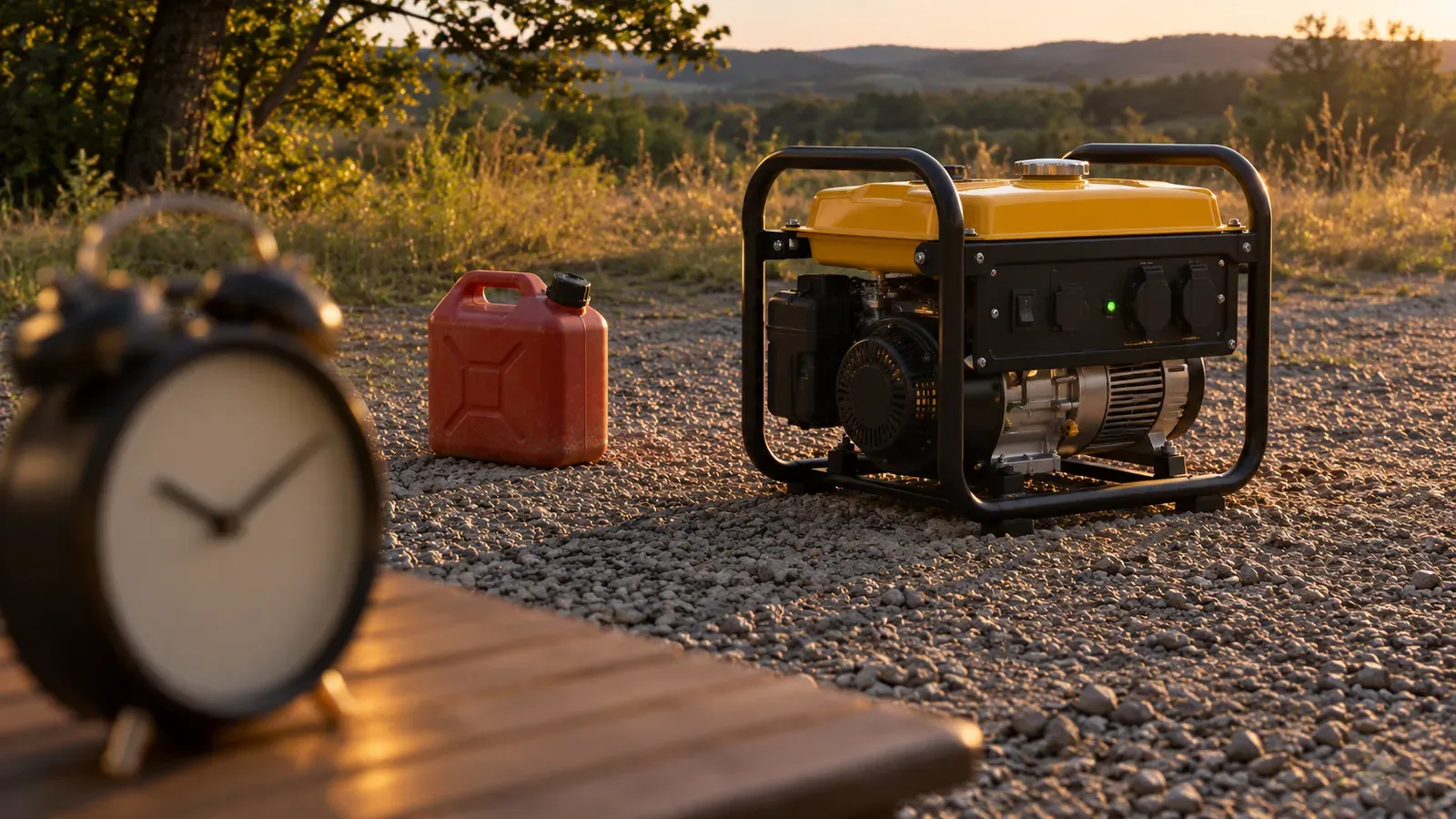
5,500–7,500 WOpen-Frame Generator at 50% Load): Suppose your manual lists a5.0-gallonusable fuel tank and a0.75 gal/hrgasoline burn rate at50%load (~2,750–3,750 W).5.0 gal ÷ 0.75 gal/hr =6.67 hoursper fill.- Because actual loads cycle up and down when compressors start, monitor real tank level rather than trusting an alarm clock.
Formula 2: Multi-day outage reserve with contingency margin
Cold outdoor air, reactive motor surges, and altitude enrichment raise fuel consumption above clean factory tests. Apply a 20% contingency margin (× 1.20) as a planning buffer (or larger for severe cold), then model your exact schedule in our generator fuel runtime calculator:
Illustrative Multi-Day Fuel = Burn Rate (gal/hr) × Run Hours/Day × Outage Days × 1.20
- Illustrative Example (
3-DayOutage Running8 Hours/Dayat0.75 gal/hr):- Daily fuel burn:
0.75 gal/hr × 8 hrs/day = 6.0 gal/day. - Three-day base fuel:
6.0 gal/day × 3 days = 18.0 gal. - Add 20% margin:
18.0 gal × 1.20 =21.6 gallons. Compare how dramatically duty-cycling changes storage requirements in the visual breakdown below.
- Daily fuel burn:
At the same assumed burn rate of 0.75 gal/hr, the hours you run the generator change the three-day fuel estimate.
| Illustrative schedule | Fuel per day | Fuel for 3 days | With 20% example buffer |
|---|---|---|---|
| 24 hours a day | 18 gal | 54 gal | 64.8 gal |
| 8 hours a day | 6 gal | 18 gal | 21.6 gal |
Check the exact generator’s fuel consumption at your expected load and the applicable storage limits before using an estimate.
Generator fuel consumption chart by wattage and load
The table below gives representative hourly burn ranges across four common residential generator sizes on unleaded gasoline (~114,000 BTU/gal) and liquid propane / LPG (~91,500 BTU/gal, where 1 gallon LPG = ~4.24 lbs).
Do not extrapolate one load figure blindly to another wattage or brand: variable-speed inverter generators drop engine RPM at light loads (typically using 35% to 45% less fuel at 25% load than fixed 3,600-RPM open-frame models, which hold constant engine speed to maintain 60 Hz). Always confirm exact burn data in your own owner’s manual.
| Generator Class & Architecture | Typical Fuel Container | Fuel Type | Burn @ 25% Load | Burn @ 50% Load | Burn @ 75% Load | Burn @ 100% Load | Illustrative Runtime on 5 Gal Gas or 20 lb LPG @ 50% Load |
|---|---|---|---|---|---|---|---|
2,000–2,200 W Closed Inverter (Eco Mode) | 1.1–1.3 gal tank | Gasoline | ~0.11 gal/hr | ~0.18 gal/hr | ~0.26 gal/hr | ~0.35 gal/hr | ~27.7 hrs per 5 gal gas (~6–7 hrs per internal tank) |
2,000–2,200 W Dual-Fuel Inverter | 20 lb LPG (~4.7 gal) | Propane | ~0.14 gal/hr (0.6 lb/hr) | ~0.23 gal/hr (1.0 lb/hr) | ~0.33 gal/hr (1.4 lb/hr) | ~0.44 gal/hr (1.9 lb/hr) | ~20.4 hrs per full 20 lb tank |
3,500–4,500 W Closed Inverter | 2.3–3.4 gal tank | Gasoline | ~0.22 gal/hr | ~0.36 gal/hr | ~0.52 gal/hr | ~0.68 gal/hr | ~13.9 hrs per 5 gal gas |
3,500–4,500 W Dual-Fuel Inverter | 20 lb LPG (~4.7 gal) | Propane | ~0.28 gal/hr (1.2 lb/hr) | ~0.45 gal/hr (1.9 lb/hr) | ~0.65 gal/hr (2.8 lb/hr) | ~0.85 gal/hr (3.6 lb/hr) | ~10.4 hrs per full 20 lb tank |
5,500–7,500 W Open-Frame Synchronous | 5.0–6.5 gal tank | Gasoline | ~0.55 gal/hr | ~0.75 gal/hr | ~0.95 gal/hr | ~1.18 gal/hr | ~6.7 hrs per 5 gal gas |
5,500–7,500 W Dual-Fuel Open-Frame | 20 lb LPG (~4.7 gal) | Propane | ~0.68 gal/hr (2.9 lb/hr) | ~0.94 gal/hr (4.0 lb/hr) | ~1.18 gal/hr (5.0 lb/hr) | ~1.45 gal/hr (6.1 lb/hr) | ~5.0 hrs per full 20 lb tank |
9,500–12,000 W Heavy Portable (240V) | 7.0–8.5 gal tank | Gasoline | ~0.80 gal/hr | ~1.15 gal/hr | ~1.50 gal/hr | ~1.85 gal/hr | ~4.3 hrs per 5 gal gas |
9,500–12,000 W Dual-Fuel Heavy Portable | 40–100 lb LPG (verify manual) | Propane | ~1.00 gal/hr (4.2 lb/hr) | ~1.42 gal/hr (6.0 lb/hr) | ~1.85 gal/hr (7.8 lb/hr) | ~2.30 gal/hr (9.8 lb/hr) | ~3.3 hrs on 20 lb (cold freeze-up risk below ~20°F) |
Gasoline vs. propane fuel tradeoffs for multi-day outages
As detailed in our gas vs. propane generator comparison and propane heater tank runtime guide, each fuel poses different logistical bottlenecks.
Energy density vs. carburetor shelf life
One gallon of E10 gasoline delivers roughly 114,000 BTU, compared with roughly 91,500 BTU per liquid gallon of propane (about 20% less energy per gallon and roughly 10% lower peak engine wattage). Untreated pump gasoline oxidizes and clogs carburetor jets within months unless stabilized and rotated, whereas sealed DOT propane cylinders stay usable indefinitely without gumming fuel jets.
Cold-weather propane vaporization physics
Notice the freeze-up warning on heavy 9,500–12,000 W dual-fuel units. Drawing ~1.4 gal/hr of propane demands over 125,000 BTU/hr of continuous boil-off vapor from the tank. In freezing winter weather (~10°F to 20°F), a single 20 lb grill tank cannot absorb enough ambient heat to boil propane that fast—pressure collapses and the generator stalls with liquid still left inside. Large generators running propane in deep winter typically require manufacturer-approved 40–100 lb cylinders, parallel manifolds, or switching over to liquid gasoline (check your manual before changing tank or regulator setups).
Fuel storage boundaries and safe local limits
Model fire codes (NFPA 30 / NFPA 30A for flammable liquids and NFPA 58 for LPG) set strict ceilings designed to prevent residential vapor fires, and local municipalities, fire marshals, insurance policies, and HOA covenants often enforce stricter quantity caps. Verify with your local fire authority rather than relying solely on a general rule of thumb:
- Stay well below attached-garage gasoline caps: Under model NFPA 30 limits, residential flammable liquid storage is commonly capped at
25 gallonsmaximum (sometimes stricter — 10 to 15 gallons — under city fire ordinances or condo rules), kept solely in listed5-gallonor smaller approved safety cans with intact spouts and caps. - Never store fuel inside living quarters or utility rooms: Gasoline vapor is roughly
3 to 4 times heavier than airand flows invisibly across basement or garage floors toward water-heater pilot lights, furnace igniters, and electric switches. Store gasoline reserves in a locked, shaded, ventilated detached shed (where permitted) away from ignition sources. - Store all portable propane cylinders outdoors (
NFPA 58): Never keep20 lbor larger LPG cylinders inside a home, basement, crawlspace, or attached garage. Keep cylinders upright outdoors on a level pad away from basement window wells and dryer vents. - Verify refueling cool-down and fire extinguisher access: Keep a rated
ABCfire extinguisher accessible outdoors (never stored right on top of the fuel cans) and observe mandatory cool-down time (manual-specified, commonly >=15 minutes) before pouring fuel.
How to cut generator fuel burn by 50% to 65%
If your outage math calls for storing 40+ gallons of fuel, change your operating cadence instead of crowding fuel cans into a shed:
- Run a hybrid Generator + Indoor Battery Duty Cycle: Operate your outdoor generator in two
3- to 4-hourwindows (morning and early evening) to handle heavy loads—heating recovery, well-pump pressure tank refills, hot meals, and fast-charging a1,500 Wh to 3,000 WhLiFePO4 portable power station. Shut the engine completely off overnight and let the silent indoor battery carry your refrigerator (~60–90 Waverage), Wi-Fi, CPAP, and LED lighting. - Use Eco-Throttle on steady loads: When running an inverter generator, keep Eco Mode enabled for steady household circuits so engine RPM drops automatically, disabling Eco Mode briefly only when starting heavy induction motors (such as a deep well pump or window air conditioner).
- Separate medical power backups: Build a dedicated battery backup plan for CPAPs, oxygen equipment, or refrigeration medications with your clinician and device manual before an outage begins.
- Use permitted transfer equipment: Have a licensed electrician install a transfer switch or interlocked inlet panel for any whole-home or furnace hardwire hookup; never backfeed through a wall receptacle.
Frequently asked questions
How long will a generator run on a tank of gas?
Divide usable tank volume by your generator’s fuel burn rate at your real load: Runtime (hrs) = Tank Capacity (gal) ÷ Burn Rate (gal/hr). As an illustrative example, an open-frame 5,500–7,500 W unit with a 5-gallon tank burning 0.75 gal/hr at 50% load runs around 6.7 hours per fill, while a 2,000 W inverter burning 0.18 gal/hr runs roughly 6 to 7 hours on an internal 1.1-gallon tank (or nearly 28 hours across a 5-gallon gas reserve). Check your specific model manual before planning.
How much fuel do you need for a multi-day outage?
Multiply your manual’s hourly burn rate at expected load by planned operating hours per day, outage days, and a contingency margin (1.20 for a 20% buffer). At 0.75 gal/hr for 8 hours/day over 3 days, base demand is 18 gallons, or 21.6 gallons with a 20% reserve. Running continuously for 24 hours/day jumps to roughly 64.8 gallons—which exceeds safe garage storage caps and underscores why cycling a generator alongside an indoor battery is far safer and cleaner.