In this guide Jump to a section
- The physics of fuel derating: gasoline vs. propane vs. natural gas
- Worked sizing math: sizing for natural gas and winter propane
- Side-by-side comparison: dual-fuel vs. tri-fuel portable generators
- Natural gas meter and hose sizing pitfalls
- Multi-fuel generator selection checklist
- Frequently asked questions
When you shop for a portable backup generator, the bold wattage label on the box (9,500 Starting Watts / 7,500 Running Watts) reflects performance on unleaded gasoline. Turning the fuel selector to Liquid Propane (LP) or Utility Natural Gas (NG) reduces available engine horsepower and electrical wattage, because dry gaseous fuels fill cylinder volume that liquid gasoline droplets barely occupy. Always confirm exact per-fuel starting and running watts on the generator manufacturer’s specification plate before buying, because derating percentages vary across engine displacements and mixer designs.
Understanding why gaseous fuels derate output, how freezing outdoor air slows vaporization inside a 20 lb propane cylinder, and when residential gas meters or hoses throttle a tri-fuel engine prevents stalling when your well pump or furnace cycles on.
The physics of fuel derating: gasoline vs. propane vs. natural gas
A four-stroke portable generator engine acts as a fixed-displacement air pump (for example, 420 cc or 459 cc). On gasoline, fuel enters as a fine liquid spray that occupies minimal intake volume and cools incoming air as it evaporates, packing dense oxygen alongside fuel energy (~114,000 BTU per gallon per EIA fuel heat values).
On Propane (C3H8) or Natural Gas (predominantly methane, CH4), fuel enters the mixer as a dry gas, displacing a fraction of intake oxygen and trimming peak brake horsepower:
- Unleaded gasoline (baseline 100% rating): Around
114,000 BTU per gallon. Produces maximum surge and running watts, but requires fresh-fuel rotation (30 to 90 daysuntreated E10) or permitted stabilization to prevent carburetor varnish. - Liquid propane (typically ~8% to 12% lower): Around
91,500 BTU per liquid gallon. Stores indefinitely in sealed steel cylinders without carburetor gumming, while losing roughly one-tenth of gasoline running wattage depending on mixer tuning. - Utility natural gas (typically ~18% to 22% lower): Roughly
1,000 to 1,030 BTU per cubic footat low residential pressure (5 to 7 inches water column, roughly0.25 PSI). Removes manual refueling altogether while utility gas pressure holds, but drops generator peak and continuous ratings noticeably below gasoline specs.
Scroll sideways to read the enlarged diagram.
Champion 4500W Dual Fuel Inverter Generator
- Running watts
- 3,500W (Gasoline) / 3,150W (Propane)
Why it fits Illustrates real-world fuel derating on one chassis: 4,500 W starting / 3,500 W running on gasoline vs. 3,150 W running on propane (10% lower), under 3% THD for furnace electronics and UPS loads; electric + recoil start, outdoor use at least 20 ft from buildings only.
Key trade-off Never run a generator indoors, in a garage, or near open windows/vents; carbon monoxide from exhaust is fatal within minutes. Maintain at least 20 feet clearance from the home.
Specifications & research
Dual-fuel inverter benchmark showing real LP derating. Source records checked on 2026-11-04. Manufacturer research, not hands-on testing.
- Starting watts
- 4,500W (Gasoline) / 4,500W (Propane) · Source checked 2026-11-04
- Running watts
- 3,500W (Gasoline) / 3,150W (Propane) · Source checked 2026-11-04
- Start type
- Electric and manual recoil start · Source checked 2026-11-04
Manufacturer documentation. Confirm exact Champion Power Equipment model specifications and household safety limits before buying.
Worked sizing math: sizing for natural gas and winter propane
Both calculations below are illustrative planning examples with stated assumptions. Always check the exact generator rating sheet and consult a licensed electrician or fuel professional for site load sizing.
1. Reverse-derating calculation for utility natural gas (÷ 0.80)
Suppose an essential subpanel requires 5,600 W continuous running power and 7,200 W motor-starting surge (for instance, a 240V deep well pump starting while a refrigerator, freezer, furnace blower, and sump pump are active). Using an illustrative 20% natural gas derating factor (NG Watts = Gasoline Watts × 0.80):
- Required gasoline running rating:
5,600 W ÷ 0.80 =7,000 W minimum running watts on gasoline. - Required gasoline peak rating:
7,200 W ÷ 0.80 =9,000 W minimum starting watts on gasoline.
Choosing a unit labeled 7,000 Starting / 5,500 Running Watts on gasoline leaves only around 4,400 W on natural gas, overloading the breaker as soon as the heavy motor starts.
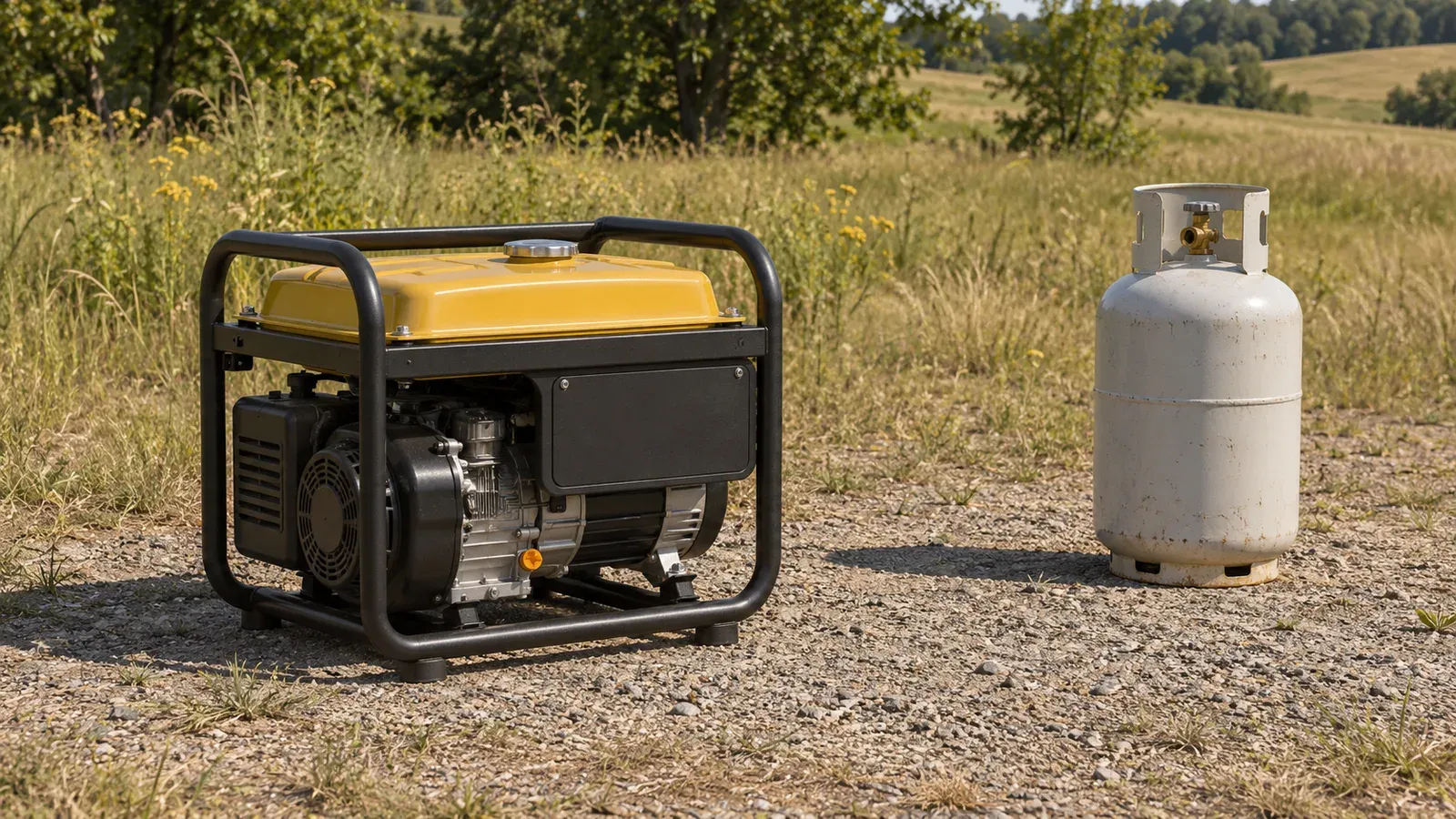
2. 20 lb propane tank runtime and winter pressure drop
A standard 20 lb grill propane cylinder holds about 4.7 gallons of liquid propane at its normal 80% fill limit (~430,050 BTU total at 91,500 BTU/gal). Assume a 5,000 W to 7,500 W generator operating near 3,000 W to 3,500 W draws roughly 70,000 BTU/hr (~0.76 gal/hr at moderate thermal efficiency):
- Illustrative warm-weather runtime:
430,050 BTU ÷ 70,000 BTU/hr ≈6.1 hours per 20 lb cylinder. - Why freezing temperatures stall
20 lbtanks early: Liquid propane must boil into vapor by pulling heat from outdoor air through the steel cylinder wall. While pure propane boils down to-44°F (-42°C), drawing70,000+ BTU/hrfrom a small20 lbcylinder when air is+15°F to +25°Fchills the remaining liquid rapidly. Frost forms on the outside shell, reducing heat transfer until internal pressure drops below the regulator minimum (~5–10 PSI) while30% to 40%of the liquid propane remains unused. - Cold-climate solution: Ask your propane supplier about sizing up to a
40 lbor100 lbcylinder (more wetted steel surface area) or using a manufacturer/supplier-approved dual-cylinder changeover manifold. Never apply heat guns, open flames, or electric blankets to a propane tank.
Side-by-side comparison: dual-fuel vs. tri-fuel portable generators
| Feature & Resilience Criteria | Dual-Fuel Portable Generator (Gasoline + Propane) | Tri-Fuel Portable Generator (Gasoline + Propane + Natural Gas) | Best Fit |
|---|---|---|---|
| Supported Fuel Sources | Unleaded gasoline (check max ethanol limit) + liquid propane (LP) | Unleaded gasoline + liquid propane (LP) + pipeline natural gas (NG) | Tri-fuel when utility gas exists at the home |
| Relative Upfront Cost Tier | Moderate (Low–Moderate premium over gas-only equivalents) | Moderate to High (higher unit tier plus licensed plumber install for NG stub-out/permit) | Dual-fuel if you lack natural gas service |
| 72-Hour Refueling Logistics | Rotate multiple 20 lb (~6–8 hrs each at load) or larger LP tanks, or stored gasoline | Hands-free pipeline supply while utility gas flows; LP/gasoline stay in reserve | Tri-fuel for multi-day storms when gas lines hold |
| Extreme Cold & Seismic Risk | Self-contained fuel on-site; size up to 40–100 lb LP cylinders below 25°F | Utility gas pressure can drop in extreme regional freezes or trip in earthquakes | Both resilient (tri-fuel still falls back to LP/gasoline) |
Power Quality (THD) | Widely available in quiet enclosed inverter chassis (<3%–5% THD) | Growing lineup of tri-fuel inverters alongside louder open-frame synchronous units | Look for <5% THD inverter for ECM furnaces and UPS gear |
Propane and Natural Gas Still Produce Lethal Carbon Monoxide
Running on propane or natural gas does NOT eliminate carbon monoxide (CO)
risk. As the CDC generator guidance
warns,
operate every combustion generator outdoors at least 20 feet from windows,
doors, vents, and garages, with exhaust aimed away from the house and working
battery-backed CO alarms indoors.
Natural gas meter and hose sizing pitfalls
Adding a tri-fuel generator to household natural gas piping requires checking supply volume and pressure drop with a licensed gas fitter under applicable local codes (often referencing NFPA 54 / NFPA 58 as adopted locally):
- Gas meter capacity vs. simultaneous furnace load: Many older residential meters (
250 CFHclass) pass roughly250,000 BTU/hrtotal. If a100,000 BTU/hrwinter furnace and40,000 BTU/hrwater heater fire at once alongside a large tri-fuel generator pulling110,000 to 140,000 BTU/hr, total demand can starve regulators unless a utility/plumber verifies meter rating and branch pipe size. - Hose diameter and length limits: Residential natural gas enters at low pressure (
~0.25 PSI/5–7" WC). Using an overly narrow (3/8-inch) or excessively long hose starves large engines under load. Confirm the generator manual’s required CSA-certified hose internal diameter (often 1/2-inch or 3/4-inch IDfor higher-wattage units) and maximum hose length (often 15 to 25 ft) from a permitted exterior shutoff and quick-connect.
Multi-fuel generator selection checklist
- Check per-fuel nameplate ratings: Compare manufacturer-published starting and running watts specifically for gasoline, propane, and natural gas rather than buying off the headline box number alone.
- Verify Total Harmonic Distortion (
THD) and voltage: Match120Vvs.240Voutlets and<3%–5% THDinverter clean power to sensitive ECM furnace blowers, well pumps, or battery chargers. - Have a licensed gas professional inspect meter & stub-out sizing: Confirm
CFHmargin, local permit rules, hose diameter, and shutoff valve location before purchasing a tri-fuel unit. - Plan cold-weather propane tank sizing: Pair freezing-climate dual-fuel units with
40 lbor100 lbtanks or approved changeover manifolds instead of relying on a single20 lbcylinder below25°F. - Verify outdoor placement & transfer wiring: Confirm
>=20 ftoutdoor clearance and have a qualified electrician install a code-compliant transfer switch or breaker interlock. Never backfeed a wall outlet; see our generator safety guide.
Frequently asked questions
How much wattage do you lose switching from gasoline to propane or natural gas?
Across typical residential models, liquid propane reduces rated gasoline output by roughly 8% to 12%, while natural gas reduces rated gasoline output by roughly 18% to 22%. Because engine compression, mixer jetting, and regulator calibration differ across manufacturers, verify exact wattage per fuel in the specific model’s manual.
How long does a 20 lb propane cylinder run a portable generator?
One standard 20 lb grill tank (~4.7 gallons usable / ~430,000 BTU) typically runs a compact 3,500 W to 4,500 W inverter generator at moderate load for roughly 8 to 14+ hours depending on eco-throttle load (Champion’s 4,500W dual-fuel unit rates up to 21 hours at 25% load on propane—see our Westinghouse iGen4500DF vs. Champion 4500W Dual-Fuel comparison for running-watt and noise differences), whereas a larger 7,500 W to 9,500 W unit at 50% load often empties a 20 lb tank in 4.5 to 6.5 hours in mild temperatures and less in sub-freezing air.
Is a tri-fuel generator better than dual-fuel if I already have natural gas?
If your utility natural gas line has adequate meter capacity and a licensed plumber installs a code-compliant outdoor quick-connect, a tri-fuel generator offers continuous pipeline fuel during multi-day blackouts while keeping propane and gasoline as fallbacks. Expect a moderate hardware step-up plus licensed-plumber gas-line work, so verify local permits and meter sizing before deciding.