In this guideJump to a section
Running an air conditioner during a summer blackout represents one of the steepest challenges in household backup power planning. The primary hurdle is not the steady-state running wattage, but the violent electrical surge required to start an inductive rotary compressor. A typical 8,000 BTU/h window unit consumes roughly 710 watts while actively cooling, but demands between 1,800 and 2,200 watts of instantaneous peak power for 100 to 200 milliseconds every single time the thermostat cycles the compressor on.
Confusing thermal cooling capacity with electrical input watts leads to catastrophic sizing errors. Seeing “10,000 BTU” on a retail box does not mean the appliance draws 10,000 watts of electricity from a wall outlet. BTU per hour measures thermal heat extraction rate from room air, whereas electrical input watts measure the actual power drawn through the copper line cord.
Find the electrical input for your model
Locate the metallic or foil data rating plate affixed to the side or lower cabinet of your window air conditioner. Federal standards require manufacturers to permanently stamp key electrical parameters directly on this plate. Never rely on the retail marketing box or online sales listings, which routinely blend cooling capacity with electrical metrics.
On the data rating plate, record four distinct metrics:
- Nominal Voltage (V): Standard residential room air conditioners operate at 115V AC (compatible with standard 120V household outlets). Larger commercial or heavy-capacity window units exceeding 15,000 BTU/h often require 208V/230V circuits with specialized tandem or perpendicular NEMA 6-15P or 6-20P plug configurations.
- Rated Load Amperage (RLA) or Running Amps (A): The continuous current consumed when the compressor and condenser fan operate under full thermal load.
- Rated Input Watts (W): The electrical real power consumed during standard testing. If input watts are printed directly, this is your baseline running figure.
- Locked Rotor Amperage (LRA): The maximum peak instantaneous current drawn at the exact millisecond the motor rotor starts turning from a dead standstill against head pressure.
If the rating plate lists only volts and running amperes without stating watts, you cannot simply calculate Watts = Volts × Amps. Alternating current inductive motors operate with an inductive power factor (PF), typically between 0.82 and 0.92 for residential hermetic compressors:
Real Power (Watts) = Volts × Amperes × Power Factor
For example, a unit labeled 115V and 6.8 Amps with a typical operating power factor of 0.88 consumes: 115 V × 6.8 A × 0.88 = 687.7 Watts (not 782 Watts).
The federal room air conditioner test procedure codified in 10 CFR Part 430 Subpart B, Appendix F establishes these ratings under fixed test conditions (95°F outdoor dry-bulb and 80°F indoor dry-bulb). When an outdoor heatwave reaches 104°F, condenser head pressure rises sharply, forcing the compressor to consume up to 10% to 15% more running watts than the factory nameplate states.
Use EER carefully; do not treat CEER as running watts
The Energy Efficiency Ratio (EER) expresses the direct ratio between cooling capacity delivered and electrical power consumed under standardized test conditions, expressed in BTU per watt-hour:
EER = Cooling Capacity (BTU/h) ÷ Electrical Input (Watts)
Rearranging this formula gives a reliable method to estimate baseline running watts when an exact nameplate wattage is missing:
Estimated Running Watts = Cooling Capacity (BTU/h) ÷ EER
For example, an 8,000 BTU/h window air conditioner with an official EER rating of 11.2 has an estimated steady-state electrical draw of: 8,000 BTU/h ÷ 11.2 BTU/Wh = 714.3 Watts.
CEER vs EER: The Metric Trap
Do not use CEER (Combined Energy Efficiency Ratio) as a divisor to calculate running wattage. Codified by the Department of Energy and referenced by ENERGY STAR product criteria, CEER incorporates inactive standby energy, off-cycle thermostat power consumption, and seasonal weighting factors.
Because CEER divides total seasonal cooling output by total energy consumed across both active cooling and standby modes, it produces an artificially depressed ratio compared to steady-state EER. Dividing 8,000 BTU by a CEER of 9.5 yields an inaccurate 842 Watts, misrepresenting the active running load of the appliance.
| Specification Metric | Engineering Definition | Proper Application in Planning | Common Misapplication |
|---|---|---|---|
| Cooling Capacity (BTU/h) | Rate of thermal energy removed from indoor air | Sizing room thermal load (e.g., 250 to 350 sq ft) | Never enter BTU as electrical wattage in an inverter calculation |
| Input Watts (W) | Continuous electrical real power drawn from outlet | Sizing generator continuous capacity or battery drain rate | Does not account for startup surge spikes |
| Rated Load Amps (RLA) | Continuous AC current under standard thermal conditions | Verifying branch circuit wire and breaker gauge (15A vs 20A) | Does not reflect locked-rotor startup amperage |
| Locked Rotor Amps (LRA) | Peak stall current drawn during initial rotor acceleration | Sizing generator peak surge watts and inverter transfer limits | Overestimating continuous fuel consumption |
| EER (BTU / Watt-hour) | Active cooling output divided by active electrical input | Deriving steady-state wattage when nameplate is missing | Ignores standby parasitic losses and ambient temperature spikes |
| CEER (Combined EER) | Weighted seasonal cooling efficiency including standby mode | Comparing annual energy efficiency between appliance models | Do not use to calculate instantaneous electrical draw |
Worked Electrical Sizing: Sizing a Power Station and Inverter for an 8,000 BTU Window AC
To illustrate the stark differences between compressor technologies when sizing off-grid backup power, we examine an 8,000 BTU/h window unit cooling a 350 sq ft bedroom during an outage.
Scenario A: Standard Fixed-Speed Rotary Compressor
A standard 8,000 BTU single-speed unit has a nameplate rating of 115V, 6.2A RLA (713 running watts), and an LRA rating of 18.5 Amps.
- Continuous Running Load: 713 Watts
- Compressor Startup Surge:
- Surge Watts = 115 V × 18.5 A = 2,127.5 Peak Surge Watts
- Duration: 120 milliseconds
- Power Source Sizing Requirement:
- The backup generator or portable power station inverter must sustain at least 2,200 watts peak surge. A 1,000W or 1,500W power station will instantly trip its internal overcurrent protection relay on compressor startup, shutting down power.
- Battery Runtime Calculation (2,048 Wh LiFePO4 Station):
- Usable Battery Capacity = 2,048 Wh × 0.90 depth-of-discharge = 1,843.2 Wh
- Inverter Efficiency Derating = 85% (0.85)
- Real Output Capacity = 1,843.2 Wh × 0.85 = 1,566.7 Wh
- Continuous Inverter Tare Loss = 45 Watts
- Compressor Duty Cycle = 60% (runs 36 minutes per hour in high heat)
- Average Effective Hourly Draw = (713 W × 0.60) + 45 W = 472.8 Watts
- Estimated Runtime = 1,566.7 Wh ÷ 472.8 W = 3.31 Hours (approx. 3 hours 19 minutes)
Scenario B: Modern Variable-Speed Dual-Inverter AC
A modern variable-speed inverter unit (such as a Midea U-shaped or LG Dual Inverter 8,000 BTU model) converts incoming 120V AC to DC, driving a brushless DC compressor motor with an electronic variable-frequency drive.
- Continuous Running Load: Modulates between 220W (low maintenance cooling) and 710W (maximum pull-down).
- Compressor Startup Surge: 0 Watts locked-rotor surge. The variable-frequency drive ramps motor frequency gradually from 0 Hz up to operating speed over several seconds. Peak draw never exceeds 750W.
- Power Source Sizing Requirement: Operates effortlessly on a compact 1,000W continuous inverter.
- Battery Runtime Calculation (2,048 Wh LiFePO4 Station):
- Once the room reaches setpoint, average steady-state modulated draw is 340 Watts.
- Average Effective Hourly Draw = 340 W + 45 W tare loss = 385 Watts
- Estimated Runtime = 1,566.7 Wh ÷ 385 W = 4.07 Hours (approx. 4 hours 4 minutes)
Variable-speed inverter air conditioners deliver a 23% longer runtime on identical battery capacity while eliminating the risk of inverter overcurrent faults.
Window AC capacity, electrical draw, and backup compatibility matrix
Before selecting a generator or portable power station, compare your air conditioner’s cooling class against its real-world electrical demands:
| Cooling Capacity Class | Recommended Room Area | Typical Running Power | Typical Startup Surge (LRA) | Minimum Generator / Inverter Rating | Operating Limit / Who Should Skip It |
|---|---|---|---|---|---|
| 5,000 BTU/h (Compact) | 100 to 150 sq ft | 410W to 460W | 1,200W to 1,500W | 1,800W Peak / 1,000W Continuous | Skip for living rooms or high sun exposure. Inadequate cooling capacity above 150 sq ft; runs continuously without cycling off. |
| 6,000 BTU/h (Small Room) | 150 to 250 sq ft | 500W to 560W | 1,500W to 1,800W | 2,000W Peak / 1,200W Continuous | Skip on sub-1,000Wh battery stations. Depletes a standard 512Wh battery in under 45 minutes of active compressor time. |
| 8,000 BTU/h (Medium Room) | 250 to 350 sq ft | 680W to 750W | 1,800W to 2,200W | 2,500W Peak / 1,500W Continuous | Fails on 1,500W modified sine inverters. Startup surge trips inverter protection; modified sine waves cause inductive hum and overheating. |
| 10,000 BTU/h (Large Room) | 350 to 450 sq ft | 850W to 950W | 2,400W to 2,900W | 3,200W Peak / 1,800W Continuous | Skip on 15A branch sharing other loads. Draws 8A running; adding a refrigerator or microwave trips the household 15A breaker. |
| 12,000 BTU/h (Open Plan) | 450 to 550 sq ft | 1,050W to 1,250W | 2,800W to 3,600W | 4,000W Peak / 2,200W Continuous | Skip on portable battery systems. Requires massive continuous wattage; only practical with a 3,500W+ dual-fuel generator or whole-home battery. |
| 8,000 to 12,000 BTU Inverter | 250 to 550 sq ft | 220W to 850W (Modulated) | 750W to 1,100W Max (Zero LRA Surge) | 1,500W Peak / 1,000W Continuous | Skip if budget is strictly limited. Costs 30% to 50% more upfront than basic rotary units; electronic inverter boards are sensitive to dirty generator power. |
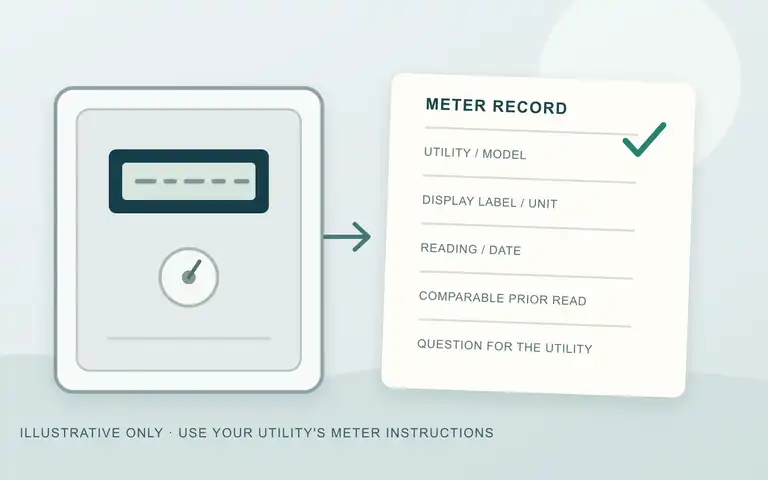
Record the backup-power checks separately
Documenting electrical checks methodically ensures your backup power system operates safely without damaged equipment or unexpected overcurrent shutdowns. When staging an emergency cooling sanctuary during an extended grid blackout, adhere to these operational boundaries:
Pre-Connection Verification Sequence
- Verify Cord Gauge and Voltage Drop: Never run a window air conditioner through an ordinary 16 AWG household extension cord. A 50-foot 16 AWG cord exhibits 0.40 ohms of loop resistance. When an 8,000 BTU compressor draws an 18.5A startup surge through that cord, line voltage drops by 7.4 volts (V_drop = I × R). This severe sag starves the compressor motor of starting torque, extending the locked-rotor duration and tripping the inverter overload relay. Use exclusively heavy-duty 12 AWG or 10 AWG outdoor cords rated for 15 or 20 amperes.
- Inspect the LCDI Plug: Modern window air conditioners feature an integrated Leakage Current Detection and Interruption (LCDI) plug on the cord end. The test and reset buttons must be operational. If connecting to a portable inverter generator with a floating neutral, verify whether your air conditioner’s internal control board requires a bonded neutral plug adapter to initialize its digital thermostat.
- Isolate the Emergency Zone: Close interior doors leading to unoccupied rooms, draw thermal curtains over sun-facing windows, and run the air conditioner in a single sealed bedroom. Limiting the cooling envelope reduces compressor duty cycle from 80% down to 35%, more than doubling your total off-grid battery runtime.
- Stage High-Draw Appliances Sequentially: Never start a window air conditioner while an electric refrigerator or chest freezer compressor is actively running on the same portable generator or power station circuit. Turn the air conditioner mode to “Fan Only,” allow the refrigerator compressor to finish its active cooling cycle, then switch the air conditioner to “Cool.”
For broader appliance backup load calculations, review our refrigerator wattage guide to balance kitchen refrigeration against cooling demands. Sizing your electrical loads to match verified nameplate ratings—rather than marketing BTU figures—ensures steady cooling and protects sensitive electronics throughout the outage.