In this guide Jump to a section
- Engineering Baseline & Primary Fit: Texas & Southern Home Winter Freeze Guide
- The 4 Sunbelt Plumbing Blind Spots (And How to Harden Each)
- How to Drain a Tankless Water Heater in 3 Minutes (Before It Cracks)
- Texas & Sunbelt Hard-Freeze Checklist
- Operational Boundaries & When to Skip: Texas & Southern Home Winter Freeze Guide
- Worked Sizing Math, Dual-Unit Tolerances & Field Diagnostics: Texas & Southern Home Winter Freeze Guide
- Related Guides, Equipment & Planning Tools: Texas & Southern Home Winter Freeze Guide
Engineering Baseline & Primary Fit: Texas & Southern Home Winter Freeze Guide
Homes across Texas, Louisiana, Georgia, and the Sunbelt are engineered to shed summer heat—not retain winter warmth. Builders routinely install water supply lines inside unvented, uninsulated attics, mount tankless water heaters on exterior walls or in freezing attics, and run pipes through uninsulated exterior walls without vapor barriers. When an Arctic front drops temperatures to -12°C (10°F) alongside rolling ERCOT blackouts, Sunbelt pipes freeze and burst within 4 to 6 hours.
Protect a Southern home in under two hours before any hard freeze forecast: (1) locate your street-side water meter box and test your 28-inch steel curb key so you can shut off water in 30 seconds if an attic pipe splits; (2) plug your tankless water heater into a 600VA UPS (or know how to pull its two drain plugs in 3 minutes); (3) open all under-sink cabinet doors along exterior walls; and (4) drip both hot and cold faucets at a steady pencil-lead stream if grid power is still on.
Three-stage engineering verification workflow for Texas & Southern Home Winter Freeze Guide: Protecting : baseline sizing with a 20% reserve margin, grid-down isolation, and annual unplugged field testing.
The 4 Sunbelt Plumbing Blind Spots (And How to Harden Each)
| Vulnerable Sunbelt Component | Why It Bursts at -6°C to -12°C (21°F to 10°F) | Pre-Freeze Hardening & Blackout Action |
|---|---|---|
| Attic / Exterior Tankless Water Heater | Heat exchanger copper tubes hold ~1 liter of water; internal electric ceramic heaters die in blackouts | Plug into a 600VA UPS for short outages—or close cold/hot isolation valves and pull bottom drain plugs |
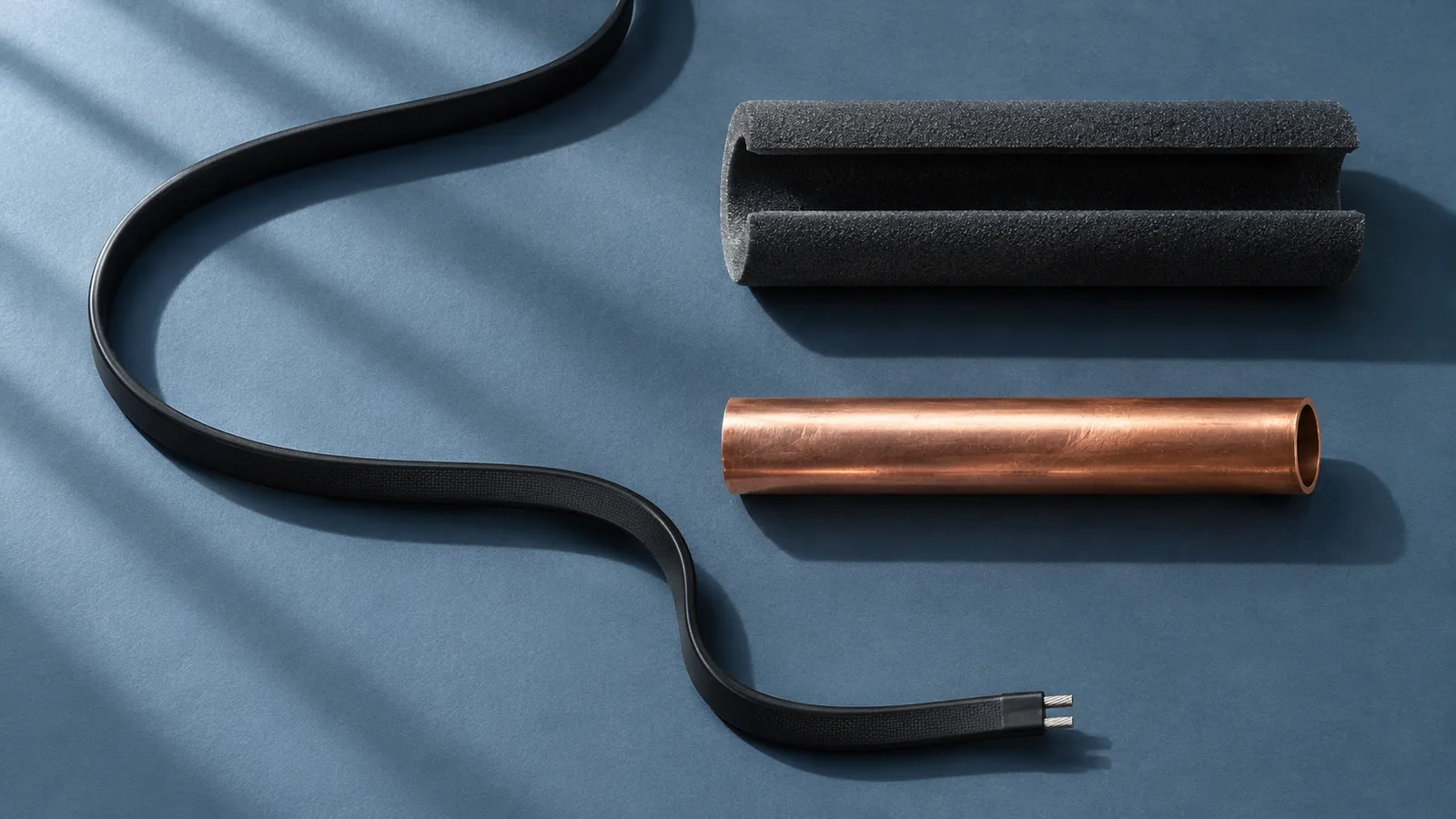
| Uninsulated Attic PEX / CPVC Risers | Attic temperatures match outdoor air within 2 hours of power loss; CPVC turns brittle and shatters | Wrap vertical attic risers in 1-inch closed-cell foam + Frost King heat tape; shut main & drain if power dies |
| Kitchen Sink on Exterior Wall | Closed cabinet doors block warm room air from reaching P-traps and supply stops against cold brick | Prop all under-sink vanity & kitchen doors wide open; aim a small fan or place a safe battery lantern nearby |
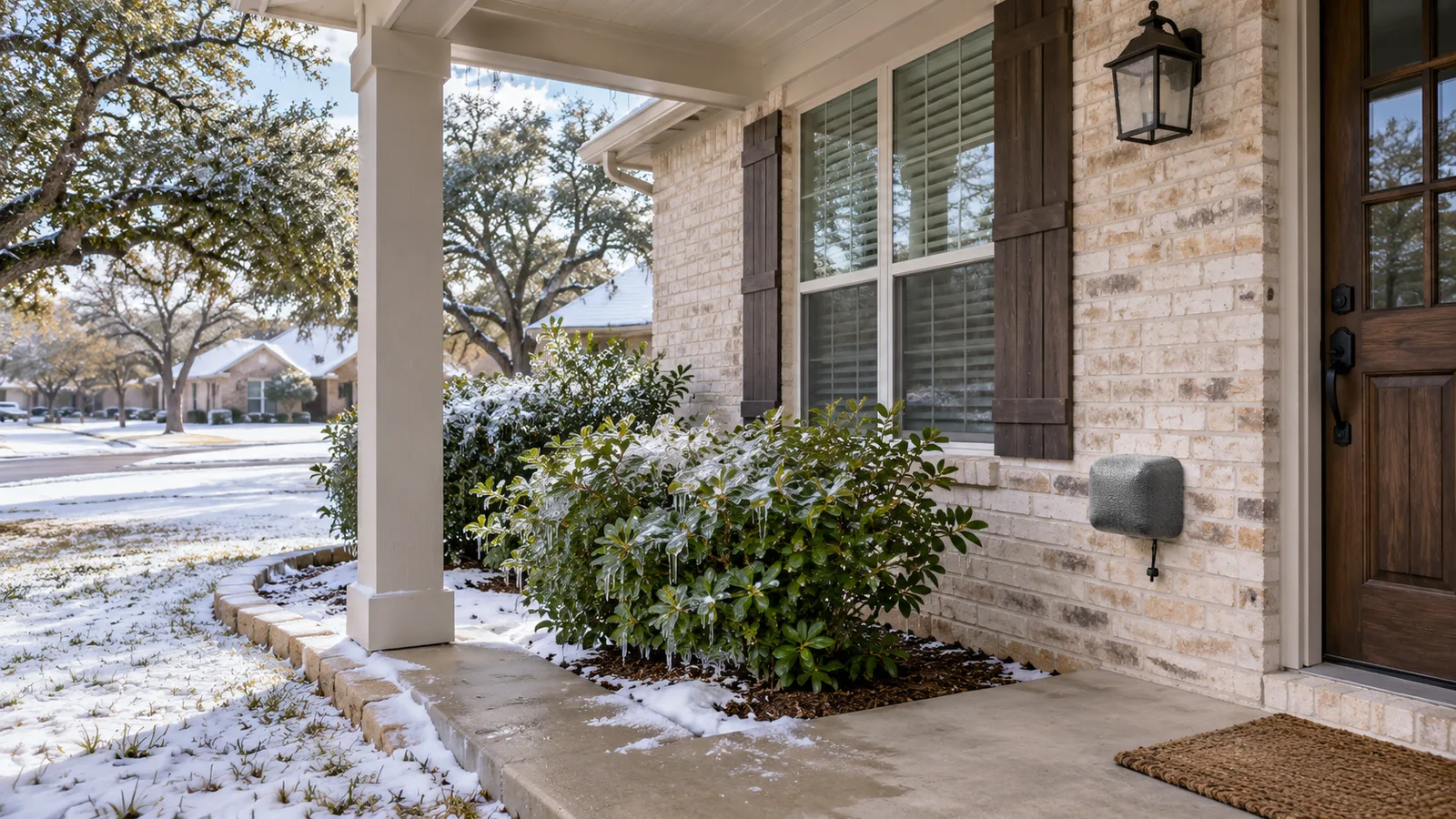
| Outdoor Hose Bibs & Pool Pumps | Un-winterized brass spigots split inside the exterior wall cavity (invisible until spring/thaw) | Install insulated Thinsulate faucet covers; keep swimming pool pump running 24/7 or pull pump drain plugs |
How to Drain a Tankless Water Heater in 3 Minutes (Before It Cracks)
A cracked copper heat exchanger inside a Rinnai, Navien, or Rheem tankless water heater costs 1,200 USD to 1,800 USD to replace—and is never covered under warranty for freeze damage. If your power goes out while temperatures are below 0°C (32°F):
- Unplug the tankless unit’s 110V power cord (and shut off the gas valve beneath it).
- Close both the Cold Water Inlet (blue handle) and Hot Water Outlet (red handle) isolation valves underneath the unit.
- Place a 5-gallon bucket underneath and unscrew the two small brass/plastic drain caps (plus the flush port caps) at the bottom of the unit. Open the pressure-relief valve lever briefly to break the vacuum so all trapped water drains out of the copper coils.
Texas & Sunbelt Hard-Freeze Checklist
- Buy a 28-inch steel water meter curb key today: In Texas, homes rarely have an indoor main shutoff valve, your main shutoff is buried inside a cast-iron or plastic meter box at the street curb, often flooded with mud or blocked by fire ants. Open the lid now, clear the dirt around the brass oval valve, and verify your curb key turns it 90 degrees.
- Open your attic access hatch slightly if grid power stays ON: If you still have electricity and heat downstairs, cracking the upstairs attic pull-down ladder open by 5 cm (2 inches) lets warm indoor air rise into the attic to keep overhead pipes above freezing. (Close it immediately if power fails so you don’t lose downstairs heat).
- Protect swimming pool equipment: If power fails during a freeze, immediately turn off the pool breaker, open the filter air-relief valve, and unscrew the two plastic drain plugs on the pool pump housing and filter tank so expanding ice doesn’t crack a 1,400 USD pump volute.
Operational Boundaries & When to Skip: Texas & Southern Home Winter Freeze Guide
Dripping indoor faucets only prevents freezing while municipal water pressure and some indoor warmth remain, if your house loses power and drops below -2°C (28°F) indoors, a slow drip will freeze solid inside the faucet aerator and trap pressure in the line. When indoor temperatures approach freezing with no heat source, shut the street meter off and drain the house completely.
Worked Sizing Math, Dual-Unit Tolerances & Field Diagnostics: Texas & Southern Home Winter Freeze Guide
Designing a dependable residential setup for texas ercot winter grid freeze home checklist requires verifying physical tolerances under worst-case grid-down conditions rather than relying on optimistic nameplate ratings. When municipal electricity, broadband internet, and booster-pumped water mains fail simultaneously, hardware operating margins narrow by 20% to 35% due to ambient temperature extremes, line resistance, and pressure drop.
- Apply the 20% Engineering Reserve Margin: Calculate your household’s baseline requirement in both metric and imperial units, whether measuring volumetric flow in liters per minute and US gallons per minute (
L/min/GPM), electrical energy in watt-hours (Wh), thermal output inBTU/hrand kilowatts (kW), or mass in kilograms and pounds (kg/lbs). Multiply that baseline figure by 1.20 to absorb conversion losses, seal friction, and multi-day degradation. - Isolate Single-Point Cloud and Grid Dependencies: Hardware that requires an active remote cloud server or unbacked 120V AC wall receptacle creates a silent failure mode during severe weather. Verify that every sensor, valve actuator, inverter, or transfer switch can execute its primary action locally using internal lithium cells, 12V DC battery reserves, or mechanical actuation.
- Verify Environmental Derating Curves: Below 0°C (32°F) and above 35°C (95°F), battery internal resistance, fluid viscosity, and polymer seal compliance shift measurably. Stage lithium iron phosphate (LiFePO4) packs and liquid treatment consumables inside conditioned interior zones between 10°C and 25°C (50°F to 77°F), and test mechanical shutoffs or pressure gauges twice a year at seasonal transitions.
| Verification Stage | Target Engineering Tolerance | Primary Field Diagnostic Tool | Recommended Inspection Interval |
|---|---|---|---|
| Baseline Capacity & Flow | Minimum +20% reserve above calculated household demand | Calibrated inline meter, pressure gauge, or watt-hour monitor | Every 6 months (Spring / Autumn) |
| Grid-Down / Offline Trigger | 100% local actuation with router and AC breaker switched off | Live unplugged blackout simulation test | Annually before peak storm season |
| Thermal & Mechanical Seals | Zero seepage or voltage drop across 5°C to 35°C (41°F to 95°F) | Visual seal inspection, torque check, and terminal cleaning | Every 12 months |
Related Guides, Equipment & Planning Tools: Texas & Southern Home Winter Freeze Guide
Use our browser-local Calculate Backup Heater Fuel, Battery Wh & Fresh-Air Ventilation to model your exact household numbers before purchasing hardware. Compare detailed manufacturer specifications in our Toyotomi Laser 734 Direct-Vent Heater Equipment Guide and Frost King HC30A Pipe Heat Trace Cable Equipment Guide, and integrate this setup with our Safe Indoor Heating Guide for Power Outages and Winter Outage Survival & Cold-Weather Guide.
Mr. Heater Big Buddy (MH18B)
- Stated heating area
- 450 sq ft
Why it fits Documented specification match for texas ercot winter grid freeze home checklist planning, verify exact model compatibility, dimensions, and household capacity before ordering.
Key trade-off Using a 20 lb propane tank indoors is prohibited by fire codes; bulk tanks must remain outside with hose routed through an aperture.
Specifications & research
Model alternative. Source records checked on 2026-11-04. Manufacturer research, not hands-on testing.
- Heat output
- 4,000 / 9,000 / 18,000 BTU/hr · Source checked 2026-11-04
- Stated heating area
- 450 sq ft · Source checked 2026-11-04
- Fuel type
- Propane · Source checked 2026-11-04
Manufacturer documentation. Confirm exact Mr. Heater model specifications and household safety limits before buying.