How Much Water a “Small” Hidden Leak Actually Wastes
According to EPA WaterSense, the average U.S. household’s leaks waste nearly 10,000 gallons of water per year, and 10% of homes have hidden leaks that waste 90 gallons or more per day. When an underground copper or PVC pipe develops a pinhole split—or a lawn sprinkler solenoid valve gets a grain of sand stuck under its rubber diaphragm—water flows 24 hours a day silently into the soil without leaving a single puddle on your kitchen floor.
Because water meters measure volume continuously, even a tiny continuous flow rate adds up to thousands of gallons on a monthly utility bill:
Daily Leak Volume (Gallons) = Leak Flow Rate (GPM) × 60 minutes × 24 hours
Monthly Leak Volume (Gallons) = Daily Leak Volume × 30 days
Volume Conversion: 1 Cubic Foot (CCF / 100) = 7.4805 US Gallons (1 CCF = 748 Gallons)| Leak Source & Equivalent Stream Size | Flow Rate (GPM) | Water Lost per Day | Water Lost per 30-Day Month | Added Monthly Water + Sewer Bill (@12 dollars / 1,000 gal) |
|---|---|---|---|---|
| Weeping Irrigation Solenoid or Pinhole (Fast drip) | 0.05 GPM | 72 gal / day | 2,160 gallons (2.9 CCF) | +25.92 dollars per month |
| Worn Toilet Flapper (Silent bowl trickle) | 0.15 GPM | 216 gal / day | 6,480 gallons (8.7 CCF) | +77.76 dollars per month |
Cracked PVC Irrigation Lateral / Valve Diaphragm (1/16" stream) | 0.50 GPM | 720 gal / day | 21,600 gallons (28.9 CCF) | +259.20 dollars per month |
Split Underground Service Line or Slab Leak (1/8" stream) | 1.50 GPM | 2,160 gal / day | 64,800 gallons (86.6 CCF) | +777.60 dollars per month |
Govee WiFi Water Leak Detector (3-Pack)
Why it fits A leak detector may alert you to water at its sensor; placement, power, and network connectivity affect notification.
Key trade-off App push notifications require functioning home Wi-Fi and internet connectivity; during power blackouts, only local 100 dB audible alarms trigger unless router is on battery backup.
Specifications & research
Early-warning water leak alarm and WiFi monitor. Source records checked on 2026-11-08. Manufacturer research, not hands-on testing.
- Alarm Volume Db
- 100 · Source checked 2026-11-08
- Connectivity
- 2.4 GHz Wi-Fi gateway connects to household router for push notifications and email alerts · Source checked 2026-11-08
- Sensor Probes
- Dual top and bottom brass sensing probes detect pooling water underneath and dripping water from above · Source checked 2026-11-08
Manufacturer documentation. Confirm exact Govee model specifications and household safety limits before buying.
Step 1: How to Read Your Water Meter’s Low-Flow Leak Indicator
Before touching any valves, make sure every indoor and outdoor water fixture is turned off: no faucets dripping, no toilets refilling, no washing machine or dishwasher running, no refrigerator ice maker filling, and no under-sink reverse osmosis tank recharging.
Walk out to your water meter (located either in a concrete/plastic curb box near the street in warmer states, or inside your basement/utility room in northern freeze zones) and flip open the protective cap on the register face:
- Analog Dial Meters (Sweep Hand + Low-Flow Triangle/Starwheel):
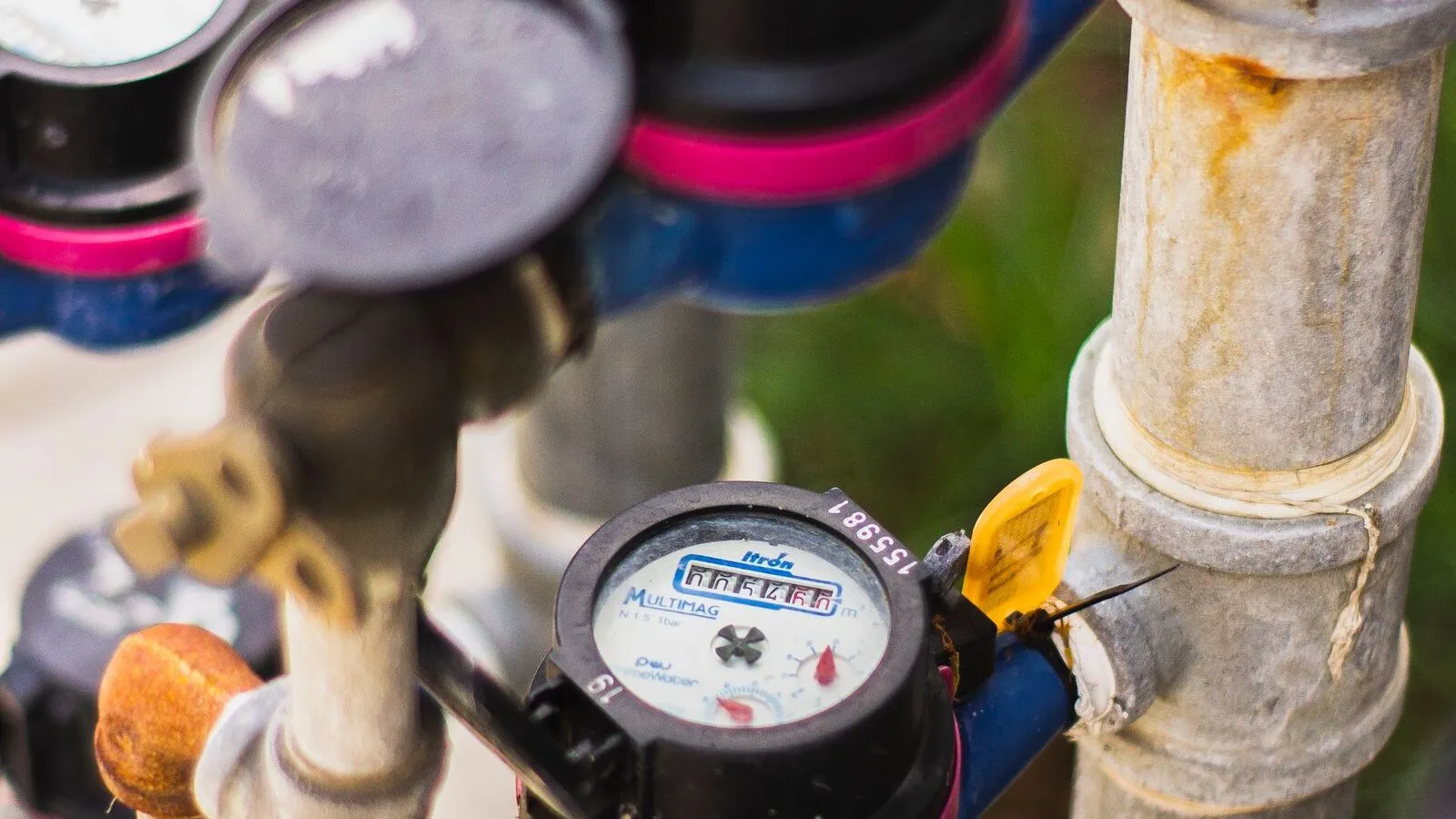
- Look for a tiny red, black, or silver triangle, gear, or starwheel near the center of the dial face. This is the low-flow leak detector. It is geared directly to the meter’s internal nutating disc or piston and spins visibly at flow rates as low as
0.015 to 0.03 GPM(about half a cup per minute). - If the small triangle is spinning continuously while all fixtures are off, you have an active leak.
- Look at the large sweep hand: one full revolution of the sweep hand typically equals 1 cubic foot (
7.48 gallons) or 10 gallons (printed on the dial face). If you suspect an ultra-slow pinhole weep that barely nudges the triangle, take a smartphone photo of the exact sweep-hand position, wait 30 minutes without using any water, and check whether the needle moved.
- Look for a tiny red, black, or silver triangle, gear, or starwheel near the center of the dial face. This is the low-flow leak detector. It is geared directly to the meter’s internal nutating disc or piston and spins visibly at flow rates as low as
- Digital Smart / Ultrasonic Meters (Sensus iPerl, Badger E-Series, Neptune Mach 10):
- Shine a bright flashlight onto the solar-activated LCD screen (or tap the lid if inductive) to wake the display.
- The LCD screen cycles between Total Volume and Current Flow Rate (
GPMorCFM), often accompanied by a faucet drip icon or a+flow arrow. Any non-zero flow rate reading when the house is idle confirms a leak.
The 15-Minute 3-Valve Isolation Test (Diagnostic Matrix)
In almost every residential plumbing layout, water flows from the street through three distinct zones controlled by three valves:
- Valve 1 — Street Meter Curb Stop: At the municipal water meter near the property line.
- Valve 2 — Irrigation Isolation Valve: Located at the branch tee feeding your lawn sprinkler Backflow Preventer (Pressure Vacuum Breaker / PVB bell on the side of the house, or Double-Check Valve Assembly in a green yard box).
- Valve 3 — House Main Shutoff Valve: Located where the main pipe enters your garage, basement, crawlspace, or exterior hose-bibb riser.
Follow this exact two-step valve sequence while watching the street water meter:
| Test Step & Valve Action | What the Street Meter Triangle Does | Confirmed Leak Zone | Next Diagnostic Action |
|---|---|---|---|
| Test 1: Close Valve 3 (House Main Shutoff Valve) completely, then check the street meter | Meter STOPS spinning | Zone C: Inside the House (or under-slab domestic lines) | Re-open House Main; test toilet flappers with food coloring, check water softener drain line, and check under-slab hot/cold pipes |
| Test 2: With Valve 3 (House Main) still closed, close Valve 2 (Irrigation Isolation Valve) | Meter STOPS spinning | Zone B: Lawn Irrigation System (between backflow valve and sprinkler zone valves) | Leave Irrigation Valve closed to stop water loss; inspect sprinkler valve boxes for weeping solenoids or cracked PVC manifolds |
| Test 3: Both Valve 3 (House Main) AND Valve 2 (Irrigation Valve) are closed | Meter KEEPS spinning | Zone A: Buried Main Water Service Line (between street meter and house/irrigation tee) | Walk the trench line from street meter to foundation looking for sunken mud or greener grass; call a leak-detection plumber |
Edge Case: What If Closing the House Main Also Turns Off Your Sprinklers?
In some homes (especially those where an irrigation system was added years after construction), the plumber tapped the irrigation line after the House Main Shutoff Valve rather than before it. If closing your House Main stops the meter, open the House Main back up and close the Irrigation Backflow Valve first: if closing only the irrigation valve stops the meter, your leak is in the sprinkler system!
How to Track Down the Exact Culprit Inside Each Zone
If the Leak Is in Zone C (Inside the House)
Before worrying about a costly concrete slab leak, check these four “silent drain” culprits that connect directly to your sewer pipe (so they never leave a puddle on the floor):
- Toilet Flappers and Fill Valves (#1 Culprit): Put 6 drops of dark blue or red food coloring into every toilet tank in the house and wait 15 minutes without flushing. If any color appears in the toilet bowl, the rubber flapper is warped or the overflow tube is set too low (
8 dollarsDIY fix). - Water Softener Stuck in Regeneration Bypass: Listen closely to the black drain tubing running from your water softener control head to the utility sink or standpipe. A worn rotor seal inside the softener head can dump
0.5 to 1.5 GPMcontinuously down the drain 24/7. - Under-Sink Reverse Osmosis Automatic Shutoff Valve (ASV): Check the
1/4-inchblack drain saddle tube under your kitchen sink. If a bladder-tank RO system’s diaphragm ASV fails, brine water trickles continuously into the P-trap even after the RO storage tank is full. - Water Heater T&P Relief Valve Pipe: Check the copper or CPVC pipe exiting the side of your water heater (which often terminates outdoors near the foundation or into a floor drain). If thermal expansion or a failed PRV pushes house pressure above
150 psi, the T&P valve will weep hot water outdoors. - Under-Slab Hot Water Line: If all toilets and appliances are shut off at their individual angle stops and the meter still spins when the House Main is open, shut off the cold-water inlet valve on top of your water heater. If closing the water heater inlet stops the meter, the leak is in an under-slab hot-water copper loop (feel your tile or laminate floors with bare feet for a warm spot).
If the Leak Is in Zone B (Irrigation System)
Irrigation leaks happen in two places:
- Mainline / Manifold Leak (Constant 24/7 Leak): The PVC pipe between your backflow preventer and the electric zone valves stays under
60+ psistreet pressure 24 hours a day. Open your green plastic round or rectangular valve boxes in the yard: if the soil inside the box is flooded or you hear a faint hiss inside a closed solenoid valve, a valve diaphragm is torn (12 dollarsdiaphragm replacement) or a PVC slip tee is cracked. - Lateral / Sprinkler Head Leak (Leaks Only When Running): If the street meter is dead still when the sprinkler controller is off, run each sprinkler zone manually for 2 minutes to spot geysering broken heads or bubbling turf.
If the Leak Is in Zone A (Buried Main Service Line)
When the leak is between the street curb meter and your house main shutoff valve:
- Walk a straight line from the street meter box to your house hose bibb or basement entry. Look for soft, spongy soil, water seeping over the curb into the gutter, or a strip of lush green grass during dry weather.
- Because the homeowner is responsible for the service line on the house side of the meter spindle (while the city is responsible for the meter couplings and street main), call your water utility first after confirming a leak. Ask whether they offer a once-every-few-years “Leak Adjustment Credit”—most municipal water utilities will forgive 50% to 100% of the excess water and sewer charges on a spiked bill once you submit a receipt showing the pipe or valve was repaired!
To catch future pipe leaks, stuck toilet flappers, and irrigation failures automatically on your phone before the bill arrives, read our guides on smart water leak sensor placement and protocol testing and automatic whole-home water shutoff valves for extended travel.
Frequently Asked Questions
How do I know if my leak is in the irrigation system or the main house line?
Turn off all faucets inside the house and confirm the small low-flow triangle on your street water meter is spinning. Next, close the Irrigation Isolation Valve (the two ball valves on your outdoor brass backflow preventer or in the primary irrigation shutoff box). If the water meter triangle stops spinning as soon as you shut off the irrigation backflow valve, the leak is 100% isolated to your sprinkler system. If the meter keeps spinning with the irrigation valve closed, close your House Main Shutoff Valve to see whether the leak is inside your house plumbing or in the buried main line between the street and the house.
Who pays for a water leak between the meter and the house?
In virtually all U.S. municipalities, the water utility owns and maintains the street main, the curb stop, and the water meter itself (up to the outlet tailpiece nut inside the meter box), while the property owner is responsible for the buried service pipe running from the meter outlet to the house. However, if a gasket or coupling is leaking inside the meter box right on the meter body, call the water utility first—they will tighten or replace meter washers at no cost, and most utilities offer a formal bill leak-adjustment credit once you repair a buried service line.