In this guide Jump to a section
When you turn on your kitchen or bathroom faucet on a freezing winter morning and only a sputter of air or a few drops come out, assume two things simultaneously:
- An ice plug has blocked the supply pipe between your main water line and that fixture.
- The pipe may already have split while frozen, and the ice plug itself is currently acting as a cork holding back
60 PSIof municipal water pressure. The moment you melt that ice plug, water will either flow cleanly out of your open faucet, or spray out of a hidden crack inside your cabinet or wall.
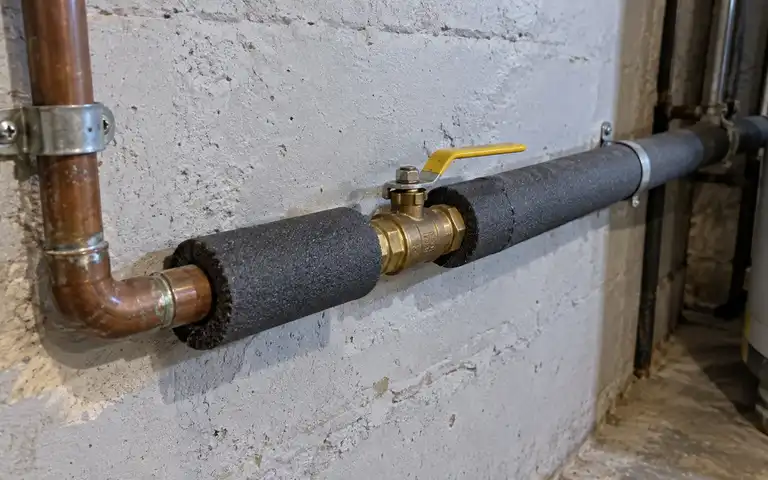
That is why Step 0 (before plugging in a hair dryer or soaking a towel) is always locating and testing your Main Water Shutoff Valve.
Step 0: Safety triage before applying any heat
Before touching a frozen pipe, run through four life-safety checks in under two minutes:
- Station someone at (or know the exact path to) the Main Water Shutoff Valve: Verify that the main ball valve or gate valve turns freely. If you hear water spraying inside a wall or ceiling as the ice begins to melt, you must be able to shut off the house water supply within 15 seconds.
- Inspect the accessible pipe for splits, bulges, or pushed-apart fittings: Run your fingers and a bright flashlight along the exposed pipe under the sink, in the basement, or in the crawlspace. If you see a longitudinal crack, a swollen bulge in copper, a pushed-out PEX/SharkBite fitting, or frost oozing from a split, stop immediately: shut off the main water valve, open the faucet to relieve pressure, and call a plumber.
- Check for standing water near electrical outlets (GFCI Shock Rule): Never use a
120Vcorded hair dryer, heating pad, or portable space heater if there is any water puddled on the floor or cabinet base. Always plug electric thawing tools into a GFCI-protected outlet. - Check if your neighbors also have no water: Open faucets in other rooms of your house (
such as an interior bathroom or basement laundry tub). If every faucet in the entire house is dry, the freeze may be at your main water meter pit or street service line (or a city water main break)—call your water utility before heating interior pipes.
Commercial Dial · Fridge/Freezer Thermometer
Rubbermaid FGR80DC Appliance Thermometer
Why it fits A refrigerator thermometer can show the current air temperature; it cannot establish earlier food temperatures during an outage.
Key trade-off A current dial reading cannot reconstruct earlier outage temperatures or establish that food is safe.
Specifications & research
Stainless steel refrigerator and freezer dial thermometer. Source records checked on 2026-10-24. Manufacturer research, not hands-on testing.
- Listed temperature range
- −20°F to 80°F; Fahrenheit and Celsius scales · Source checked 2026-10-24
- Dial diameter
- Not verified in this source record · Source checked 2026-10-24
- Numeric accuracy tolerance
- Not verified in this source record · Source checked 2026-10-24
Manufacturer documentation. Confirm model, placement and readable markings; a current reading is not an outage log.
How to find the exact frozen section
If only one sink, toilet, or shower is dry while the rest of the house has normal water pressure, trace that specific branch line backward from the fixture:
- Open both the hot and cold taps to determine whether only the cold line, only the hot line, or both lines are frozen.
- Feel the exposed pipe with your bare hand: An unfrozen pipe feels cool (
45°F–55°F), whereas the frozen section feels bitterly, painfully cold (<= 32°F), often shows surface frost or condensation beading, and sounds dull and solid (like a wooden dowel) when tapped lightly with a screwdriver handle compared to the hollow metallic ring of a liquid-filled copper pipe. - Check the 4 classic pinch points:
- Right where the pipe exits the back of the sink cabinet into an exterior wall.
- Above a basement rim joist or foundation sill plate where cold outdoor air leaks in.
- Next to a garage door track or unheated crawlspace vent.
- Along an attic truss near the cold roof eaves.
Thaw it step by step: why you must start at the open faucet and work backward
The golden rule of thawing a frozen pipe is Direction of Heat Application:
- Step 1: Turn the faucet handle fully OPEN (
both hot and cold). - Step 2: Start applying gentle heat closest to the open faucet and work slowly backward toward the frozen blockage.
Why direction matters: If a 3-foot section of pipe is frozen and you blast heat onto the middle of the ice plug (or start from the street side while the faucet side is still plugged with solid ice), the trapped pocket of melted water and steam has nowhere to go between the remaining ice plugs. Starting at the open faucet side ensures a clear channel out of the spout as the ice recedes.
Safe heat sources vs. prohibited fire and rupture hazards
| Thawing Method | Safety Verdict | Maximum Surface Temp | Why It Works (Or Why It Causes Disasters) |
|---|---|---|---|
1. Handheld Hair Dryer (Low/Med) | SAFE (Best Choice) | ~110°F–140°F | Gentle convective air safe for copper, PEX, CPVC, and PVC; keep moving back and forth from faucet toward blockage |
| 2. Hot-Water-Soaked Towels | SAFE (Zero Power) | ~115°F–130°F | Wrap thick terrycloth towels around the pipe and pour hot (not boiling) water over them into a bucket below; ideal during power outages |
| 3. Electric Heating Pad / UL Heat Tape | SAFE | ~110°F–135°F | Wrap an electric heating pad around the accessible frozen pipe section; never leave unattended |
| 4. Portable Fan / Space Heater Aimed Into Cabinet | SAFE (With 3 ft Clearance) | ~85°F–105°F air | Warms the entire cabinet cavity and adjacent drywall when the freeze is 6 to 18 inches inside an exterior wall |
| 5. Propane Blowtorch / Butane Torch | PROHIBITED (Fatal Fire & Steam Hazard) | 3,500°F+ flame | Ignites dust/studs inside walls within seconds, melts lead-free solder joints, scorches PEX/CPVC, and flashes trapped water into explosive steam (1,600× volume expansion!) |
6. Paint-Stripping Heat Gun (1,000°F) | PROHIBITED on Plastic / Wall Cavities | 750°F–1,100°F | Softens and bursts pressurized PEX (rated to ~180°F–200°F), CPVC, and PVC pipes and chars drywall paper |
7. Pouring Boiling Water (212°F) Directly on Pipe | PROHIBITED on PVC / CPVC / Drains | 212°F (100°C) | Thermal shock cracks rigid PVC/CPVC glue joints and porcelain; use warm/hot tap water (~120°F–130°F) over a wrapped towel instead |
| 8. Unvented Kerosene or Charcoal Heater in Crawlspace | PROHIBITED (Lethal CO Hazard) | Extreme CO + Fire | Fills confined crawlspace and floors above with lethal carbon monoxide within minutes |
How to Thaw a Pipe Hidden Behind Drywall Without Cutting the Wall
If the frozen section is inside a closed exterior wall where a hair dryer cannot touch the pipe directly:
- Open the faucet fully and open the cabinet doors below the sink.
- Crank your home’s thermostat up to
72°F–75°F(or place an indoor-safe heater in the room3 feetaway from the wall) and use a small desk fan or battery fan to blow warm room air directly through the pipe penetrations (escutcheon holes) under the sink into the wall cavity. - If you have access to the other side of the wall or the basement ceiling below that stud bay, warm that surface gently as well.
Emergency frozen-pipe thawing checklist
Follow this checklist from start to finish until full water flow returns:
- Verify your Main Water Shutoff Valve location and operation: Be ready to turn off the main valve in 15 seconds if a hidden crack begins leaking as the ice melts.
- Open the affected hot and cold faucets completely: Leave them open during the entire thawing process so air, steam, and trickle flow tell you the moment the ice channel opens.
- Apply gentle heat (
hair dryerorhot wet towels) starting at the faucet end: Move slowly backward toward the cold wall or crawlspace section; never hold a hair dryer stationary in one spot on plastic PEX or CPVC pipe. - Maintain gentle heat until FULL water pressure is restored: Do not stop as soon as a tiny trickle starts—keep warming the pipe until the full annular ring of ice has melted off the inner pipe wall.
- Perform the 15-minute Post-Thaw Leak & Meter Check:
- Once full flow returns, close the faucet and dry the pipe completely with a paper towel.
- Inspect every fitting, elbow, and solder joint with a flashlight for weeping drops.
- Listen closely against the drywall with a drinking glass or mechanics stethoscope—if you hear a continuous hissing sound behind the wall when all faucets are closed (or if the small triangle/star leak indicator dial on your water meter is spinning), a hidden pipe has split inside the wall. Shut off the main water valve immediately and call a licensed plumber.
- Prevent a repeat freeze tonight: Leave the cabinet doors open, slip foam pipe insulation sleeves over the exposed pipe, and leave the faucet dripping at
~1 gallon per houruntil outdoor temperatures rise above freezing.
For preventive risk scoring and drip math, read our how cold and how long before pipes freeze guide and our dripping faucet physics and water cost guide.
Frequently asked questions
How do you thaw a frozen pipe safely?
First, make sure you know where your home’s main water shutoff valve is in case the pipe has already cracked. Next, open both the hot and cold handles on the frozen faucet so melting water and steam have an escape path. Apply gentle heat (using a standard handheld hair dryer, an electric heating pad, or towels soaked in hot water) starting near the open faucet and working slowly backward toward the frozen section until full water pressure returns.
What should you never use to thaw a frozen pipe?
Never use an open flame or extreme-heat tool (such as a propane blowtorch, butane torch, paint-stripping heat gun, kerosene heater, or charcoal stove) to thaw a frozen pipe. Open flames and 1,000°F heat guns frequently ignite wood studs and insulation inside walls, melt solder joints on copper pipes, rupture pressurized PEX and CPVC plastic tubing, and boil trapped water into explosive steam pockets that burst the pipe.
How do you know if a frozen pipe has burst inside a wall?
A pipe often cracks while frozen solid, but the ice plug blocks the water from leaking until the pipe begins to thaw. Once you thaw the pipe (or as the weather warms up), close all faucets in the house and check for four signs: (1) a hissing or running-water sound inside the wall or ceiling, (2) water spots, damp drywall, or dripping in the room or basement directly below, (3) a drop in water pressure at the fixture, or (4) the low-flow leak-indicator dial spinning on your main water meter while all household fixtures are turned off. If you see any of these signs, shut off your main water valve immediately and call a plumber.