In this guide Jump to a section
Every winter cold snap triggers the same midnight question: “It’s 24°F outside: how many hours do I have before my pipes freeze?”
Because water freezes at 32°F (0°C), many homeowners assume pipes either freeze the instant outdoor temperatures dip to 31°F or never freeze as long as the hallway thermostat reads 68°F. Both assumptions are wrong. A pipe buried inside an exterior kitchen wall or an unheated crawlspace sits in a thermal tug-of-war between indoor heat and outdoor cold, and why a pipe bursts has less to do with ice pushing outward on the wall of the freeze spot than with extreme hydraulic water pressure (2,000+ PSI) trapped between an expanding ice plug and a closed faucet.
Start with the household: who is home and where is the main water shutoff?
Before checking outdoor temperatures or wrapping foam sleeves around pipes, establish human control over your home’s water supply:
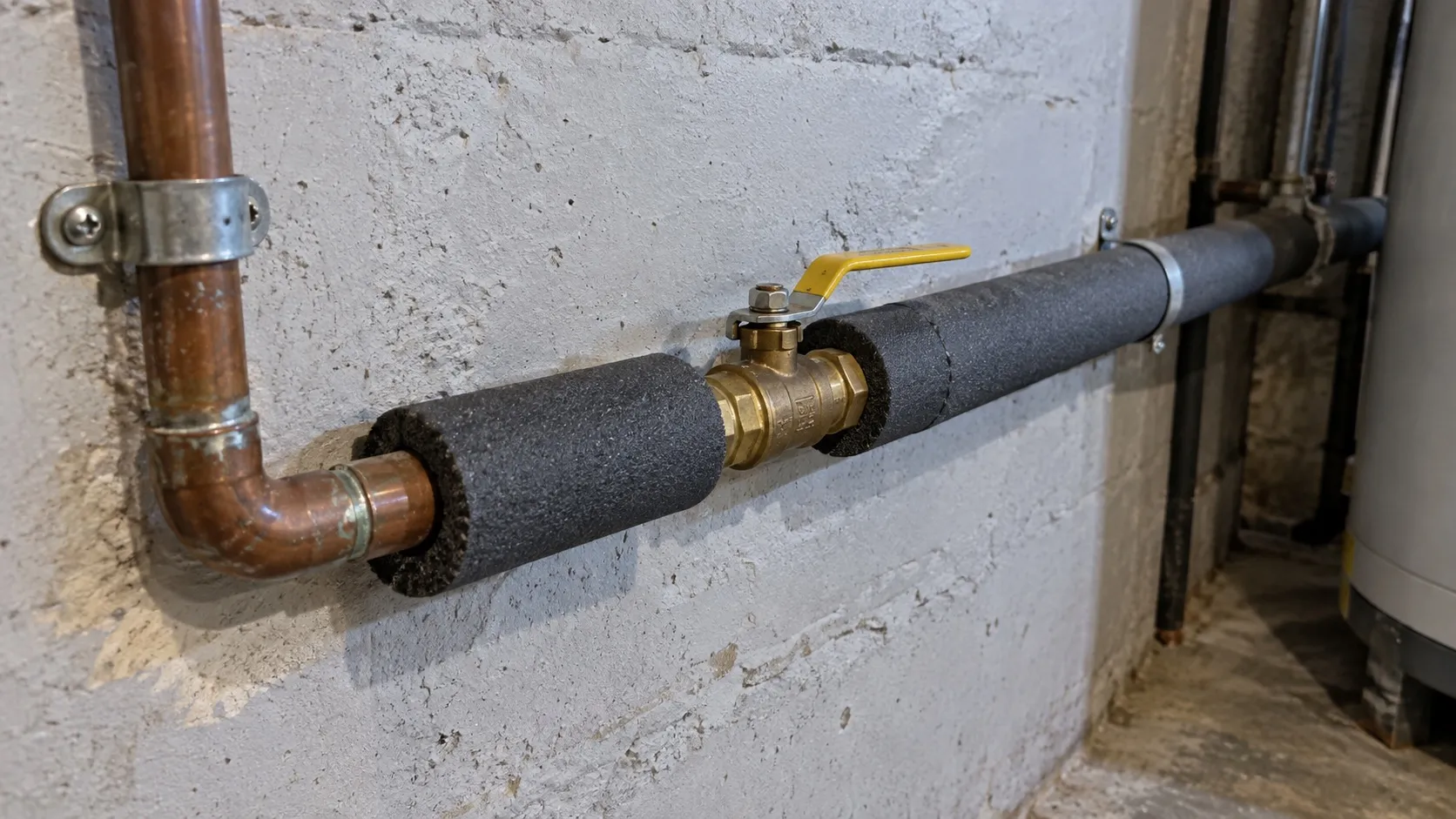
- Locate and test your Main Water Shutoff Valve today: If a
1/2-inchor3/4-inchpressurized supply pipe splits behind your drywall at 3:00 AM, municipal water pressure (50 to 80 PSI) will pump 4 to 8 gallons of icy water per minute (240 to 480 gallons per hour) into your ceilings and floors. Everyone in the household (including teenagers, spouses, and house-sitters) must know where the main interior shutoff valve or street curb key is located and verify that it turns smoothly by hand. - Coordinate with neighbors before winter travel: If you are leaving town during winter, leave a house key and the exact location of your main water valve with a trusted neighbor.
- Never shut off fire-sprinkler supply valves without professional guidance: Residential fire-sprinkler risers (
NFPA 13D) have separate freeze-protection rules and must never be isolated without consulting your fire department or sprinkler contractor.
Frost King 24-Ft Pipe Freeze Protection Cable
- Power Consumption
- 7 Watts per linear foot (168 W total)
Why it fits Pipe heat cable may help protect compatible pipes; follow the installation instructions and do not rely on it as a guarantee against freezing.
Key trade-off Must never be spiraled, crossed, or overlapped over itself, which causes dangerous local overheating.
Specifications & research
Automatic thermostatically controlled pipe heating cable. Source records checked on 2026-11-08. Manufacturer research, not hands-on testing.
- Cable Length Feet
- 24 · Source checked 2026-11-08
- Power Consumption
- 7 Watts per linear foot (168 W total) · Source checked 2026-11-08
- Automatic Thermostat
- Built-in bimetal thermostat energizes cable when pipe drops below 38°F and shuts off when warmed above 45°F · Source checked 2026-11-08
Manufacturer documentation. Confirm exact Frost King model specifications and household safety limits before buying.
The 20°F threshold and latent-heat physics: why there is no single timer
Why do building scientists at the Insurance Institute for Business & Home Safety (IBHS) identify 20°F (-6.7°C) as the critical outdoor alert threshold when water freezes at 32°F?
1. The thermal gradient across an exterior wall or crawlspace
Even when your indoor thermostat is set to 68°F, the drywall, stud cavity, and under-sink cabinet act as thermal resistors between your room air and a water pipe stapled against the outer sheathing.
- When outdoor air is
28°F to 31°F, enough heat usually leaks from your68°Fliving room into the wall cavity to keep the pipe surface above32°F. - Once outdoor air drops to
20°F (-6.7°C)or lower for 6 or more hours, the cold soaking through the exterior siding, brick, or soffit vents overwhelms the small amount of indoor heat reaching the pipe, dropping the interior of the stud bay or attic below32°F.
2. The two-stage physics of freezing (Sensible Cooling + Latent Heat of Fusion)
Standing water inside a pipe does not turn into solid ice the second the pipe wall hits 32°F. Water must lose heat in two distinct stages:
- Stage 1 (Sensible Cooling,
50°F → 32°F): Each pound of water loses1 BTUfor every1°Fdrop (18 BTU/lbto cool from50°Fto32°F). - Stage 2 (Latent Heat of Fusion,
32°F Liquid → 32°F Solid Ice): Before32°Fliquid water can crystallize into solid32°Fice, it must shed144 BTU per poundof latent heat, which is 8 times more energy than it took to cool the water from50°Fto32°F!
During that latent-heat plateau, slushy ice crystals form along the inner pipe wall and grow inward until they fuse into a solid ice plug. As that ice plug expands by ~9% in volume, it acts like a hydraulic piston, compressing the liquid water trapped between the ice blockage and your closed sink faucet until the copper, PEX, or PVC pipe ruptures at its weakest joint.
5-question Pipe Freeze Risk Checker (0 to 11 score)
Because no honest formula can give an exact minute-by-minute countdown without knowing the hidden gaps inside your drywall, use this 5-Question Pipe Freeze Risk Rubric (BP-084) to score your home’s plumbing before a cold front arrives.
Add the points that apply to your most vulnerable water pipe:
| Risk Factor Question | Condition A (0 Points) | Condition B (1–2 Points) | Condition C (2–3 Points) | Your Score |
|---|---|---|---|---|
| 1. Where does the pipe run? | Interior partition wall or heated basement (0 pts) | Inside an exterior masonry or framed wall (+2 pts) | — | 0 or 2 |
| 2. Is the space unheated? | Conditioned living space (0 pts) | Partially heated garage or utility room (+1 pt) | Unheated attic, vented crawlspace, or pier-and-beam underbelly (+3 pts) | 0, 1, or 3 |
| 3. Is the pipe insulated? | Wrapped in closed-cell foam sleeve + UL heat cable (0 pts) | Passive foam pipe sleeve only (+1 pt) | Bare copper, PEX, CPVC, or galvanized pipe (+2 pts) | 0, 1, or 2 |
| 4. What is the overnight forecast? | Above 28°F (-2.2°C) or brief dip (0 pts) | 21°F to 27°F for 4+ hours (+1 pt) | 20°F (-6.7°C) or lower for 6+ hours — OR house heat is OFF in a power outage (+3 pts) | 0, 1, or 3 |
| 5. Is there wind / draft exposure? | Tight, air-sealed building envelope (0 pts) | Windy forecast (>15 mph) hitting sill-plate, soffit, or crawlspace vents (+1 pt) | — | 0 or 1 |
Worked scoring example & action tiers
Suppose you live in a pier-and-beam or slab home where the kitchen sink pipe runs inside a north-facing exterior wall (+2 pts), in a partially unheated cabinet cavity (+1 pt), with bare uninsulated pipe (+2 pts), during a 10-hour overnight freeze at 16°F (+3 pts) with 25 mph north winds (+1 pt):
- Adding those five risk factors (
2 + 1 + 2 + 3 + 1) yields a Total Risk Score of9 out of 11 points(High Risk).
Match your total score (0 to 11) to the required action tier below:
- Scoring
0 to 3 Points(Low Risk) means you should keep your indoor thermostat at60°F+(55°F+absolute minimum if away), disconnect outdoor garden hoses, and install insulated outdoor spigot covers. - Scoring
4 to 7 Points(Moderate Risk) means you should open all kitchen and bathroom sink cabinet doors so room heat reaches the wall cavity, slip closed-cell polyethylene or elastomeric foam sleeves over accessible pipes, and seal rim-joist or crawlspace air drafts. - Scoring
8 to 11 Points(High Risk, Immediate Action) requires opening cabinet doors, starting a slow continuous faucet drip (~5–10 drops/minuteor pencil-lead trickle) on both hot and cold lines at the vulnerable fixture, and if house heating fails during a power outage, shutting off the main water valve and draining the lowest and highest faucets before indoor temperatures drop below40°F–45°F.
Why PEX Still Needs Protection Even Though It Expands
Cross-linked polyethylene (PEX) tubing is far more flexible than rigid copper or CPVC and can often swell around an ice plug without splitting the main tube body. However, PEX brass/poly crimp fittings, manifold joints, and connected bronze faucet valves do NOT stretch, and a frozen PEX line still cuts off all running water to your toilets and sinks until thawed. Treat PEX with the exact same freeze precautions as copper.
Step-by-step freeze prevention checklist (before, during, and after)
- Disconnect every outdoor garden hose before the first freeze: A garden hose left attached traps water inside the barrel of a “frost-free” sillcock (
hose bibb), splitting the brass tube inside your wall where you will not see the leak until you turn the spigot on in spring. - Open sink vanity and kitchen cabinet doors on exterior walls: Closed cabinet doors act as an insulation barrier that locks room heat out of the under-sink plumbing bay.
- Drip the furthest exterior-wall faucets when outdoor temps hit
<= 20°F: A slow drip relieves downstream hydraulic pressure so that even if slush forms in the line, pressure cannot spike to bursting levels. - Shut off and drain the house if a blackout drops indoor temps below
42°F: Turn off the main water shutoff valve, turn off the water heater power/gas supply (so an heating element never fires in a partially drained tank), and open the lowest basement/laundry faucet and highest upstairs faucets to drain standing water. - Never thaw a frozen pipe with an open flame: If a faucet produces no water on a freezing morning, read our step-by-step guide to thawing frozen pipes safely, check our dripping faucet physics & cost math, or use our pre-travel plumbing winterization checklist.
Frequently asked questions
At what temperature do pipes freeze?
Water freezes at 32°F (0°C), but plumbing inside walls, attics, and crawl spaces typically does not freeze the moment outdoor air hits 32°F because heat escaping from your house buffers the pipes. Building science research from the Insurance Institute for Business & Home Safety (IBHS) shows that residential pipe-freeze failures rise sharply once outdoor temperatures reach 20°F (-6.7°C) or lower for several hours, especially when wind blows through unsealed crawlspace vents, attic soffits, or exterior-wall sill plates.
How long does it take for pipes to freeze?
There is no single countdown timer because freeze time depends on outdoor temperature, wind infiltration, pipe insulation, and whether your home’s heat is running. In an unheated attic, garage, or vented crawlspace below 20°F, an uninsulated pipe with stationary water can freeze in 3 to 6 hours. Inside a heated home that loses power during a winter blackout, interior plumbing generally remains safe until indoor room temperatures fall below 40°F to 45°F (typically 8 to 24 hours after the furnace stops, depending on your home’s insulation).
How do you know if your pipes are at risk of freezing?
Score five physical factors: (1) whether the pipe runs inside an exterior wall, (2) whether it passes through an unheated attic, garage, or crawlspace, (3) whether the pipe is bare/uninsulated, (4) whether the outdoor forecast sits at or below 20°F for 6+ hours (or your furnace is out), and (5) whether cold wind can infiltrate the cavity. Any pipe combining two or more of those factors during a <= 20°F freeze requires open cabinet doors, pipe insulation, and pressure-relieving faucet dripping.