In this guide Jump to a section
- Start with the people who help: your local neighbor handoff
- Heat and airflow rules: why 55°F is the absolute floor (and 60°F is safer)
- Water shutoff and depressurization: how to stop a flood before it starts
- Comparing a 1-week trip vs. a seasonal 3-month vacancy
- Homeowners insurance freeze-exclusion rules (ISO HO-3)
- 15-minute pre-departure winterization checklist
- Frequently asked questions
Most catastrophic winter water-damage claims do not happen while the homeowner is sitting in the living room. They happen while the family is away for Thanksgiving, Christmas, or a week-long winter trip: a local power outage stops the furnace, or someone turns the thermostat down to 45°F to save money on the heating bill, a 3/4-inch copper pipe freezes and splits in an exterior wall, and municipal water pressure (60 PSI) pumps 300+ gallons per hour through the house for four days straight before anyone notices water pouring out under the front door.
Spending 15 minutes on a deliberate pre-departure plumbing and heating sequence eliminates that flood scenario even if a regional ice storm knocks out power to your neighborhood on Day 2 of your trip.
Start with the people who help: your local neighbor handoff
Automated smart thermostats and Wi-Fi water leak sensors stop reporting the moment a winter tree branch takes down your home’s power or broadband line. Before locking your door for a winter trip, set up a human backup loop:
- Designate a trusted neighbor or local contact with a physical house key: If your smart thermostat goes offline—or if your electric utility sends a text alert for a neighborhood power outage—your local contact can walk inside within an hour to check the indoor temperature and drain the plumbing before the house freezes.
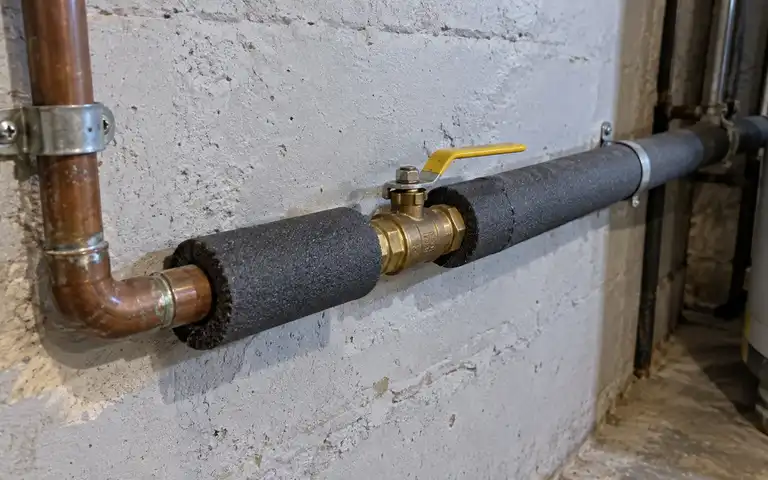
- Hang a bright tag on the Main Water Shutoff Valve: Write clear 1-2-3 instructions on a luggage tag tied directly to the main water valve in the basement, utility room, or garage so your neighbor does not waste 20 minutes hunting behind storage bins.
- Leave emergency contact numbers on the kitchen counter: List your cell number, your HVAC contractor, your plumber, and your insurance carrier policy number.
Govee WiFi Water Leak Detector (3-Pack)
Why it fits A leak detector may alert you to water at its sensor; placement, power, and network connectivity affect notification.
Key trade-off App push notifications require functioning home Wi-Fi and internet connectivity; during power blackouts, only local 100 dB audible alarms trigger unless router is on battery backup.
Specifications & research
Early-warning water leak alarm and WiFi monitor. Source records checked on 2026-11-08. Manufacturer research, not hands-on testing.
- Alarm Volume Db
- 100 · Source checked 2026-11-08
- Connectivity
- 2.4 GHz Wi-Fi gateway connects to household router for push notifications and email alerts · Source checked 2026-11-08
- Sensor Probes
- Dual top and bottom brass sensing probes detect pooling water underneath and dripping water from above · Source checked 2026-11-08
Manufacturer documentation. Confirm exact Govee model specifications and household safety limits before buying.
Heat and airflow rules: why 55°F is the absolute floor (and 60°F is safer)
When leaving home for a few days or weeks in winter, never turn the heating system off and never dial the thermostat down to 45°F or 50°F.
- Why
55°F(13°C) is the minimum baseline: Your thermostat measures the air temperature on an interior hallway wall. When the center of your house is55°Fand the outdoor temperature plunges to5°Fwith a25 mphwind, the temperature inside an uninsulated exterior kitchen wall cavity or above a garage ceiling can easily sit20°F to 25°Fcolder than the hallway—dropping right into the30°F to 32°Ffreezing zone. - Set
58°F to 62°Ffor older or pier-and-beam homes: If your house was built before 1980, has plumbing inside exterior walls, or sits over a vented crawlspace, leaving the thermostat at58°F to 62°Fcosts only1.50 to 3.00 dollars per daymore than50°Fwhile providing a critical thermal buffer against sudden overnight cold snaps. - Open all interior room doors and under-sink cabinet doors: Closing bedroom, bathroom, or laundry room doors traps cold air in outer rooms, while closed kitchen and vanity cabinet doors block furnace heat from reaching the supply pipes against the exterior wall.
- Replace the furnace filter and fresh thermostat batteries before leaving: A clogged furnace filter can trip the furnace’s high-limit safety switch and lock out the burner while you are 500 miles away. Equally important, dead
AAbatteries in a wall thermostat can drop the heating relay open in the middle of the night.
Water shutoff and depressurization: how to stop a flood before it starts
Even if you leave your heat at 60°F, a multi-day winter power outage while you are traveling will eventually chill the house below freezing. Shutting off the main water supply valve and relieving line pressure ensures that even if a pipe freezes during a blackout, it is limited to the few gallons of standing water already in the tubing rather than an unlimited 60 PSI street supply.
Two Exceptions: Hydronic Boilers and Fire Sprinklers
- Hydronic Baseboard / Radiator Heating Boilers: If your home is heated by hot water circulating through baseboard radiators or radiant floors (
hydronic heating), shutting off the main domestic water supply is generally fine only if you leave the boiler’s closed-loop circulating system filled and running, or Verify with your heating technician whether your boiler relies on an automatic water-feed valve. - Residential Fire Sprinkler Systems (
NFPA 13D): Never close the master valve that feeds fire-sprinkler heads. Close only the domestic plumbing isolation valve located downstream of the fire-sprinkler tee.
Why you must protect the water heater when shutting off main water
When you close the main water valve and open a basement faucet to drain the house lines, water can siphon out of the top few inches of your hot water heater tank—exposing the upper 4,500 W electric heating element to air.
- If the
240Vwater heater circuit breaker is stillON, the exposed upper element will glow red-hot in dry air and burn out (dry-fire) in less than 30 seconds. - The rule: Whenever you shut off the main house water valve for a trip:
- On an electric tank water heater: Flip the
240Vwater heater breaker toOFFin your electrical panel (and do not turn that breaker back ON when you return home until you have turned the main water back on and bled all air out of an upstairs hot water faucet!). - On a gas tank water heater: Turn the gas control dial to
VAC(Vacation) orPILOT.
- On an electric tank water heater: Flip the
Comparing a 1-week trip vs. a seasonal 3-month vacancy
| Winterization Step | Short Winter Trip (3 to 14 Days Away) | Extended Seasonal Vacancy (1 to 4 Months / Unheated Cabin) |
|---|---|---|
| Thermostat Setting | Leave ON at 58°F to 60°F (55°F absolute floor) | Either maintain 55°F+ monitored heat OR perform a full compressed-air plumbing drain |
| Main Water Supply Valve | Turn OFF (downstream of fire sprinklers) | Turn OFF at both interior main valve and street curb stop |
| Supply Pipes & Faucets | Open lowest basement tap & highest upstairs tap to drop pressure to 0 PSI | Blow out all hot/cold supply lines, washing machine valves, and dishwasher solenoid with 40–50 PSI oil-free compressed air |
| Water Heater Tank | Electric breaker OFF / Gas dial on VACATION (leave tank full of water in heated space) | Power/Gas OFF and completely drain the tank via bottom hose bibb |
| Toilets & Drain P-Traps | Leave filled (protected by 58°F–60°F indoor heat) | Flush toilets, sponge out bowls/tanks, and pour non-toxic RV pink propylene glycol antifreeze into every toilet bowl and sink/shower P-trap |
Homeowners insurance freeze-exclusion rules (ISO HO-3)
Read the Perils Insured Against / Exclusions section of a standard homeowners insurance policy (ISO HO-3), and you will almost always find a strict condition regarding freezing of a plumbing, heating, air conditioning, or automatic fire-protective sprinkler system, or of a household appliance:
Typically, the insurer excludes water damage from a frozen pipe while the dwelling is vacant or unoccupied unless you have used reasonable care to:
- Maintain heat in the building, OR
- Shut off the water supply and drain all systems and appliances of water.
Doing both—keeping the thermostat at 58°F–60°F and shutting off the main water supply valve with the lines depressurized—protects both your physical house and your insurance coverage if a multi-day grid failure occurs while you are away. (Always read your own policy document and ask your insurance agent whether your policy specifies a minimum thermostat temperature or a required periodic check-in interval during winter absences.)
15-minute pre-departure winterization checklist
Run through this checklist in order right before walking out the door for a winter trip:
- Set thermostat to
58°F–60°F(never below 55°F) and install freshAAthermostat batteries: Verify the furnace cycles on cleanly before you leave. - Open all under-sink cabinet doors and interior room doors: Let warm room air circulate freely around kitchen, bathroom, and laundry plumbing.
- Turn OFF the washing machine hot/cold wall valves and refrigerator ice-maker supply: Rubber washing-machine fill hoses and
1/4-inchice-maker lines are among the most common burst points. - Switch the water heater to
VACATION(gas) or flip the240VbreakerOFF(electric): Never leave an electric water heater energized when main water pressure is shut off. - Close the Main House Water Shutoff Valve: Turn the main ball valve
90 degreesto the closed position (after any fire-sprinkler connection). - Open the lowest faucet and one upstairs faucet: Let the residual pressurized water drain into the sink, then leave those two faucets cracked open (or close them after pressure drops to
0 PSI). - When you return home: Turn the main water valve back
ONslowly, run an upstairs hot faucet until all sputtering air is purged and a solid stream of water flows, and only then turn your electric water heater breaker backON.
For related winter plumbing protocols, see our pipe-freeze timing and 11-point risk checker, our step-by-step guide to thawing frozen pipes safely, and our automatic water shutoff valve guide for extended travel.
Frequently asked questions
What temperature should you leave the heat on when away in winter?
Most insurance carriers, utilities, and the Insurance Institute for Business & Home Safety (IBHS) advise leaving your thermostat set to at least 55°F (13°C) or higher when away in winter, and 58°F to 62°F in older homes or whenever plumbing runs through exterior walls, attics, or crawl spaces. Because the air inside an closed exterior-wall cavity is often 15°F to 25°F colder than the hallway where the thermostat sits, setting the thermostat below 55°F allows pipes inside walls to freeze during an overnight cold snap.
Should you shut off the water when leaving for a week?
Yes. Shutting off your home’s main interior water valve (downstream of any residential fire-sprinkler tee) and opening the lowest faucet to relieve line pressure prevents a catastrophic flood if a pipe freezes or an appliance hose ruptures while you are away. Always switch a gas water heater to Vacation/Pilot or turn OFF the 240V circuit breaker on an electric water heater before shutting off the main water valve so the heating element cannot dry-fire.
What is the difference between shutting off water and draining pipes?
Shutting off the main water valve stops the municipal street supply (50 to 80 PSI) from pumping thousands of gallons of new water into your house if a pipe splits, but leaves standing water trapped inside your pipes, toilet tanks, and water heater. Draining the pipes means opening the lowest and highest faucets (and for long unheated vacancies, blowing out lines with compressed air and pouring non-toxic RV antifreeze into P-traps and toilet bowls) so there is no standing water left in the plumbing to freeze and expand.