In this guide Jump to a section
- Why 120 V stations fail on 240 V loads and MWBC shared neutrals
- Transfer switch vs. mechanical breaker interlock
- Worked 4,096 Wh load budget: well pump surge vs. continuous draw
- Single-unit 240 V vs. 120 V high-capacity stations
- Split-phase 240V electrician and panel checklist
- Limits: central HVAC, electric water heaters, and cold-weather derating
Connecting a 120 V portable power station to a four-prong 240 V home inlet box with a plastic “bridge adapter” feels like a clever shortcut when only lights and a fridge are on your outage list. Inside the walls of most homes built since the 1970s, however, bridging both hot legs of a breaker panel onto a single 120 V inverter turns an ordinary shared neutral wire into an unprotected heating element.
Understanding 180° split-phase geometry separates safe whole-home battery backup from panel fires and stalled well motors. This article maps the exact electrical physics behind 240 V split-phase power stations, 30 A transfer equipment, and 4,096 Wh outage budgeting. For well-pump motor nameplate diagnostics specifically, see our 120V vs. 240V well pump guide, and compare panel isolation hardware in our transfer switch vs. breaker interlock guide.
Why 120 V stations fail on 240 V loads and MWBC shared neutrals
North American residential electrical panels receive two 120 V hot conductors (L1 and L2) plus one grounded neutral (N) and equipment ground (G). Utility transformers keep L1 and L2 180 degrees out of phase: at the exact millisecond L1 peaks at +170 V (120 V RMS), L2 sits at -170 V (-120 V RMS). Measuring voltage between L1 and N yields 120 V, while measuring across L1 and L2 yields 120 - (-120) = 240 V.
A standard 120 V portable power station generates only a single hot leg (L1 to N). It lacks a second out-of-phase L2 inverter leg, creating two distinct failures at your main panel:
- Zero voltage across 240 V two-pole breakers: Deep-well submersible pumps, central heat pumps, electric dryers, and
240 Vwater heaters connect acrossL1andL2. WhetherL2sits dead (0 V) or bridged toL1(120 - 120 = 0 V), the motor sees zero volts across its windings and never spins. - Double-current neutral overload on Multi-Wire Branch Circuits (
MWBCs): Under NFPA 70 (NEC) Article 210.4, electricians routinely save copper by running one12/3cable (blackL1, redL2, and one shared white neutralN) to feed two separate20 Acircuits in kitchens, garages, or home offices. BecauseL1andL2are180°opposed, their return currents subtract on the shared white wire (I_N = |I_1 - I_2|), keeping neutral current at20 Aor less even when both circuits run flat out. BridgingL1andL2with aTT-30toL14-30adapter puts both hot legs at0°in-phase. Their currents now add together (I_N = 20 A + 20 A = 40 A) down a12 AWGwhite wire rated for20 A, with no circuit breaker on the neutral to trip before insulation melts inside the wall.
Swipe across the drawing or focus it and use the arrow keys.
Transfer switch vs. mechanical breaker interlock
Never feed any portable power station into a dryer or range outlet using a double-male cord. As Ready.gov electrical safety warnings emphasize, backfeeding energizes utility lines outside your house at lethal transformer voltages, endangering lineworkers and destroying your station’s inverter the instant grid power returns.
A licensed electrician isolates your backup source using one of two NEC-compliant paths:
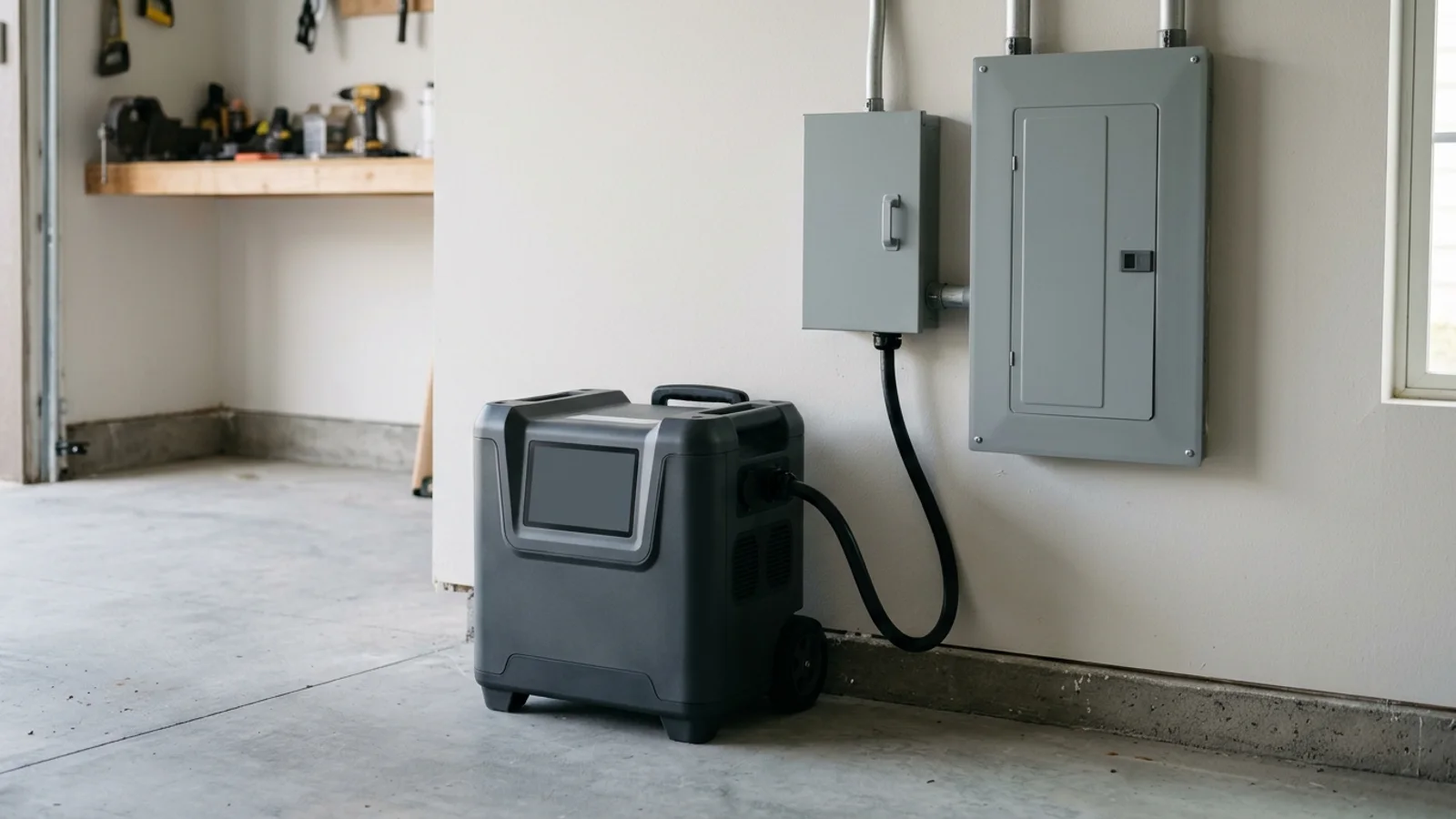
- Mechanical main-breaker interlock (
30 Aor50 ANEMA L14-30P/CS6375inlet): A stamped metal sliding plate bolted onto your main panel cover physically prevents the utility main breaker and the backfed240 Vgenerator breaker from closing at the same time. You flip off heavy non-essential breakers (range, EV charger, central AC) and turn on only the branch breakers your4 kWhstation can carry. - Listed
30 Amanual transfer switch (6to10dedicated circuits): Wires specific essential circuits (well pump, furnace blower, refrigerator, bedroom outlets) throughLINE / OFF / GENrocker switches inside a separate steel enclosure beside the main panel. If your portable power station uses a bonded neutral-ground architecture or triggersGFCInuisance faults on a shared panel neutral, ask your electrician whether your local Authority Having Jurisdiction (AHJ) requires a switched-neutral transfer panel rather than a solid-neutral switch.
Worked 4,096 Wh load budget: well pump surge vs. continuous draw
Most homeowners underestimate motor startup surge and overestimate how many hours 4,096 Wh covers when running heating blowers and well pumps together. Reference Franklin Electric’s AIM submersible motor manual for 230 V pump ratings rather than guessing from horsepower alone.
Consider a rural home backing up essential systems on a 4,096 Wh, 4,000 W continuous / 8,000 W surge 120/240 V split-phase LFP power station:
3/4 HP,230 Vsubmersible well pump: Typical Franklin Electric230 V3/4 HPsingle-phase ratings sit near8.0 Afull-load (~1,700 Wreal running power) with41.8 Alocked-rotor amps (LRA). Multiplying41.8 A × 230 Vgives9,614 VAof brief apparent inrush for under half a second (~4,800to5,500 Wreal starting watts at typical motor startup power factor), which clears inside an8,000 Winverter surge window. Running the pump15 minutes/dayto refill the pressure tank consumes1,700 W × 0.25 h = 425 Whnet (~500 Whfrom the battery at85%inverter efficiency).120 Vrefrigerator (140 Wrunning ×8 h/day):1,120 Whnet (1,318 Whbattery draw after15%inverter loss).120 Vgas furnace blower (400 Wrunning ×4 h/dayintermittent heating):1,600 Whnet (1,882 Whbattery draw).- Router and fiber ONT on direct
12 VDC (15 W × 24 h):360 Whbattery draw (zero AC inverter loss).
Adding those four essential loads gives 500 + 1,318 + 1,882 + 360 = 4,060 Wh/day—meaning a single 4,096 Wh split-phase station delivers roughly 20 to 24 hours of real water, heat, and refrigeration before needing solar (1,000 W to 2,600 W array) or a generator recharge. Model your exact furnace, well pump, and fridge duty cycles in our battery backup runtime calculator.
Single-unit 240 V vs. 120 V high-capacity stations
Choosing the wrong voltage tier either leaves your water well dead or forces you to haul a 113.5 lb wheeled chassis when you only needed 120 V cords:
| Specification | Single-unit 120/240 V split-phase (4 kWh class) | High-output 120 V single-phase (2 kWh class) |
|---|---|---|
| Native AC voltage | 120 V and 240 V (180° split-phase L14-30R) | 120 V / 60 Hz single-phase only (5-20R) |
| Typical stored capacity | 4,096 Wh (LiFePO4, expandable) | 2,042 Wh (LiFePO4, fixed) |
| Continuous / surge AC | 4,000 W continuous / 8,000 W peak | 2,200 W continuous / 4,400 W peak |
| 240 V submersible well pump | Yes (verify exact motor LRA vs 8 kW surge) | No (zero 240 V output) |
| MWBC panel inlet safety | Safe via listed L14-30 transfer switch/interlock | Unsafe on 240 V MWBC inlets; use 120 V cords or single-pole switch |
| Portability & weight | ~113.5 lb (wheeled luggage handle) | ~39.5 lb (one-person stair carry) |
For rural homes with 240 V well pumps or 240 V breaker-panel transfer switches, a single-unit 120/240 V station eliminates the clumsy dual-unit combiner boxes older systems required. Verify in the EcoFlow DELTA Pro 3 manual how its 120 V and 240 V outlet groups switch, since EcoFlow notes those two output groups cannot run simultaneously.
XL Upgrade · 4 kWh 120V/240V Station
EcoFlow DELTA Pro 3
- Continuous AC output
- 4,000 W
Why it fits Delivers native 120/240 V split-phase output at 4,000 W continuous and 8,000 W surge from a single 4,096 Wh LiFePO4 unit on wheels, with 2,600 W solar input and a 10 ms transfer mode.
Key trade-off Single-unit 240 V output is rated on the U.S. DELTA Pro 3; home-panel, transfer-switch, and 240 V circuit connections require qualified electrical work and verification against the exact U.S. manual.
Specifications & research
Single-unit 120/240 V split-phase hub. Source records checked on 2026-08-20. Manufacturer research, not hands-on testing.
- Nominal capacity
- 4,096 Wh · Source checked 2026-08-20
- Continuous AC output
- 4,000 W · Source checked 2026-08-20
- Base-unit weight
- 113.54 lb · Source checked 2026-08-20
Manufacturer documentation. Confirm the exact model, connections, and load requirements before buying.
By contrast, skip heavy 240 V hardware if you live on municipal city water, cook with natural gas or propane, and only need to keep a kitchen refrigerator, 120 V gas furnace fan, and Wi-Fi router running via direct indoor extension cords or a dedicated 120 V single-circuit transfer switch. A lighter 2 kWh 120 V station carries up basement stairs effortlessly and cuts hardware weight by nearly two-thirds.
Large · 2 kWh Extended Outage
Jackery Explorer 2000 v2
- Continuous AC output
- 2,200 W
Why it fits Provides 2,042 Wh LiFePO4 capacity and 2,200 W continuous 120 V AC output at just 39.46 lb for households on municipal water that do not have 240 V well pumps or split-phase panel inlets.
Key trade-off Solar input is limited to 400W combined; different wattage panels and simultaneous solar plus car charging are not supported by Jackery's support instructions.
Specifications & research
Lighter 120 V-only 2 kWh alternative. Source records checked on 2026-10-24. Manufacturer research, not hands-on testing.
- Nominal capacity
- 2,042 Wh · Source checked 2026-10-24
- Continuous AC output
- 2,200 W · Source checked 2026-10-24
- Base-unit weight
- 39.46 lb · Source checked 2026-10-24
Manufacturer documentation. Confirm the exact model, connections, and load requirements before buying.
Split-phase 240V electrician and panel checklist
Walk through these checks with a licensed electrician before purchasing transfer gear or a 240 V power station:
- Inspect your main breaker panel with the cover on for handle-tied two-pole
15 Aor20 Abreakers serving separate kitchen or living-area circuits, which signal shared-neutralMWBCwiring that forbids120 Vhot-bridging adapters. - Read the well-pump control box or pressure-switch nameplate for horsepower (
HP), voltage (230 Vvs115 V), full-load amps (FLA), and locked-rotor amps (LRA), then confirm your chosen inverter’s surge curve clears startup current without tripping overload protection. - Select a listed
30 ANEMA L14-30Poutdoor/indoor power inlet paired with either a mechanical main-breaker interlock or a dedicated manual transfer switch, and confirm whether your station’s neutral-ground bonding requires a switched-neutral transfer panel. - Label the panel directory with exact breaker numbers allowed during battery backup so nobody flips on a
4,500 Welectric water heater or240 Vrange during an outage. - Test a live simulated outage transfer under load (well pump cycling while refrigerator runs) for at least
20 minutesin clear weather rather than discovering an overload trip during a storm.
Limits: central HVAC, electric water heaters, and cold-weather derating
Even a 4,096 Wh split-phase station with 8,000 W surge is a selective essential-loads backup system, not an unlimited whole-house utility replacement. Traditional 3-ton to 5-ton 240 V central air conditioners and heat-pump compressors draw 60 A to 110 A locked-rotor inrush (14,000 VA to 26,000 VA) unless fitted with an electronic soft-start kit, and a standard 4,500 W electric resistance water heater drains a 4 kWh battery in under 50 minutes. Keep those two-pole breakers switched off during outages, and store your LFP station inside conditioned space above 32 °F (0 °C) so winter charging from solar or a backup generator is never locked out by the battery management system.