In this guide Jump to a section
- Carbon monoxide and fuel-storage stop boundaries
- Core engineering comparison: inverter generator vs. LFP power station vs. hybrid
- Why the daytime-recharge hybrid cuts 72-hour fuel burn
- Choosing your generator fuel and power station pairing
- Pre-purchase generator and power station checklist
- Limits where battery-only or generator-only wins
Running a quiet 3,500 W inverter generator all night just to keep a 140 W kitchen refrigerator and a 35 W CPAP machine alive burns gallons of scarce fuel at terrible thermal efficiency. On the other hand, buying a 2 kWh portable power station with no way to refill it during a three-day winter cloud bank leaves your food warming above 40 °F (4 °C) on the second morning.
Choosing between a fuel generator and a battery station starts with your outdoor space and outage length. This guide compares continuous inverter generators, standalone LiFePO4 (LFP) power stations, and the Daytime-Recharge Hybrid Architecture across 72-hour fuel burn and carbon monoxide safety. If your primary question is sub-20-millisecond switching for desktop workstations rather than multi-day fuel economy, review our UPS vs. power station transfer-time guide first; for engine maintenance and model shortlists, see our portable generator buyer’s guide.
Carbon monoxide and fuel-storage stop boundaries
Combustion generators kill quietly when exhaust drifts into living spaces. Per Ready.gov power outage guidance and NFPA carbon monoxide safety standards, every portable fuel generator must run strictly outdoors, at least 20 feet (6.1 meters) away from windows, doors, soffit vents, crawlspace openings, and attached garages, with the exhaust pipe pointed away from your home and neighboring structures.
Skip combustion generators completely if you live in an apartment, high-rise, or townhome without an open yard at least 20 feet from every neighbor’s window. Never run an engine on a covered balcony, inside a screened porch, or inside an open garage door, because EPA indoor air quality tracking shows odorless carbon monoxide builds to fatal concentrations within minutes even when doors are cracked. Place battery-backed CO alarms on every floor inside the home before starting any engine outdoors.
Core engineering comparison: inverter generator vs. LFP power station vs. hybrid
Each architecture solves a different physical constraint during a grid outage:
| Architecture | Fuel or cell source | Continuous AC output | Noise in living space | Overnight refueling or CO risk | Typical 72-hour readiness |
|---|---|---|---|---|---|
| Enclosed inverter generator | Gasoline or 20 lb propane (LPG) | 1,800 W to 3,500 W (< 3% THD) | 48 to 61 dBA outdoors | High if left running while sleeping | Unlimited while fuel cans last |
| 1–2 kWh LFP power station | LiFePO4 cells (3,000+ cycles) | 1,800 W to 2,400 W (120 V) | 0 dBA (fan only under heavy load) | Zero exhaust; zero fuel storage | 18 to 24 hours without solar/recharge |
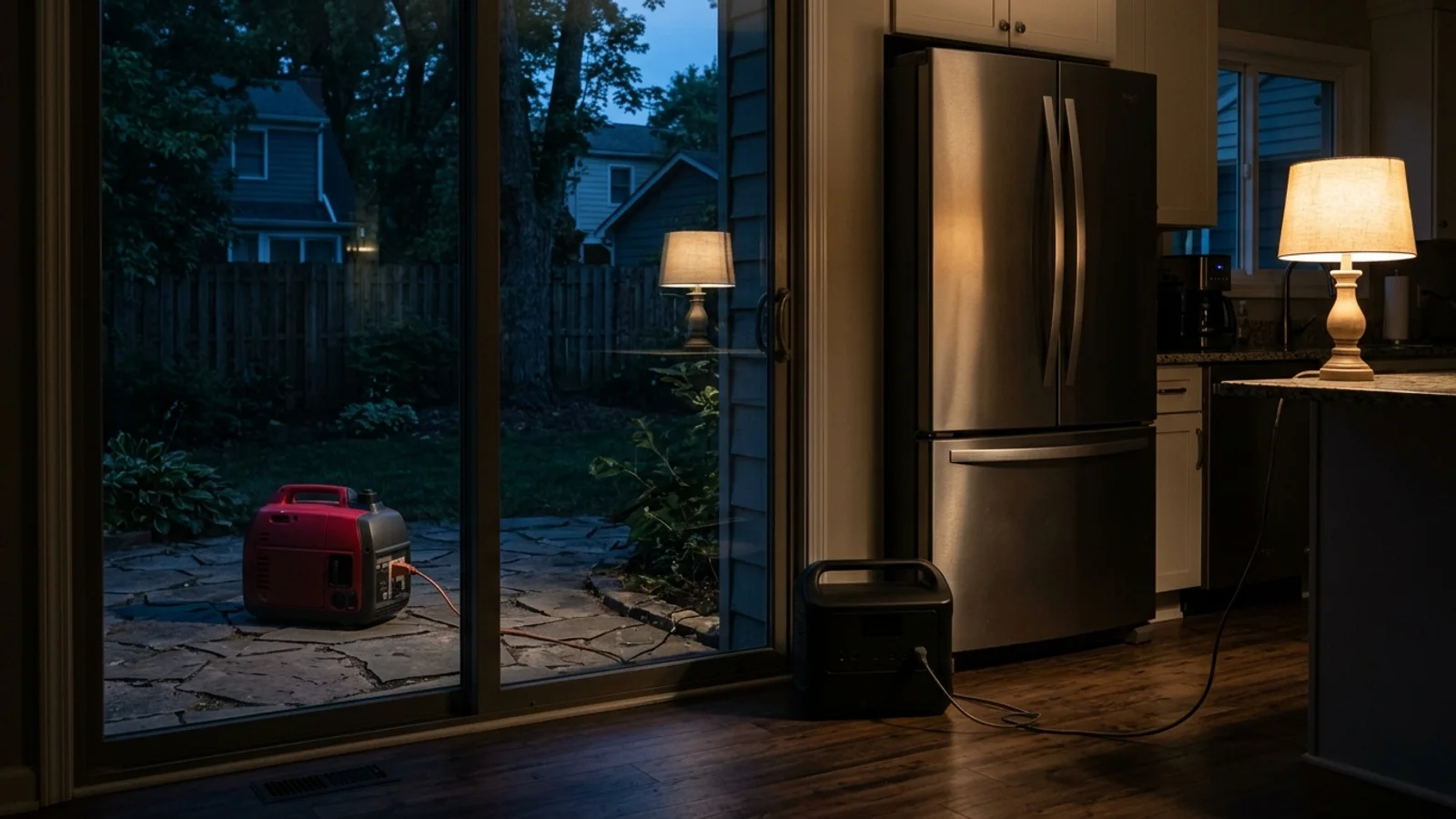
| Daytime-recharge hybrid | Small generator + 2 kWh LFP station | 2,400 W indoor AC + 12 V DC | 0 dBA for 22 hours/day | Zero overnight engine run or CO drift | 72+ hours on ~2.4 gal gas or one 20 lb tank |
Swipe across the drawing or focus it and use the arrow keys.
Why the daytime-recharge hybrid cuts 72-hour fuel burn
Small gasoline and propane engines suffer severe parasitic losses when idling under tiny household loads. A 3,150 W to 3,500 W inverter generator spends fixed mechanical energy overcoming piston ring friction, cooling-fan drag, and alternator excitation just to stay spinning. Feeding a 140 W refrigerator compressor (which cycles off completely for two-thirds of every hour) plus a 15 W fiber ONT/router loads that engine to under 7% of rated capacity.
Charging an LFP power station reverses that curve. Modern 2 kWh LFP stations pull 1,600 W to 1,800 W straight into their internal AC rectifiers, pushing a 3,150 W propane generator into its 50% to 60% thermal sweet spot where specific fuel consumption per kilowatt-hour drops sharply.
Worked 72-hour energy and fuel example
Suppose a household backs up three critical loads across a 72-hour outage in a 70 °F (21 °C) home:
- Kitchen refrigerator (
140 Wrunning,8 hours/daycompressor cycle):140 W × 8 h = 1,120 Wh/daynet. Divided by an85%AC inverter efficiency factor, battery draw equals1,120 ÷ 0.85 = 1,318 Wh/day. - Fiber ONT and Wi-Fi router on direct
12 VDC (15 W × 24 h):360 Wh/daywith zero AC inverter conversion loss. - CPAP machine with heated humidifier switched off on DC (
35 W × 8 h):280 Wh/day. - Total daily battery budget:
1,318 + 360 + 280 = 1,958 Wh/day(5,874 Whacross72 hours).
Now compare how the three backup setups handle that exact 5,874 Wh 72-hour load:
| 72-hour backup setup | Operating schedule | Fuel or recharge demand | Primary operational tradeoff |
|---|---|---|---|
| Continuous inverter generator | 72 hours straight in Eco idle | 16 to 20 gal gasoline or 90 to 110 lb propane (~5 20 lb tanks) | Overnight CO drift risk, outdoor noise, and dark refueling |
Standalone 2,048 Wh LFP station | Continuous until empty (~22 h) | 0 fuel (dead on Day 2 without 600 W+ clear sun) | Needs large solar array or grid return before Day 2 |
| Hybrid daytime recharge | 2 h/day engine charge + 22 h/day battery | 2.1 to 2.4 gal gasoline or 1 20 lb (9.1 kg) propane tank | 75% to 85% lower fuel burn; zero overnight engine run |
You cut fuel consumption by roughly 75% to 85%, avoid storing dozens of volatile gas cans in a shed, and sleep in silent darkness with zero combustion fumes near the bedroom. Test your own refrigerator, freezer, and medical runtime figures in our generator runtime and fuel calculator before buying fuel cans.
For households building the indoor half of this hybrid setup, a 2,048 Wh LiFePO4 station with 1,800 W AC charging refills from near-empty back to 80% in roughly 43 minutes on a single afternoon generator session and covers 2,400 W continuous AC loads indoors.
EcoFlow DELTA 2 Max Portable Power Station
- Continuous AC output
- 2,400 W
Why it fits Pairs 2,048 Wh LiFePO4 storage and 2,400 W continuous AC output with 1,800 W AC input (0% to 80% in 43 minutes) and up to 1,000 W solar input, letting a two-hour afternoon generator run cover overnight indoor loads silently.
Key trade-off Unlike the Anker SOLIX F2000 or Jackery 2000 Plus, the DELTA 2 Max has no built-in luggage wheels and lacks a 30-amp TT-30 RV outlet (capped at 20A/2,400W per standard duplex outlet).
Specifications & research
2 kWh fast-charging LFP anchor. Source records checked on 2026-11-16. Manufacturer research, not hands-on testing.
- Nominal capacity
- 2,048 Wh · Source checked 2026-11-16
- Continuous AC output
- 2,400 W · Source checked 2026-11-16
- Base-unit weight
- 50.7 lb · Source checked 2026-11-16
Manufacturer documentation. Confirm the exact model, connections, and load requirements before buying.
Choosing your generator fuel and power station pairing
Not every inverter generator matches every power station charger cleanly. Small 1,800 W continuous suitcase units such as the Honda EU2200i (48 to 57 dBA, 47.4 lb, 0.95 gal gas tank) lift easily with one hand and run quietly in tight suburban driveways, yet they trip their 15 A (1,800 W) overload breaker if you plug in a power station set to maximum 1,800 W AC charging alongside another load. Before plugging in, lower the power station’s AC charging limit in its app or front menu to 1,000 W or 1,200 W so the small generator keeps steady voltage and frequency headroom.
Gasoline also degrades in plastic cans within 3 to 6 months unless treated with fuel stabilizer, whereas sealed propane (LPG) cylinders store indefinitely without gumming carburetors. Stepping up to a 3,150 W propane / 3,500 W gasoline dual-fuel inverter generator gives you full 1,800 W battery charging headroom on clean-burning 20 lb grill tanks plus electric push-button starting in freezing weather. Note that Honda EU2200i is gasoline-only from the factory and relies on manual recoil starting.
Champion 4500W Dual Fuel Inverter Generator
- Running watts
- 3,500W (Gasoline) / 3,150W (Propane)
Why it fits Supplies 3,150 W continuous on shelf-stable propane (3,500 W on gasoline) with under 3% THD clean sine wave and electric start, giving a 2 kWh LFP station full 1,800 W fast-charging headroom without tripping a 15 A breaker.
Key trade-off Never run a generator indoors, in a garage, or near open windows/vents; carbon monoxide from exhaust is fatal within minutes. Maintain at least 20 feet clearance from the home.
Specifications & research
Dual-fuel daytime recharge engine. Source records checked on 2026-11-04. Manufacturer research, not hands-on testing.
- Starting watts
- 4,500W (Gasoline) / 4,500W (Propane) · Source checked 2026-11-04
- Running watts
- 3,500W (Gasoline) / 3,150W (Propane) · Source checked 2026-11-04
- Start type
- Electric and manual recoil start · Source checked 2026-11-04
Manufacturer documentation. Confirm exact Champion Power Equipment model specifications and household safety limits before buying.
Pre-purchase generator and power station checklist
Complete these checks before ordering a generator, battery station, or extension cord:
- Measure a flat, uncovered outdoor pad at least 20 feet (6.1 meters) from every window, door, dryer vent, and neighbor’s wall opening; cancel any combustion generator purchase if your property lacks that clearance.
- Read the exact refrigerator and medical-device nameplates inside your home and confirm the power station’s continuous watts cover combined running loads plus compressor startup surge.
- Verify the power station supports adjustable AC input wattage (
400 Wto1,800 W) so a1,800 Wsuitcase generator or15 Acircuit does not overload during recharge. - Pair any outdoor generator with a 12 AWG or 10 AWG outdoor-rated (
SJTW/STW) cord long enough to clear the 20-foot zone without excessive voltage drop, plus a grounding/neutral plug check if your power station requires bonded neutral sensing to accept AC charge. - Install working battery-backed carbon monoxide alarms on every sleeping level and near the exterior entry door closest to the outdoor generator pad.
Limits where battery-only or generator-only wins
Three household constraints break the hybrid recommendation. High-rise apartments and tight zero-lot townhomes should skip combustion engines completely; pair a 2 kWh LFP station with folding 220 W to 400 W portable solar panels angled through an unobstructed south-facing window or balcony rail, and trim non-essential AC inverter loads so the battery covers 36 to 48 hours between sunny afternoons.
Homes relying on 240 V deep-well submersible pumps or multi-ton central HVAC cannot use standard 120 V portable power stations or 120 V suitcase generators to energize two-pole breakers; those properties require a 120/240 V split-phase transfer setup. Finally, lithium iron phosphate cells safely discharge down to roughly -4 °F (-20 °C), yet their internal Battery Management System (BMS) locks out charging below 32 °F (0 °C) to prevent permanent lithium plating, so keep your LFP station inside heated living space before running any winter recharge cycle.