Water Storage Safety: Sanitize, Label, Rotate, and Use
Follow current CDC steps to clean and sanitize emergency water containers, label and rotate self-filled water, avoid recontamination, and respond to advisories.
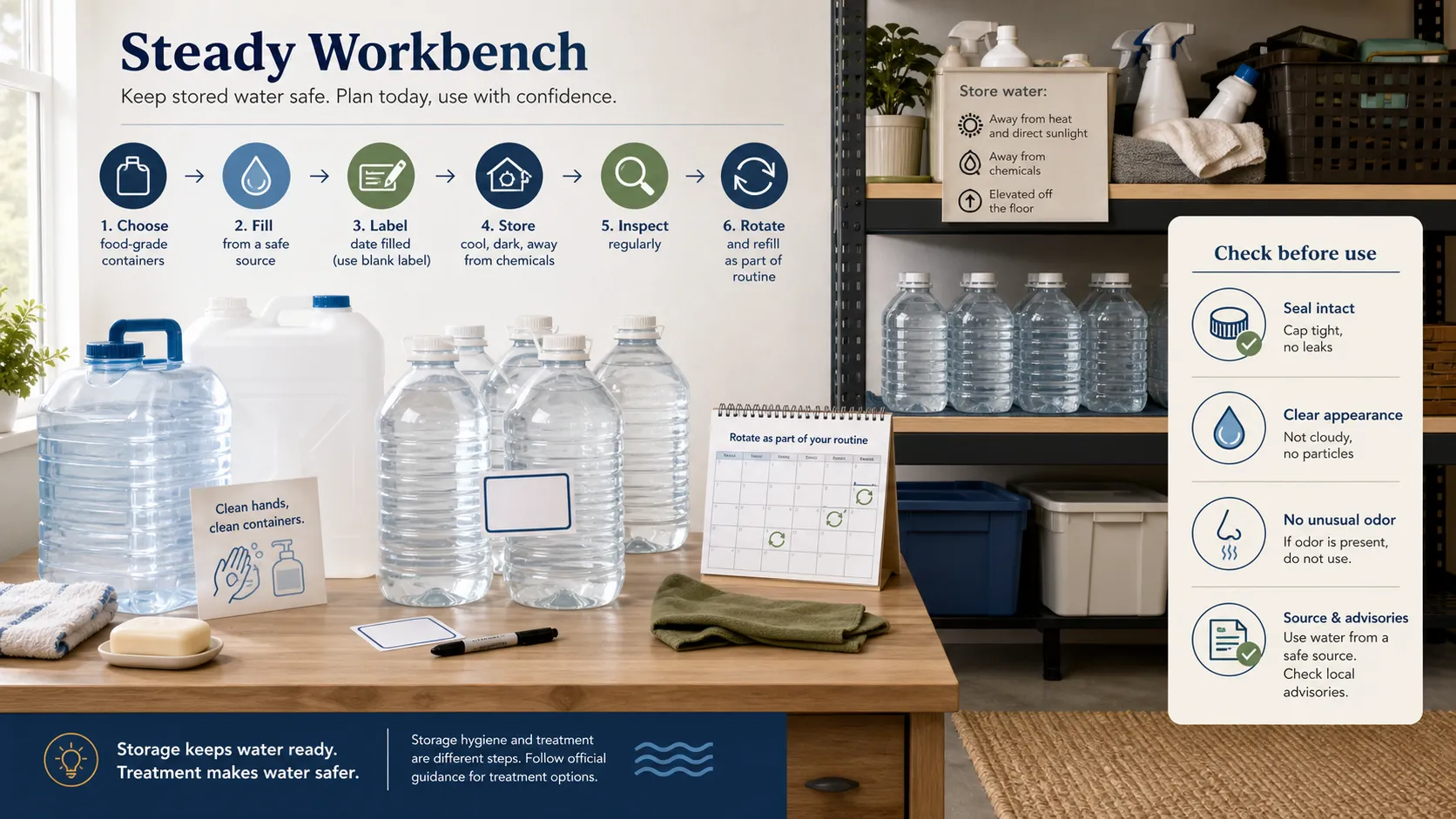
In this guideJump to a section
- Start with the safest source
- Clean and sanitize the empty container
- Label every container
- Store self-filled water correctly
- Prevent contamination during use
- Know when storage water is questionable
- If the water source becomes unsafe
- Build a six-month maintenance routine
- Primary safety sources
- Your next step
Interactive checklist
Stored-water safety check
0 of 4 complete. Progress stays in this browser and also appears in My Plan.
Safe emergency water depends on three separate tasks: starting with safe water, sanitizing the container, and preventing recontamination during storage and use. Container sanitation is not the same as treating questionable water. Keep the procedures separate and follow current public-health instructions for the exact situation.
Use the water storage calculator to determine quantity and the water storage container guide to select a suitable container. The CDC recommends at least one gallon per person per day for three days and suggests trying for a two-week supply when possible.
Start with the safest source
CDC identifies unopened commercially bottled water as the safest and most reliable emergency source. Observe its expiration date and protect the package according to the producer’s storage directions.
For water filled at home, use water from a known safe source and a suitable container. Do not use a container that held bleach, pesticides, petroleum products, or another toxic chemical. If authorities say the tap water is unsafe, follow the current advisory rather than filling or using the stored supply as though nothing changed.
Clean and sanitize the empty container
The following is the CDC process for emergency water storage containers. It sanitizes the empty container. It is not the formula for disinfecting drinking water.
- Wash the container with soap and rinse completely with water.
- Make a sanitizing solution with 1 teaspoon of unscented liquid household chlorine bleach in 1 quart, or 4 cups, of water. CDC specifies bleach containing 5% to 9% sodium hypochlorite.
- Close the container and shake it so the solution touches every inside surface.
- Wait at least 30 seconds, then pour the sanitizing solution out.
- Let the empty container air-dry before use.
- Fill it with clean water and close it with a tight lid.
Use the current CDC page each time because product formulations and public-health guidance can change. Never mix bleach with ammonia, acids, or other cleaners. Follow the bleach label for handling, ventilation, protective equipment, and storage.
If a container or dispenser manufacturer provides additional cleaning limits, follow them too. Replace equipment that cannot be cleaned, is cracked, has a damaged seal, or retains contamination.
Label every container
CDC says to label the container “drinking water” and include the storage date. Also record enough information to manage the supply:
- source of the water
- date filled or commercial expiration date
- container capacity
- next replacement or review date
- location on the household inventory
Use a label that remains readable in a damp environment. Do not store drinking water in an unmarked container that could be confused with cleaning water, fuel, or another liquid.
Store self-filled water correctly
CDC advises keeping self-filled containers:
- in a cool place, with current guidance specifying 50°F to 70°F
- away from direct sunlight
- away from toxic substances such as gasoline and pesticides
Inspect the area for leaks, flood exposure, pests, puncture risks, and a safe load-bearing surface. Water is heavy. Do not put a large container on weak shelving or where a leak could block an exit or reach electrical equipment.
Replace self-filled water every six months under current CDC guidance. Follow the labeled expiration date for store-bought water. When rotating, do not automatically assume old water is suitable for drinking or food preparation. Inspect the package and follow public-health guidance for use or disposal.
Prevent contamination during use
Opening the container begins a new handling period. Protect the cap, neck, spigot, pump, and any scoop from hands, floors, dirty counters, and standing water.
CDC advises using a clean scoop or device every time when one is needed. Do not touch the water or inside surfaces with your hands, and do not scoop with your hands. A narrow opening or protected dispenser helps limit contact.
Use stored safe water for drinking, cooking, brushing teeth, food preparation, handwashing, ice, and infant formula whenever officials say tap water is unsafe for those uses. Follow infant formula package directions exactly and use current CDC infant feeding emergency guidance.
Do not pour unused water from a cup or pot back into the storage container. Keep one clean vessel for dispensing and a separate vessel for washing or waste water.
Know when storage water is questionable
Do not use stored water when:
- the container leaked, cracked, lost its closure, or was submerged in floodwater
- it was stored beside a spilled toxic chemical or has a fuel or chemical odor
- hands, dirty tools, animals, or floodwater entered the container
- the source was under an advisory when the container was filled
- the label or history is missing and safety cannot be established
Water contaminated with fuel, toxic chemicals, or radioactive material cannot be made safe by boiling or disinfecting. The CDC says to use bottled water or a different source and contact the health department.
If the water source becomes unsafe
Follow the local health department or water utility advisory first. Different events can require different actions, and a boil-water notice does not address chemical contamination.
When safe bottled water is unavailable and the concern is germs, CDC says boiling is the best way to kill germs:
- If water is cloudy, filter it through a clean cloth, paper towel, or coffee filter, or let it settle and draw off the clear water.
- Bring clear water to a rolling boil for 1 minute. At elevations above 6,500 feet, boil for 3 minutes.
- Cool it and store it in clean, sanitized containers with tight covers.
For chemical disinfection, use the current CDC emergency water treatment page and the bleach label. CDC’s amount depends on bleach concentration, water volume, and whether the water is cloudy, colored, or very cold. Do not reuse the container-sanitizing formula as a drinking-water treatment formula.
Portable filters do not remove every germ or chemical. Follow the filter instructions and CDC guidance for any additional disinfection step. No household filter should be assumed to make chemically contaminated water safe.
Build a six-month maintenance routine
Put one recurring date on the household calendar:
- Inspect commercial packages, self-filled containers, caps, seals, and dispensers.
- Confirm labels remain readable and inventory quantities are correct.
- Check the storage space for heat, sunlight, leaks, pests, and chemicals.
- Replace self-filled water according to the six-month schedule.
- Clean and sanitize empty containers using the current CDC steps.
- Refill from a safe source, relabel, and test dispensing without hand contact.
Use the same review to confirm that cooking water matches the two-week emergency menu and every planned package direction.
Primary safety sources
- CDC: How to Create an Emergency Water Supply
- CDC: How to Make Water Safe in an Emergency
- CDC: Safe Water Storage
Your next step
Complete the storage and rotation fields in the Household Water Plan Worksheet, then set one six-month reminder that names the containers to inspect and the CDC source to recheck before using bleach or another treatment.