How Much Emergency Water for a Family of 4? 12–56 Gallons
A family of four needs 12 gallons for 3 days or 56 gallons for 2 weeks before added needs. Plan container counts, weight, reserves, and refills.
The goal of a water calculation is not to produce one impressive number. It is to create a supply your household can store, lift, reach, dispense, and maintain.
The CDC emergency water supply guide provides the planning baseline used here. It recommends at least 1 gallon per person per day for 3 days and says to try to store a 2-week supply if possible.
The baseline formula
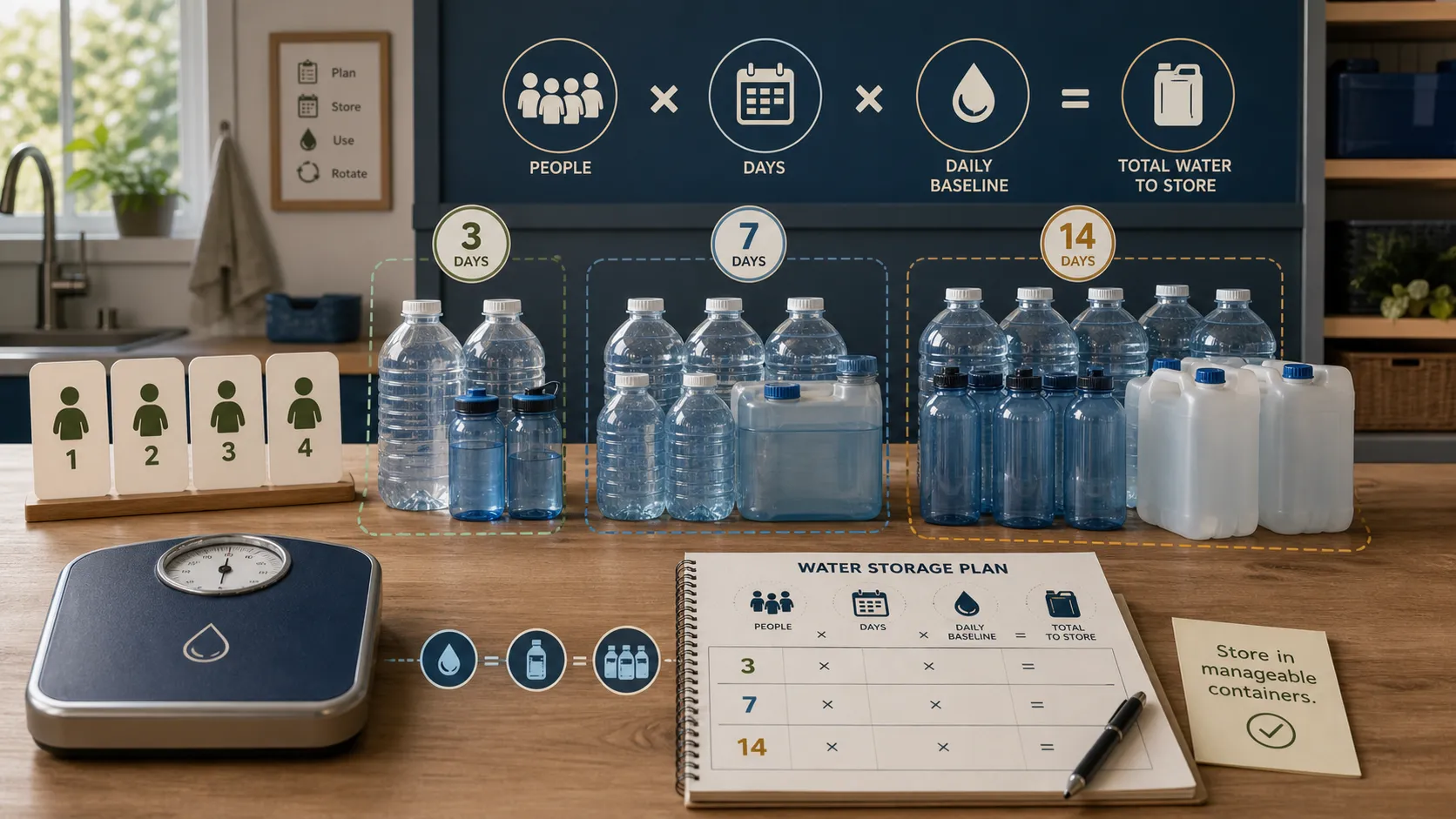
people × days × 1 gallon = baseline gallons
For a household of four:
- 4 people × 3 days × 1 gallon = 12 gallons
- 4 people × 7 days × 1 gallon = 28 gallons
- 4 people × 14 days × 1 gallon = 56 gallons
The gallon baseline supports drinking, cooking, brushing teeth, and other essential uses. It is not just a drinking-water allowance.
Keep the baseline and optional reserve visible as separate parts of the result.
Choose a duration
Minimum starting point: 3 days
Three days is the CDC minimum and a useful first milestone for households with limited space or budget. It covers short interruptions and gives you a concrete system to test.
Stronger target: 2 weeks
The CDC says to try to store a 2-week supply if possible. Build toward that target in stages if 14 days cannot be stored at once.
| Duration | One person | Two people | Four people | Six people |
|---|---|---|---|---|
| 3 days | 3 gal | 6 gal | 12 gal | 18 gal |
| 7 days | 7 gal | 14 gal | 28 gal | 42 gal |
| 14 days | 14 gal | 28 gal | 56 gal | 84 gal |
| 30 days | 30 gal | 60 gal | 120 gal | 180 gal |
These are baseline quantities. The 30-day row is an arithmetic extension of the one-gallon-per-person-per-day baseline, not a CDC-stated target; CDC recommends a 3-day supply and says to try for 2 weeks if possible. Round container counts up so usable capacity meets or exceeds the target. Thirty days for four people is 120 gallons, weighing about 1,001 pounds as water alone before containers. Check floor capacity, access, and a safe refill plan before treating a long-duration amount as stored supply. Use the calculator’s custom duration to estimate another household size or time window.
How long 55 gallons lasts a household of four
At the CDC planning baseline, four people use 4 gallons per day. A 55-gallon supply therefore covers 13 full days, with 3 gallons remaining for day 14. It falls 1 gallon short of the 56-gallon two-week baseline.
That example assumes no added water for pets, hot weather, illness, medical equipment, or meals that require extra preparation water. It also assumes all 55 gallons remain usable. Keep a smaller portable reserve so one leak, contaminated dispenser, or inaccessible drum does not remove the whole supply.
Add household-specific reserves
The CDC advises considering more water for pregnant people, people who are sick, pets, and hot climates. Other household realities can also change the plan.
Review these questions:
- Does anyone have a medical condition that changes hydration or hygiene needs?
- Does anyone use powdered medication, formula, tube feeding, or medical equipment that requires water?
- Are there infants, pregnant people, older adults, or people who may need caregiver support?
- How much water do current pet-care instructions require?
- Will hot weather increase drinking needs?
- Will shelf-stable foods require cooking water?
- Does the household need an accessible container size or dispensing method?
Do not use a generic percentage as a substitute for medical instructions. Record known clinical and pet needs separately, then add them to the baseline.
The calculator keeps pet water separate from the human baseline. Enter a daily amount based on the animal’s known use or veterinary guidance; simply indicating that you have a pet does not add gallons. Account separately for food preparation, medication, cleaning, heat, activity, and any veterinarian-directed needs.
Convert gallons into containers
Use this formula for each container size:
target gallons ÷ usable container capacity = containers needed, rounded up
For a 56-gallon baseline:
| Container size | Rounded-up count | Handling note |
|---|---|---|
| 1 gallon | 56 | Easy to lift, more units to rotate |
| 2.5 gallons | 23 | Moderate lift, useful for shelves |
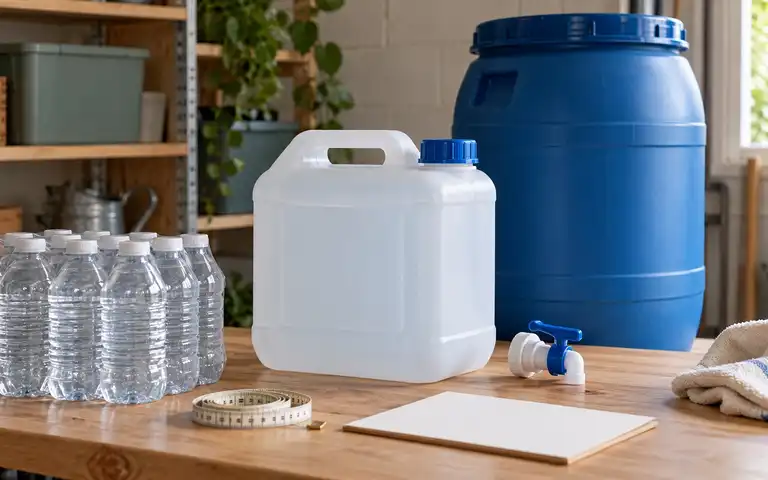
| 5 gallons | 12 | About 42 pounds of water, plus container and fittings |
| 7 gallons | 8 | About 58 pounds of water, plus container and fittings |
A mixed system often works better than one container size. Smaller containers support daily use and evacuation. A larger stationary container can add capacity if the floor, location, pump, and refill process are suitable.
Plan around full weight
The USGS approximation is 8.34 pounds per US gallon of water (checked September 30, 2026). The table’s weights are for water alone; add the container and fittings. Temperature and actual fill volume can change the weight. These estimates do not establish a safe lift or approve a shelf or floor load. Place large containers before filling them. Do not stack containers unless the manufacturer says they are designed for that load and configuration.
Choose and place containers
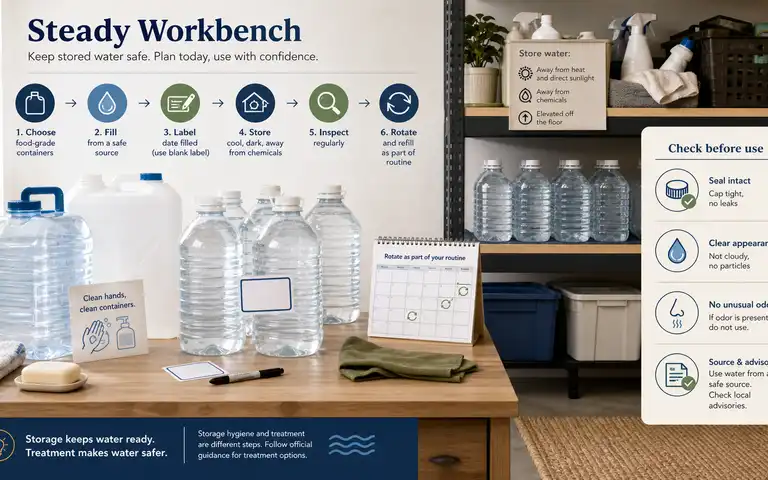
The CDC recommends FDA-approved food-grade water storage containers when filling your own supply. Contact the manufacturer if the food-grade status is unclear.
Avoid containers that previously held toxic chemicals. Follow the manufacturer’s cleaning, sanitizing, filling, stacking, temperature, and dispensing instructions.
A practical location is:
- Cool and away from direct sunlight.
- Away from gasoline, pesticides, cleaners, and other chemicals.
- Protected from flooding, freezing, pests, and impact.
- Accessible without moving unsafe loads.
- Distributed enough that one leak or damaged room does not destroy the entire supply.
For help choosing containers by opening, dispensing method, and placement, read the Water Storage Container Guide.
Keep the correct cap, wrench, spigot, or pump with the container. A sealed supply is not useful if nobody can dispense it safely.
Separate storage from treatment
This guide explains the stored-water quantity. It does not provide one treatment formula for well water, rainwater, rivers, lakes, or floodwater because those sources can contain different germs and chemicals.
During an emergency:
- Use unopened bottled or safely stored water first.
- Follow the utility or health department advisory.
- Use the CDC’s current emergency water treatment instructions only when the method matches the known problem.
- Do not use water suspected of fuel or toxic chemical contamination.
Read the Emergency Water Safety Guide and Water Treatment Methods before planning a backup source.
Label, rotate, and inspect
For self-filled containers, the CDC recommends replacing the water every 6 months. Follow the step-by-step CDC container sanitizing and bleach procedures in our water storage safety guide before refilling. For unopened commercial water, observe the expiration date on the container.
Label each unit with:
- Fill or purchase date.
- Planned replacement or label date.
- Source, if self-filled.
- Container capacity.
- Any handling or dispensing instructions.
Inspect the storage area for leaks, damaged caps, bulging, cracks, pests, chemical exposure, or unsafe shelving. Do not taste questionable water to decide whether it is safe.
Build the supply and a refill path in stages
If 2 weeks is not practical today:
- Store 1 day of water in sizes everyone can use.
- Expand to the 3-day minimum.
- Test access and dispensing for one day.
- Add one additional week.
- Work toward 2 weeks while preserving safe placement and access.
Progress is useful only when the containers remain maintained. A smaller current supply is safer than a larger forgotten one.
Then write down where the next safe water would come from if the outage outlasts the stored supply. The answer may be an official distribution site, a known-safe backup location, or a utility restoration plan. Record how you would learn that the source is open and safe, which containers can travel, and who can carry them. Do not count a creek, pool, rain barrel, or uncertain well as potable refill capacity.
Emergency water quantity FAQ
- How much emergency water does a household of four need?
- The CDC baseline is 12 gallons for 3 days or 56 gallons for 2 weeks. Add separately for pets, pregnancy, illness, hot weather, and other known household needs.
- Is one gallon per person per day only for drinking?
- No. The CDC describes the supply as supporting drinking, cooking, brushing teeth, and other uses. Additional household or medical needs may require more.
- How often should self-filled emergency water be replaced?
- The CDC recommends replacing water filled into your own storage containers every 6 months. Follow the label date for unopened commercial water.
- Can I treat any source and store it for years?
- Do not assume that. Source hazards differ, and fuel or toxic chemicals cannot be made safe by household boiling or disinfection. Store safe water first and follow local health guidance during an incident.
Official Sources
- CDC: How to Create an Emergency Water Supply
- CDC: How to Make Water Safe in an Emergency
- CDC: How to Find Clean Water in an Emergency
Your next step
Use the calculator above to get your baseline figures, then record the result in the Household Water Plan Worksheet. Keep container sizes, full weight, storage locations, added reserves, rotation, and refill contacts together.