In this guideJump to a section
- Start with stored water
- Read the advisory before choosing a method
- Treat germs with an approved method
- Match certification to the contaminant
- Decide whether the source requires testing, treatment, or a safer substitute
- Source-specific boundaries
- Build a maintainable household system
- Emergency water decision checklist
- Follow through on your water source
- Store the first layer before choosing treatment
- Official sources
INFO
Copy each advisory into a one-page decision card: issuing authority, time checked, affected source or address, named hazard, prohibited uses, approved alternative or treatment, and the condition that ends the advisory. If the hazard is unknown, use another safe source instead of choosing a generic filter.
Water planning becomes safer when it starts with the source and the official advisory, not with a favorite filter. A boil-water advisory, a flooded well, a chemical spill, and a routine service interruption are different problems. They should not share one improvised treatment recipe.
The safest household sequence is simple:
- Store a usable supply of safe water now.
- Listen to the water utility, health department, or emergency officials during an incident.
- Use bottled or stored water when directed.
- Treat water only when the known problem can be addressed by an approved method.
- Test private or uncertain sources when health officials recommend it.
Toxic contamination is a stop sign
The CDC says water contaminated with fuel or toxic chemicals cannot be made safe by boiling or disinfection. A household filter should not be assumed to fix an unknown chemical spill. Use another safe source and follow official instructions.
Start with stored water
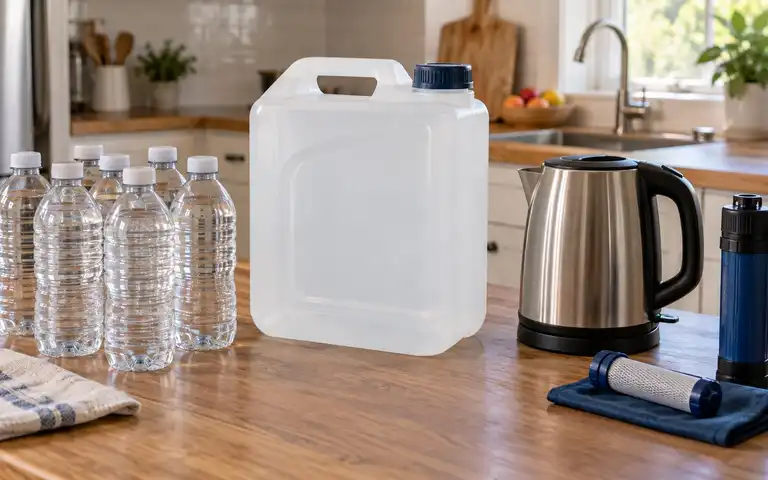
The CDC emergency water supply guide recommends at least 1 gallon per person per day for 3 days and says to try to store a 2-week supply if possible. That water supports drinking, cooking, brushing teeth, and other essential uses.
Turn that baseline into a household plan. Add capacity for pets, pregnancy, illness, hot weather, and other needs identified by the CDC, but keep the baseline and additional reserve visible as separate numbers.
Store unopened commercial water according to its label. For water filled into your own food-grade containers, the CDC recommends replacing it every 6 months.
Read the advisory before choosing a method
| Situation | First action | What not to assume |
|---|---|---|
| Water service interruption | Use stored or bottled water | A filter cannot produce water when no source is available |
| Boil-water advisory | Follow the utility’s exact instructions | A taste-and-odor filter is not a substitute for boiling |
| Do-not-drink or do-not-use advisory | Use another source and follow officials | Boiling may not address the contaminant |
| Flooded private well | Use another safe source until the well is assessed, disinfected, and tested | Clear water is not proof of safety |
| Suspected fuel or toxic chemicals | Do not drink or bathe in the water | Home boiling, disinfection, and routine filters are not a remedy |
| Known routine contaminant | Match a current certified treatment claim to that contaminant | A standard number alone does not mean every contaminant is reduced |
Advisory wording matters. A local utility may issue instructions for drinking, cooking, ice, brushing teeth, infant formula, pet water, or bathing. Follow those instructions even when they differ from a general preparedness checklist.
Treat germs with an approved method
The CDC’s Making Water Safe in an Emergency page gives current steps for boiling, disinfecting, and filtering when bottled water is unavailable.
Boiling
For water that may contain germs, the CDC recommends bringing clear water to a rolling boil for 1 minute. Above 6,500 feet, boil for 3 minutes. Let it cool naturally and store it in clean, sanitized containers with tight covers.
Boiling does not remove fuel, toxic chemicals, salts, or many dissolved contaminants. If officials suspect chemical contamination, use another source.
Chemical disinfection
Household bleach concentration varies. Follow the product label for drinking-water disinfection or use the current CDC concentration table. The CDC page distinguishes common 5% to 9% sodium hypochlorite products from 1% products and gives different quantities for clear and cloudy water.
Do not use scented, color-safe, or splashless bleach. Do not invent a stronger dose. Chemical disinfectants kill many germs, but they do not work equally well against every parasite. Follow the package directions for chlorine dioxide, chlorine, or iodine products.
Filtration
Portable filters have different pore sizes and performance claims. Many remove parasites, some are rated for bacteria, and many do not remove viruses or dissolved chemicals. Read the label and current certification rather than relying on the words “purifier,” “advanced,” or “military grade.”
Filtered water may still need boiling or disinfection. Follow the filter instructions and the local advisory.
Match certification to the contaminant
NSF explains that its standard numbers are not rankings. A product certified to a standard may be certified for selected claims, not every contaminant covered by the standard.
Use this verification sequence before buying or relying on a device:
- Identify the contaminant from a utility report, advisory, or qualified laboratory result.
- Find the exact model in the certification body’s current listing.
- Confirm that the listing names the contaminant reduction you need.
- Check rated capacity, flow, replacement interval, and operating conditions.
- Keep the instructions and replacement record with the device.
The NSF home water treatment guide explains how to read standards and contaminant claims. The NSF standards guide also explains common standards and their limits.
Decide whether the source requires testing, treatment, or a safer substitute
Testing is useful when it answers a specific question. It is not a ritual that turns an uncertain source into safe water.
Public water
Start with the utility’s Consumer Confidence Report and current notices. Contact the utility or health department when the report is unclear or when an emergency changes the source or treatment process.
Private wells
Private well owners are responsible for water safety. The CDC advises contacting the health department about testing and maintenance. After flooding or emergency disinfection, use another safe source until the well has been handled and tested according to local guidance. See the CDC’s well water testing guidelines and post-emergency well disinfection steps.
Home test strips
Consumer strips may help with narrow maintenance checks, but they are not a substitute for a qualified laboratory when decisions involve bacteria, PFAS, lead, or other health concerns. Ask the health department which analytes, sampling method, and laboratory are appropriate.
Source-specific boundaries
Rainwater
Collected rainwater is not automatically drinking water. Roof material, debris, animals, smoke, storage, and local rules all matter. Keep it separate from treated plumbing and use the Rainwater Collection Basics guide for a non-potable-first plan.
Rivers, lakes, and floodwater
Outside sources can contain sewage, livestock waste, and chemicals. The CDC says suspected fuel- or toxin-contaminated water cannot be made safe at home. Floodwater should not be treated as a routine backcountry source.
Pools and spas
The CDC lists pool and spa water for personal hygiene and related uses, not drinking. Keep potable storage separate instead of planning to convert pool water into drinking water.
PFAS
Boiling and germ-focused disinfection do not remove PFAS. Start with a water report or qualified test, then use a filter with a current PFAS reduction claim if appropriate. Read PFAS in Emergency Water Planning and the PFAS Home Filter Guide for the two different decisions.
Build a maintainable household system
An emergency water setup should work for the person who is most likely to use it under stress.
- Label stored water with fill or purchase dates.
- Keep a printed copy of utility and health department contact information.
- Store the correct dispensing cap, pump, or spigot with each container.
- Record filter model numbers and replacement dates.
- Keep the CDC treatment page bookmarked and printed.
- Practice retrieving and dispensing stored water without contaminating it.
- Review the plan twice per year and after moving, changing household size, or adding medical needs.
Emergency water decision checklist
- Household quantity calculated
- Safe water stored for at least 3 days
- Two-week target considered where space and budget allow
- Food-grade containers labeled and accessible
- Local utility and health department contacts saved
- Treatment instructions stored with supplies
- Filter claims verified for the exact model and contaminant
- Private well testing plan documented, if relevant
- Rainwater and other non-potable sources clearly separated
Emergency water safety FAQ
- Is clear water safe to drink after a disaster?
- Not necessarily. Germs and chemicals may be invisible. Use stored or bottled water first, listen to local officials, and treat only when the known problem can be addressed by an approved method.
- Does boiling remove every contaminant?
- No. Boiling is effective against germs when used as directed, but it does not remove fuel, toxic chemicals, salts, PFAS, or many dissolved contaminants. Chemically contaminated water may require a different source.
- Can one emergency filter handle every water source?
- No. Filters have specific performance claims and operating limits. Confirm the exact model, contaminant claim, capacity, and maintenance schedule in a current certification listing and follow local advisories.
- When should a private well be tested after flooding?
- Use another safe source and contact the local health department. Follow its well assessment, disinfection, flushing, and testing instructions before resuming normal use.
Follow through on your water source
When the utility later lifts a boil-water notice, the household still needs to know what to do with stored water, ice, filters, and normal use. Follow the authority’s return-to-service instructions, then use the boil-water advisory closeout checklist for that specific transition; this guide remains the owner for choosing a method while an advisory is active.
For a specific result, use the water-quality report reading guide to identify what a table row, violation, or result does and does not tell you. If your concern is lead at a particular tap, the home lead-in-water plan separates utility-wide information from a household sampling and follow-up question.
Store the first layer before choosing treatment
Use the Water Storage Calculator to set the household baseline and the Water Plan Worksheet to record container locations and rotation dates, then label the containers and save the utility or health-department contact that will identify the hazard during an incident. Treatment is the backup decision, not a substitute for known safe water.