In this guide Jump to a section
- USDA 40 °F food-safety and medication freeze-burn boundaries
- The 120 V inverter tare trap vs. 12 V DC compressor efficiency
- Latent heat of fusion: when a rotomolded cooler still wins
- 72-hour energy, ice, and capacity comparison table
- Hardware pairing: 12 V DC chest fridge and 1 kWh LFP station
- Pre-outage cold-chain checklist
- Limits: cabinet volume, warm-kitchen duty cycles, and solar cloud cover
Four hours into a summer power outage, a closed residential refrigerator crosses the 40 °F (4 °C) food-safety threshold, and most households either rush to drain a 1 kWh portable power station on their kitchen fridge or scramble for bagged ice that turns to lukewarm water by the second afternoon.
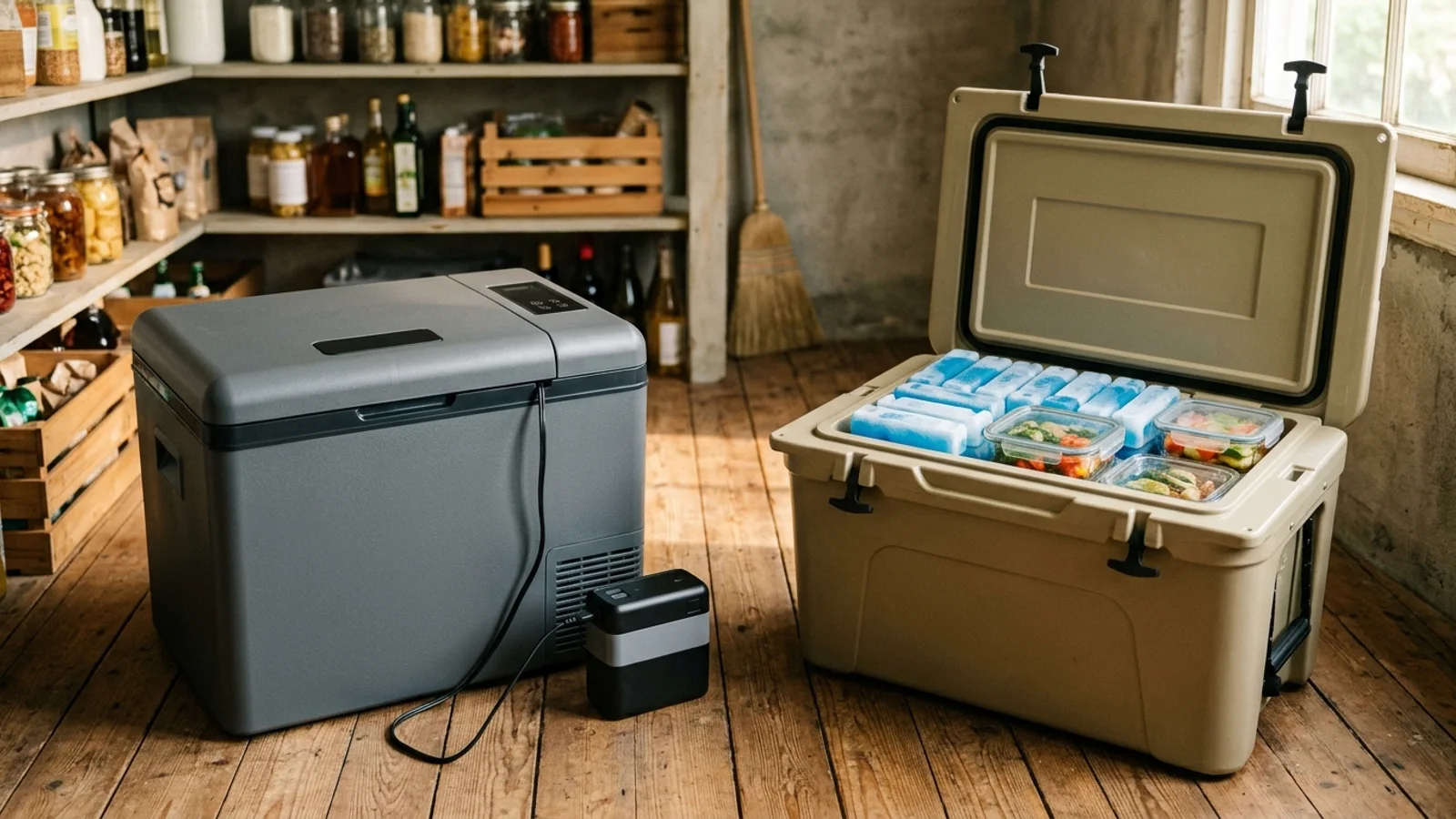
Choosing between a 12 V DC compressor chest fridge and a heavy rotomolded ice cooler comes down to inverter idle losses, meltwater contamination, and whether you can recharge a battery after day two. For model-by-model comparisons within each category, see our 12V portable car refrigerator guide and our rotomolded cooler ice-retention guide.
USDA 40 °F food-safety and medication freeze-burn boundaries
Per FDA power outage food-safety rules and American Red Cross emergency guidance, perishable foods (meat, poultry, fish, dairy, cut produce, cooked leftovers) must stay at 40 °F (4 °C) or below, while frozen food must hold near 0 °F (-18 °C) to remain safely frozen. Once refrigerated perishables sit above 40 °F (4 °C) for more than 2 hours, bacterial growth accelerates and you must discard them regardless of smell or appearance.
Two secondary cold-chain hazards ruin emergency stashes even when temperatures stay cold:
- Meltwater cross-contamination in ice coolers: As bagged cubes thaw, raw poultry or beef packaging leaks bloody water into the pool surrounding milk cartons, washed fruit, and baby formula. Always isolate raw proteins in sealed, leak-proof tubs above the drain line, or use sealed frozen HDPE water jugs instead of loose cubes.
- Medication freeze-burn: Insulin, biologics, and pediatric liquid antibiotics degrade permanently if frozen solid. Never pack prescription vials directly against ice blocks in a cooler or flush against the evaporator plate of a
12 Vchest fridge set near33 °F (0.5 °C); place vials inside an insulated inner pouch on the warmest basket shelf with a standalone thermometer probe.
The 120 V inverter tare trap vs. 12 V DC compressor efficiency
Plugging a standard 120 V kitchen refrigerator into a 1,024 Wh portable power station wastes roughly one-third of the battery before the compressor ever cools a single carton of milk. Every 1,000 W to 2,000 W AC inverter draws constant no-load idle tare—typically 12 W to 18 W continuously (15 W × 24 hours = 360 Wh/day)—just to keep high-voltage switching MOSFETs and cooling fans awake. Add 140 W × 8 hours = 1,120 Wh/day of compressor run time (~1,318 Wh/day with conversion loss), and your 1,024 Wh power station hits zero in 15 to 17 hours.
A 45 L 12 V DC compressor chest refrigerator flips both numbers in your favor:
- Zero AC inverter tare (
0 Wh/daywasted): Plugging directly into the station’s regulated12 VDC car port leaves the AC inverter completely switched off. - Top-opening chest retention: When you lift a top-opening chest lid for ten seconds, cold dense air stays pooled inside the cabinet instead of spilling onto your kitchen floor like an upright kitchen door.
- Low DC duty cycle: Set to
37 °F (3 °C)in a72 °F (22 °C)room, aSecop/Danfoss-class DC compressor draws roughly42 Wto45 Win Eco mode and cycles on roughly30%of the hour (~13 Wto14 Waverage =~312to340 Wh/day). On a1,024 WhLFP battery (~900 Whusable on DC), that delivers65to75+ hours(~3 full days) before needing a single watt of solar or vehicle charging, while also holding0 °F (-18 °C)if configured as a dedicated emergency freezer.
1. 120V Kitchen Fridge on 1 kWh LFP
~16 hrs2. 45L 12V DC Chest Fridge on 1 kWh LFP
65–75+ hrs3. 50 Qt Rotomolded Cooler + 20 lb Block Ice
96–120 hrs- AC inverter tare (~360 Wh/day). Keeping a 120V inverter awake wastes roughly
a third of a 1 kWh battery, draining it in
15–17 hrs. - Direct 12V DC chest cooling (0 W tare). Skipping AC conversion plus low
cyclic draw stretches
1,024 Whto65–75+ hrs. - Phase-change block ice (334 kJ/kg). Pre-frozen jugs absorb ambient heat with
zero electricity for
96–120 hrswhen staged cold.
Runtime estimates assume a 70–75 °F indoor room and pre-chilled contents. Compare capacity and meltwater tradeoffs.
Latent heat of fusion: when a rotomolded cooler still wins
If you have no solar panels, no vehicle inverter, and no way to recharge a battery during a five-day grid failure, a passive rotomolded ice chest still outperforms electronics on simplicity. Ice absorbs 334 kJ/kg (144 BTU/lb) of thermal energy simply transitioning from 32 °F (0 °C) solid to 32 °F (0 °C) liquid. Packing 20 lb (9.1 kg) of pre-frozen block ice inside a 50-quart rotomolded chest with 2-to-3-inch polyurethane walls provides roughly 3,039 kJ (~844 Wh thermal equivalent) of cooling absorption with zero moving parts, zero battery BMS lockouts, and zero dependency on sunlight.
Rotomolded coolers fail primarily through lack of pre-staging and bagged cube melt. Dumping room-temperature groceries and bagged gas-station ice into a warm 75 °F cooler burns half your ice mass just chilling the plastic liner. Freeze four to six half-gallon HDPE water jugs solid inside your garage freezer year-round so they drop straight into a pre-chilled cooler at 2:1 ice-to-food volume, per Ready.gov ice staging advice.
72-hour energy, ice, and capacity comparison table
Use these worked 72-hour estimates for a 72 °F (22 °C) indoor room before committing to battery capacity or cooler sizing, and check your exact appliance draw in our battery backup runtime calculator.
Metric (72-hour window) | 120 V Kitchen Fridge + 1 kWh LFP | 45 L 12 V DC Fridge + 1 kWh LFP | 50 Qt Rotomolded Cooler + Block Ice |
|---|---|---|---|
Total 72 h energy or ice needed | ~4,440 Wh (~4.5 full battery cycles) | ~960 to 1,020 Wh (1 charge cycle) | 0 Wh (20 to 25 lb frozen water blocks) |
| Usable chilled food volume | ~18 to 22 cu. ft. (full pantry) | 45 L (~1.6 cu. ft., ~3 grocery bags) | ~20 to 25 L food (after 2:1 ice ratio) |
Sustained 0 °F (-18 °C) freezing | Yes (while battery stays charged) | Yes (0 °F to 50 °F single-zone) | No (melts near 32 °F without dry ice) |
| Meltwater spoilage risk | None | None | High unless using sealed jugs or dry tubs |
| Outage duration without recharge | 15 to 17 hours | 65 to 75+ hours | 96 to 120 hours (4 to 5 days) |
Hardware pairing: 12 V DC chest fridge and 1 kWh LFP station
Choose a 12 V chest refrigerator with a true variable-speed compressor (Secop / Danfoss or equivalent) rather than cheap thermoelectric “12V coolers.” Thermoelectric Peltier boxes run continuously at 50 W to 65 W (1,200 to 1,560 Wh/day), draining a 1 kWh battery in under 18 hours while only cooling 25 °F to 35 °F below ambient room air—failing USDA 40 °F limits completely in an 85 °F summer room.
ICECO VL45 ProS 45-Liter 12V DC Compressor Portable Refrigerator
- Temperature range
- -18°C to +10°C (0°F to 50°F)
Why it fits Uses a Secop BD35F compressor across a -18 °C to +10 °C (0 °F to 50 °F) range at roughly 45 W Eco draw (~14 W average), stretching a 1 kWh battery past 65 hours via 12 V DC with zero ice meltwater; note that single-zone cabinets run either fridge or freezer temperatures at once, not both.
Key trade-off The VL45 ProS is a single-zone cabinet (it cools the entire 45L interior to either refrigerator *or* freezer temperatures, not both simultaneously)—if you need separate fridge and freezer compartments at once, step up to the dual-zone ICECO VL60 ProD.
Specifications & research
True 12 V DC compressor fridge. Source records checked on 2026-11-16. Manufacturer research, not hands-on testing.
- Storage volume
- 45 Liters (47.5 Quarts) — Holds ~60 cans or 3 grocery bags · Source checked 2026-11-16
- Compressor unit
- Danfoss / Secop BD35F (5-Year Compressor Warranty) · Source checked 2026-11-16
- Temperature range
- -18°C to +10°C (0°F to 50°F) · Source checked 2026-11-16
Manufacturer documentation. Confirm exact ICECO model specifications and household safety limits before buying.
When pairing that 12 V fridge with a 1,024 Wh LFP power station, verify two electrical details before an outage hits: confirm the 12 V cigarette port stays powered continuously without an idle auto-shutoff timer (some stations turn DC off after 2 to 12 hours under light cycling loads unless Eco-standby is disabled), and ensure the station supports 400 W to 600 W solar input if blackouts stretch beyond Day 3.
Medium · 1 kWh Rapid-Charge LFP
Anker SOLIX C1000 Gen 2
- Continuous AC output
- 2,000 W
Why it fits Supplies 1,024 Wh LiFePO4 capacity, a regulated 12 V DC car socket with AC inverter switched off, and up to 600 W solar input at 24.9 lb for multi-day 12 V chest fridge operation and vehicle/solar top-offs.
Key trade-off The manual describes SurgePad up to 2,400 W, says it works better with heat-generating loads, does not support precision instruments or strict-voltage devices, and does not operate in bypass mode. Do not use this as a general motor-start or surge rating.
Specifications & research
1,024 Wh LFP DC power anchor. Source records checked between 2026-10-04 and 2026-10-22. Manufacturer research, not hands-on testing.
- Nominal capacity
- 1,024 Wh · Source checked 2026-10-22
- Continuous AC output
- 2,000 W · Source checked 2026-10-22
- Base-unit weight
- 24.9 lb · Source checked 2026-10-04
Manufacturer documentation. Confirm the exact model, connections, and load requirements before buying.
Pre-outage cold-chain checklist
Stage these five checks before storm season so food and medications stay below 40 °F (4 °C):
- Plug your
12 Vfridge into your LFP power station’s12 VDC socket with the AC button turned OFF, and test a24-hourcycle to confirm the station’s DC port does not auto-sleep between compressor cycles. - Keep four to six half-gallon HDPE water jugs frozen solid in your main freezer year-round so you have instant block ice and emergency drinking water if you transition to a cooler.
- Place a standalone digital max/min thermometer inside the top basket of your chest fridge or cooler; never rely solely on a fridge’s exterior digital display, which reads near the cold evaporator wall.
- Pack raw meats inside sealed gasketed containers or double zip bags on the bottom rack so condensation or accidental thaw water never drips onto ready-to-eat dairy or produce.
- Move critical perishables (milk, eggs, meat, cheese, insulin) into the
45 L12 Vchest or pre-chilled cooler within 2 hours of a grid outage instead of repeatedly opening the warm kitchen refrigerator door.
Limits: cabinet volume, warm-kitchen duty cycles, and solar cloud cover
A 45 L portable compressor chest holds roughly three full grocery bags—about 10% to 15% of a family-sized 20 cu. ft. refrigerator—forcing households to prioritize high-protein perishables and medications rather than bulky condiments or bottled beverages. Ambient temperature also shifts runtime dramatically: moving a 12 V chest from an air-conditioned 70 °F hallway into a 95 °F (35 °C) garage increases compressor duty cycle from ~30% to ~55%–65%, cutting a 70-hour runtime down toward 35 to 40 hours. Meanwhile, a rotomolded cooler hits a hard wall once your pre-frozen block ice melts if local stores have sold out of ice and no home freezer is powered to refreeze jugs.