If your lease, building rules, or window design rule out a window air conditioner, compare temporary options with your landlord or property manager before installing them. Portable units still need a suitable window opening, drainage, electrical supply, and a secure exhaust-panel fit; permission and compatibility depend on your lease, building, and exact product.
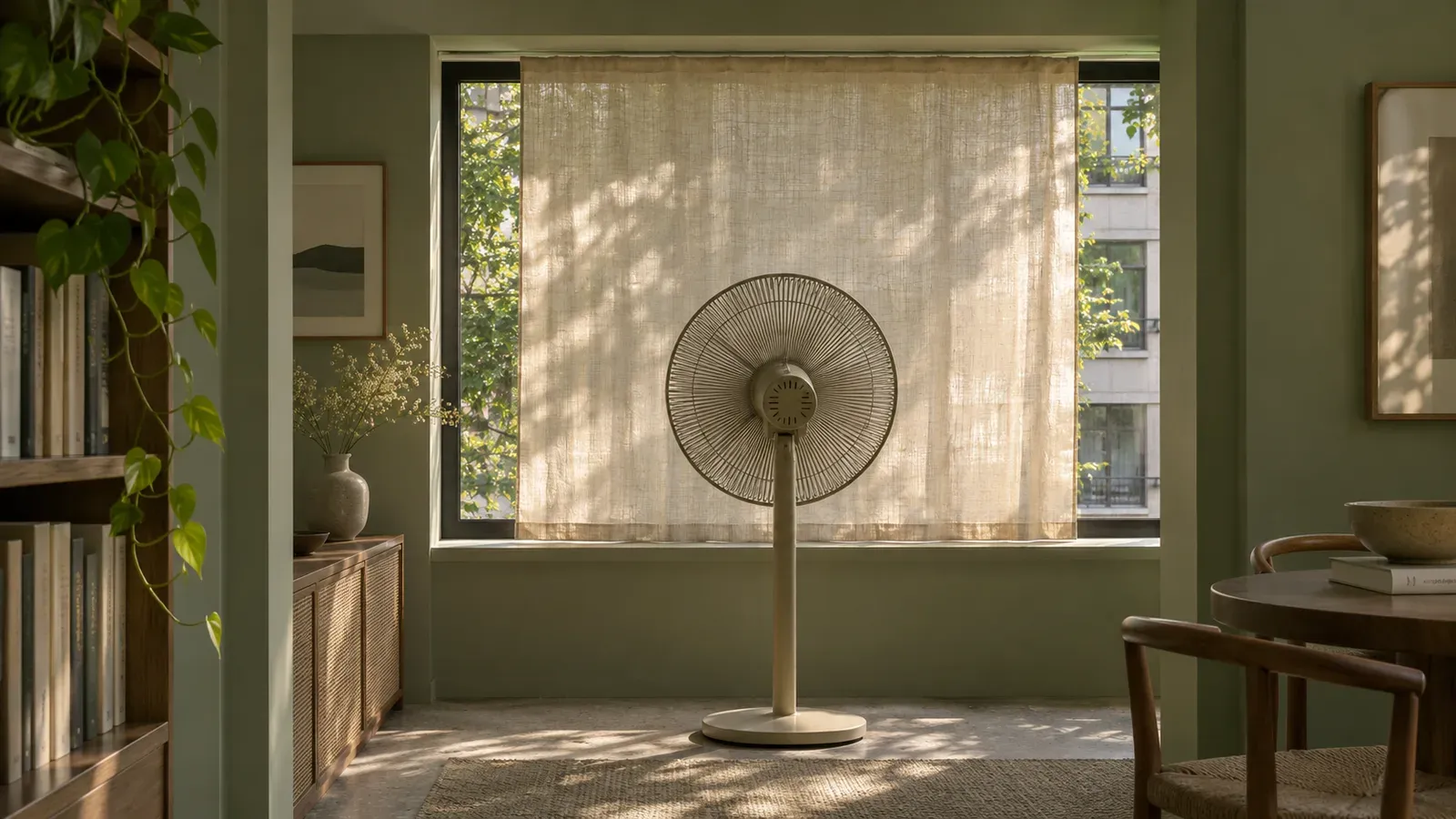
Fans and window coverings may improve comfort, but they do not guarantee a safe indoor temperature. The CDC advises using fans only when indoor temperatures are below 90°F; follow current local guidance, use air conditioning or go to a cooler place if the home remains dangerously hot, and seek urgent help for signs of heat illness.
Scroll sideways to read the enlarged diagram.
The portable AC trap: single-hose versus dual-hose
Portable air conditioners vary by model and duct configuration. Check both the Combined Energy Efficiency Ratio (CEER) / DOE SACC cooling rating and the manufacturer’s instructions for the exact unit; older nominal ASHRAE BTU labels alone do not capture duct heat losses or infiltration penalties.
Why single-hose portable ACs create negative room pressure
The U.S. Department of Energy distinguishes single-duct and dual-duct portable AC configurations: a single-duct unit pulls already-conditioned indoor air over its hot condenser coil and exhausts that heated air through a single window hose outdoors. Because air leaving the apartment must be replaced, the resulting slight negative pressure pulls warm, humid, or smoky outside air back indoors through door undercuts, utility chases, and hallway gaps while also heating the flexible exhaust duct inside the room.
How dual-hose designs reduce infiltration
A dual-hose (or concentric dual-duct) unit draws condenser intake air through a second duct connected to the window kit and exhausts it back outdoors, keeping indoor air pressure closer to neutral. Actual cooling capacity, airflow balance, and energy use still depend on hose length, seal tightness, and unit efficiency, so neither configuration guarantees a specific room temperature drop without reading the unit’s SACC rating and installation manual.
Compare the capacity and energy information for the exact model and configuration, then check its manufacturer instructions for window-panel fit, condensate handling, clearances, and electrical requirements. A portable unit is not automatically allowed by a lease or compatible with every window.
Hurricane Classic 20-Inch Box Fan
Why it fits A box fan may help with cooling or a compatible DIY air cleaner; check the fan and filter instructions before assembly.
Key trade-off Standard non-HEPA box fan; must be paired with MERV 13 filter media or shroud in a Corsi-Rosenthal configuration for fine particulate reduction.
Specifications & research
20-inch high-velocity square-frame box fan. Source records checked on 2026-11-08. Manufacturer research, not hands-on testing.
- Blade diameter inches
- 20 · Source checked 2026-11-08
- Airflow cfm
- High-velocity 3-speed motor moving up to 2,400 CFM of air · Source checked 2026-11-08
- Frame design
- Square housing designed to seal flush against standard 20x20-inch MERV 13 furnace filters · Source checked 2026-11-08
Manufacturer documentation. Confirm exact Hurricane model specifications and household safety limits before buying.
Renter cooling options tradeoff matrix
| Cooling Method | Upfront Cost Tier | Cooling Effectiveness | Acoustic & Airflow Profile | Lease Compliance & Installation | Best Room Use |
|---|---|---|---|---|---|
| Portable AC (dual-hose preferred) | High appliance + energy cost | Active refrigeration cooling; compare DOE SACC rating for the exact model | Compressor plus condenser fan noise; verify dBA rating | Verify lease rules, window-kit fit, condensate drain, and dedicated circuit | Warm bedrooms or living rooms with a sealable window |
| Removable window film or shade | Low to moderate per window | Reduces solar heat gain passively; cannot lower air temperature below shaded indoor baseline | Silent, zero power draw | Check lease rules, adhesive removal, and double-pane glass warranty notes | Sun-facing east or west apartment windows |
| Box or room fan | Low appliance and wattage cost | Accelerates evaporative skin cooling; does not cool room air like an AC | Moderate fan airflow noise | Plug-in only; watch outdoor AQI and wildfire smoke before window use | Personal airflow or night purging when outdoor air is cool and clean |
| Evaporative cooler | Low to moderate unit cost | Cools via water evaporation only in dry air; loses effectiveness above moderate humidity | Fan airflow sound plus periodic water refills | No window duct required, but check humidity and mold risk | Dry climates with cross-ventilation; avoid in humid or sealed rooms |
To calculate room volume and fan runtimes under battery power, review our heat wave physics cooling guide.
Non-destructive window solar rejection
Reducing direct sun through a window may help limit solar heat gain, but results depend on the window, orientation, covering, and installation. The U.S. Department of Energy describes solar heat gain coefficient as a measure of heat transmitted through a fenestration product; a film’s own rating does not establish the performance of your installed window. Check the exact product instructions and glazing compatibility, and ask the property manager before applying or fitting anything.
1. Removable window film
Products and application methods differ. Read the manufacturer’s installation and removal instructions, including any restrictions for coated, insulated, or damaged glass. Do not assume a film is compatible or damage-free because it is described as removable.
2. Temporary opaque coverings
A removable interior shade or panel can block direct sunlight, but do not press an improvised panel tightly against glass or assume a reflectance figure predicts room cooling. Consider access, condensation, window operation, and emergency egress; follow the window and covering instructions.
3. Interior shades or curtains
A shade can reduce direct sun when closed. Product insulation values and installation requirements vary; do not treat a published material value as the whole window’s performance. Confirm that any tension-mounted hardware fits securely and does not damage the frame or interfere with window operation.
Night-flush cross-ventilation for apartments
If outdoor air is cooler than indoor air and the air-quality and security conditions are suitable, window ventilation may help remove some indoor heat. There is no single outdoor-temperature cutoff or guaranteed cooling result. Do not ventilate from a smoky or otherwise unsafe outdoor environment.
- Check conditions: Check outdoor temperature, local air quality, weather, security, and building rules before opening windows.
- Use fans as directed: If conditions permit, place a fan securely according to its manual and keep it away from water and hazards.
- If cross-ventilating, open only windows that are safe and allowed, and close them when outdoor air becomes warmer, smoky, or otherwise unsuitable. Do not leave a window unsecured or obstruct required egress.
For households also managing wildfire smoke, pair ventilation with protocols from our wildfire smoke and evacuation plan for renters.
Electrical requirements and circuit limits
Portable air conditioners draw substantial power, but requirements vary by model and the building’s wiring. Read the unit’s rating plate and manual, check whether other outlets share the circuit, and ask the landlord or a qualified electrician if capacity is unclear. Do not use an extension cord unless the manufacturer explicitly permits the exact cord type and rating.
Before operating a portable AC, confirm the outlet, circuit, window kit, exhaust routing, and condensate handling match the manufacturer’s instructions. Stop using it and seek qualified help if the plug, outlet, or cord becomes hot, damaged, or discolored.
Understanding the continuous load limits of a residential electrical panel prevents sudden thermal breaker trips in the middle of a heat wave. The National Electrical Code (NEC) dictates that any device running continuously for three hours or more must not exceed 80 percent of the total rated circuit amperage. On a standard 15-amp rental apartment circuit equipped with 14-gauge copper wiring, the continuous limit caps at exactly 12 amps (1,440 watts). An older single-hose compressor surges up to 40 amps of locked rotor current (LRA) for milliseconds during startup, sending heavy electrical stress down the wiring. If that compressor cycles on while an 800-watt desktop computer runs on the exact same bedroom circuit, the combined transient load instantly exceeds the thermal capacity of the breaker, killing power to the room. In older unrenovated buildings with degraded wire insulation, overloading the circuit forces the copper conductors to heat past 90°C (194°F), creating a severe fire hazard hidden behind the drywall.
Illustrative 120V 15-amp circuit load check
| Combined Circuit Scenario (120V 15A Branch) | Steady-State Draw | 80% Continuous Limit (1,440 W) | Practical Breaker Risk |
|---|---|---|---|
| Portable AC alone (typical nameplate) | ~950–1,300 W (varies by unit) | Near ceiling | Safe only when manual and nameplate confirm headroom |
| Portable AC + workstation / gaming PC | ~1,400–2,000+ W | Exceeded | High risk of breaker trip during compressor startup |
| Box fan + HEPA air cleaner | ~80–160 W combined | Well below ceiling | Leaves wide margin for lighting and chargers |
| Portable AC + microwave / hair dryer / kettle | ~2,200–2,900+ W | Far exceeded | Immediate overload; move kitchen or heat loads to separate circuit |
Figures above are illustrative branch-circuit checks; verify exact nameplate amperage and watts on your own equipment before plugging into an apartment circuit.
Renter apartment cooling verification checklist
Execute this mandatory mechanical check before deploying high-draw cooling appliances:
- Inspect the main apartment breaker panel to confirm the target wall outlet sits on a dedicated 15-amp or 20-amp circuit.
- Ensure the dual-hose AC power cord plugs directly into the grounded wall receptacle without any power strips or extension cables.
- Measure the rigid window bracket installation to verify the exhaust hose attaches securely without crimps or 90-degree bends that choke airflow.
- Test the static-cling ceramic film by running a hand over the glass interior; it must feel room temperature, not hot from solar radiation.
- Close all interior doors to seal the target bedroom, isolating the specific air volume for maximum evaporator efficiency.
In upper-floor apartments during heat-dome blackouts, losing elevator access and booster-pump water pressure amplifies dehydration risk within hours. Size your indoor hydration margin, sanitation capacity, and stair-haul loads with the High-Rise Water, Sanitation & Stair-Load Planner, read why upper units lose water in our high-rise booster pump outage guide, compare stackable under-bed water containers, and check dimensions on WaterBrick 3.5-gallon containers.
Renter apartment cooling without window AC FAQs
How can renters cool an apartment without installing anything?
Options include compatible removable coverings, ventilation when outdoor conditions are suitable, and a portable AC if the exact unit can be installed as directed and is allowed by the lease and building.
Why are single-hose portable air conditioners bad?
DOE describes single-duct units as drawing condenser air from the conditioned space; replacement air and cooling effects depend on the room, building, and exact unit. Compare labeled performance for the same rating basis and follow the product instructions.
Does static-cling window film damage rental apartment glass?
It depends on the product and glass. Read the exact film instructions for permitted glazing, installation, and removal; ask the property manager before applying it. “Removable” is not a guarantee for every window or finish.
Do DIY ice fans actually work in an apartment?
An ice-and-fan setup is not a substitute for air conditioning or a heat-safety plan. Avoid adding moisture if indoor humidity is already a concern, and use cooling or seek a cooler location if the home remains dangerously hot.