In this guide Jump to a section
- Principle 1: solar radiation and window physics
- Principle 2: thermal mass and night-flush timing
- Principle 3: electric fan safety and physiological thresholds
- Principle 4: evaporative cooling and humidity limits
- Daytime vs nighttime cooling protocol
- Battery-powered fan runtime planning
- Prepare a cooler-place plan
- Passive cooling FAQs
During an extended summer blackout or AC failure, residential rooms warm rapidly because buildings absorb sunlight through windows and hold heat inside walls, floors, and furniture. Without mechanical refrigeration, passive cooling manages four physical heat paths: solar radiation, conduction through the envelope, convective airflow, and latent heat evaporation.
Passive strategies slow heat gain and flush stored heat when nights cool down, yet they cannot cool a home indefinitely during prolonged heat domes. Extreme heat turns dangerous even indoors: if your home grows too hot or occupants cannot stay cool, relocate to an air-conditioned public building or cooling center, follow local emergency guidance, and seek medical care promptly for heat illness symptoms (CDC heat and health guidance).
Scroll sideways to read the enlarged diagram.
Principle 1: solar radiation and window physics
Direct sunlight passing through glass windows is typically the fastest daytime heat source inside an uncooled room. Standard glass transmits short-wave visible sunlight inward readily. Once that light hits floors, rugs, drywall, and upholstery, those surfaces warm up and re-emit long-wave infrared heat, which standard window glass traps indoors like a greenhouse.
Illustrative solar heat gain math
Under ASHRAE steady-state assumptions, instantaneous solar heat gain through glazed area follows:
q_solar = A × SHGC × I_t
where A is glass area in square feet, SHGC is the Solar Heat Gain Coefficient (roughly 0.60 to 0.75 for older clear double-pane glass versus around 0.25 for modern low-e glazing), and I_t is incident solar irradiance (reaching around 250 BTU/hr per sq ft on an unshaded west-facing window during a peak summer afternoon).
For an illustrative unshaded 5 ft × 6 ft west window (30 sq ft) with an SHGC of 0.70:
q_solar = 30 × 0.70 × 250 = 5,250 BTU/hr
One large unshaded west window can therefore dump roughly 5,250 BTU/hr—nearly half a residential air-conditioning ton—into a room before afternoon air conduction is even counted. Real homes vary with roof overhangs, trees, glass tint, and sun angle.
Exterior versus interior window shading
Where you place shading alters how much solar heat enters the room:
- Light-colored interior blinds or curtains intercept sunlight only after it crosses the glass, reflecting roughly
20 to 30 percentback outside while converting the rest into warm room air behind the blinds. - Exterior shades, awnings, solar mesh screens, or outdoor shutters stop photons on the outside face of the glass first, rejecting roughly
80 to 90 percentof direct solar heat gain before it enters the envelope.
Principle 2: thermal mass and night-flush timing
Drywall, concrete slabs, tile floors, brick, and heavy wood furnishings store thermal energy according to:
Q = m × c × ΔT
where m is mass, c is specific heat capacity, and ΔT is temperature change. In dry or coastal climates with wide diurnal swings (for instance dropping from triple digits at 4:00 PM into the 60s overnight), night flushing removes heat from that structural mass so the home starts morning cooler.
- Night charging (when outside turns cooler than inside): Open low shaded windows on the breezy side and high windows on the opposite leeward side. Set an upper-story box fan blowing outward to exhaust rising warm air and pull cool night air across interior floors and walls. Keep windows shut if wildfire smoke, unsafe air quality, street crime risk, or unguarded child window-fall hazards make opening them unsafe (DOE Building Science natural ventilation guidance).
- Daytime coasting (before outdoor air warms past indoor air): Close and latch windows cleanly early in the morning, deploy exterior or tight interior shades, and turn off ovens, dryers, and heat-generating electronics so cooled walls absorb internal heat slowly.
If overnight lows stay near 80°F or humidity remains heavy, night flushing delivers minimal drop and indoor temperatures ratchet upward day after day. At that point, move people early to an air-conditioned site.
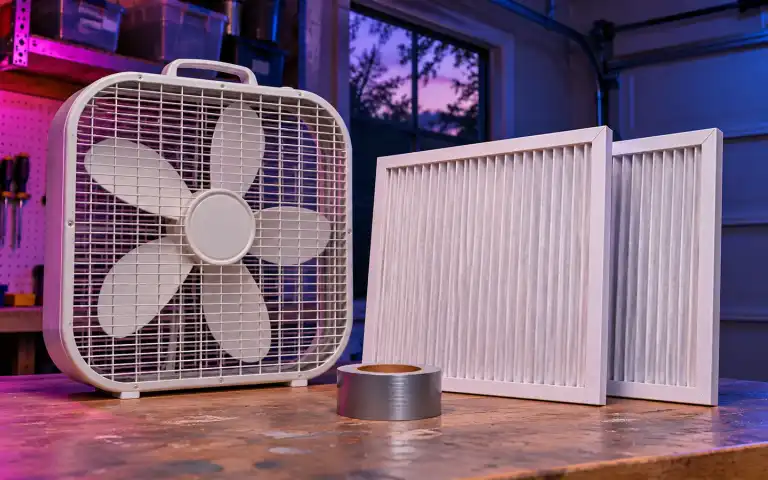
Hurricane Classic 20-Inch Box Fan
Why it fits A 20-inch box fan exhausts warm room air during safe night-flush windows (55 W low / 75 W high) and supports personal cooling below CDC temperature limits; it never replaces air conditioning.
Key trade-off Standard non-HEPA box fan; must be paired with MERV 13 filter media or shroud in a Corsi-Rosenthal configuration for fine particulate reduction.
Specifications & research
20-inch high-velocity box fan. Source records checked on 2026-11-08. Manufacturer research, not hands-on testing.
- Blade diameter inches
- 20 · Source checked 2026-11-08
- Airflow cfm
- High-velocity 3-speed motor moving up to 2,400 CFM of air · Source checked 2026-11-08
- Frame design
- Square housing designed to seal flush against standard 20x20-inch MERV 13 furnace filters · Source checked 2026-11-08
Manufacturer documentation. Confirm exact Hurricane model specifications and household safety limits before buying.
Principle 3: electric fan safety and physiological thresholds
Electric fans do not lower room air temperature like an air conditioner; the fan motor actually adds a small amount of electrical heat (35 to 80 W) into a closed room. Fans cool people only by moving air across skin to speed sweat evaporation and convective heat loss:
q_conv = h_c × A_skin × (T_skin - T_air)
Because dry skin typically sits near 95°F (35°C), physicists note that moving hot air hotter than skin temperature transfers convective heat into the body instead of out of it. Public-health guidance is even more protective because sweat efficiency drops rapidly before dry-bulb air hits 95°F, especially in humid weather or among older adults and infants.
- Current CDC indoor threshold: CDC guidance on heat and health advises using electric fans indoors only when temperatures are below 90°F (32°C); above that point, a fan can raise body temperature and speed heat stress. Older federal thresholds cited
95°Fto99°F(including EPA guidance referencing extreme indoor heat in the upper 90s°F), so treating 90°F as your hard stop gives vital margin before convective reversal or sweat failure occurs. - Not a safety guarantee below 90°F: High humidity, advanced age, dehydration, cardiovascular disease, or heat-sensitizing medications can make rooms unsafe well below
90°F. Symptoms—heavy sweating or stopped sweating, dizziness, nausea, confusion, or rapid pulse—demand immediate cooling in air conditioning and medical care regardless of thermometer readings.
Learn how temperature and relative humidity combine into physiologic heat load in our guide on indoor heat index and wet-bulb safety thresholds.
Principle 4: evaporative cooling and humidity limits
Evaporating liquid water absorbs about 1,000 BTU per pound (2,260 kJ/kg), which drives desert swamp coolers in dry air (relative humidity under 30 percent). In humid summer conditions (relative humidity above 55 percent), air already holds substantial water vapor. Running a DIY ice chest fan or wet-towel misting setup inside an unvented humid room adds latent humidity, pushes wet-bulb stress higher, and impairs your body’s ability to evaporate sweat.
Daytime vs nighttime cooling protocol
| Phase or Condition | Household Action | Physical and Safety Limit |
|---|---|---|
| Early morning (outside warmer than inside soon) | Close and latch windows, close exterior blinds or tight shades, shut down stove/oven cooking | Slows solar heat gain; does not remove existing stored heat in walls |
| Midday to evening peak | Stay on the lowest floor, hydrate steadily, apply cool damp cloths to neck and wrists, power down idle electronics | Basement or ground floors run cooler via earth coupling, not active refrigeration |
| Indoor air approaches 90°F | Stop relying on electric fans to cool people; begin moving household to an air-conditioned site | CDC warns fans above 90°F can increase body temperature and heat illness risk |
| Cool, clean overnight window | Open shaded ground intake and high opposite exhaust window with an outward-facing box fan | Skip whenever wildfire smoke, storm hazards, or warm humid nights defeat cross-ventilation |
Battery-powered fan runtime planning
During grid outages, estimating fan runtime prevents overnight battery exhaustion:
Runtime (hours) = (Battery Capacity in Wh × Inverter/DC Efficiency) / Fan Power in W
Under illustrative assumptions (0.85 conversion efficiency and steady speed):
- A small
15 WUSB or 12V DC personal fan on a256 WhLiFePO4 battery yields roughly(256 × 0.85) / 15 ≈ 14.5 hours. - A
55 Wlow-speed 20-inch AC box fan running night-flush exhaust through an inverter on a1,024 Whstation yields roughly(1,024 × 0.85) / 55 ≈ 15.8 hours(real AC inverter idle losses lower runtime slightly, and pure sine wave output avoids motor hum and overheating).
Prepare a cooler-place plan
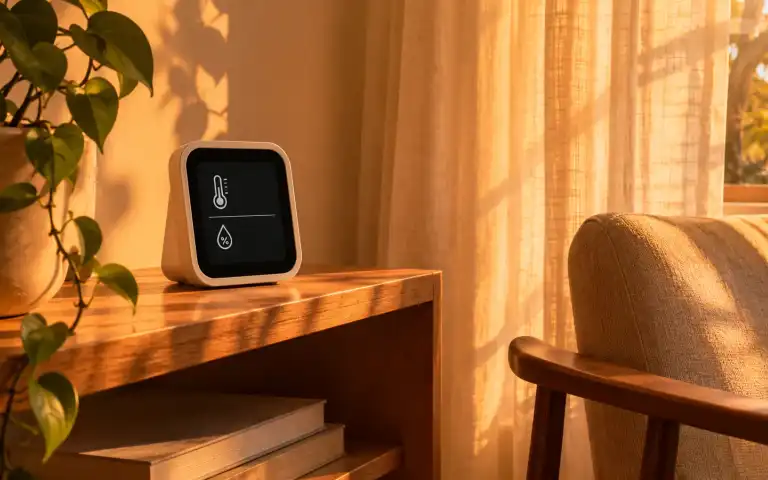
Keep a digital indoor thermometer and hygrometer to compare indoor versus outdoor conditions, never as proof that a room is medically safe. Identify cooling centers, public libraries, clinics, or air-conditioned friends before heat waves arrive, confirm accessible transit, pet policies, and backup power plans for powered medical devices or refrigerated medicines, and check regularly on elderly neighbors or anyone taking medications affecting sweat response.
Pre-heat-wave readiness checklist
- Exterior shade screens, awnings, or reflective window coverings are staged for east and west glass.
- Window screens lock securely if used for night-flush cross-ventilation, with alternate plans ready if smoke arrives.
- Battery fan wattages are tested on your power station so overnight capacity is measured, not guessed.
- Nearest air-conditioned cooling center hours, transit route, and pet/medical accommodation rules are written down offline.
- Household knows the 90°F indoor fan stop rule and emergency heat-stroke warning signs requiring 911.
Passive cooling FAQs
Do electric fans cool rooms or just people?
Electric fans move air across skin; they do not cool air inside a room. In a sealed unoccupied room, a running fan’s motor actually converts all its electrical draw into slight additional heat.
Why do public health agencies set the indoor fan limit at 90°F instead of waiting for 95°F or 99°F?
While dry skin sits around 95°F and older guidance focused on upper-90s°F reversal physics, current CDC heat-health guidance sets 90°F (32°C) as the conservative cutoff because high humidity, dehydration, and vulnerable physiology reduce sweat cooling well before air exceeds skin temperature.
Do DIY ice-bottle fan coolers work during an AC outage?
Ice melts slowly relative to room loads: melting 10 pounds of ice absorbs about 1,440 BTU, roughly 17 minutes of output from a small 5,000 BTU window unit. Inside humid closed rooms, evaporating cold moisture also raises indoor humidity and hurts natural sweat cooling.