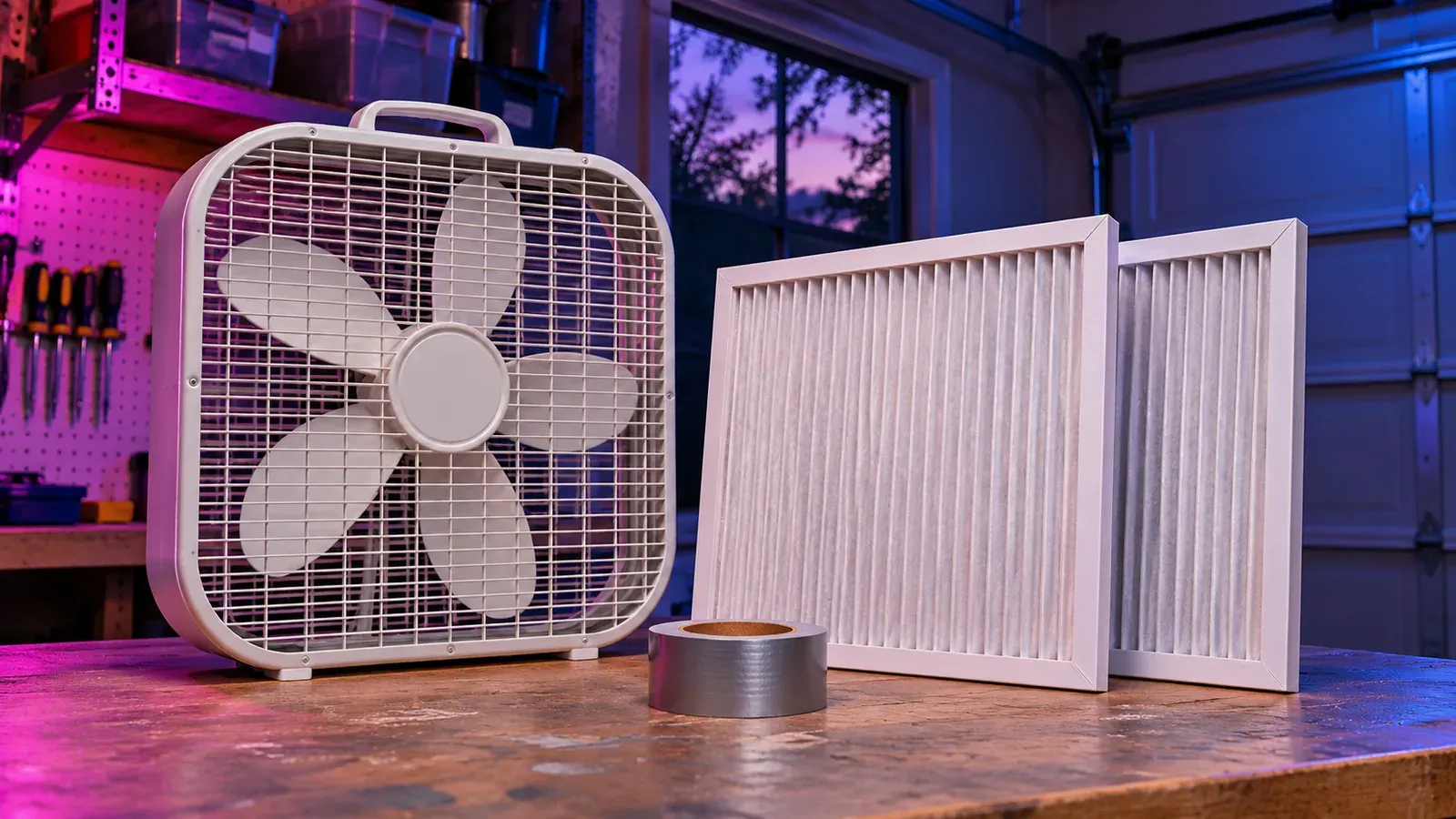
When wildfire smoke pushes the Air Quality Index (AQI) into unhealthy or hazardous territory, commercial HEPA air purifiers often sell out locally within hours. A four-filter Corsi-Rosenthal box provides a practical fallback built from a standard 20-inch box fan, four MERV 13 furnace filters, duct tape, and corrugated cardboard.
EPA generally prefers a commercial air cleaner with a certified Clean Air Delivery Rate (CADR) when a suitable unit is available and within budget, because a homemade assembly’s true output varies with the fan motor, filter depth, tape seal, and fan speed. Follow local smoke and evacuation guidance first: particle filtration does not remove dangerous gases or make every room safe during nearby fire threats.
Scroll sideways to read the enlarged diagram.
Choose a design before buying
EPA notes three common DIY configurations: a single-filter fan, a two-filter wedge, and a four- or five-filter cube. A single taped filter forces the full fan discharge through just 400 sq in (20 × 20 in) of filter face, creating steep backpressure, loud noise, and higher motor winding heat. Two-filter wedges double intake area (800 sq in), while a four-filter cube expands nominal panel area to 1,600 sq in, lowering face velocity by up to 75 percent at the same flow rate.
Slower air through pleated media improves fine-particle capture by diffusion and electrostatic attraction while holding fan motor temperatures down. Five-filter cubes swap the cardboard base for a fifth filter raised on blocks, though a four-filter cube on a solid cardboard bottom fits better on flat floors and uses fewer replacement filters.
Before picking parts, compare relative costs and tradeoffs against a certified commercial HEPA unit rather than assuming a DIY build always wins on total ownership.
| Factor | Four-Filter Corsi-Rosenthal Cube | Commercial Certified HEPA Purifier |
|---|---|---|
| Upfront cost tier | Low (fan, four filters, tape, cardboard) | Moderate to High |
| Verified CADR rating | No standardized label without testing | Yes (AHAM-verified smoke CADR listed) |
| Typical intake panel area | 1,600 sq in nominal across 4 filters | Compact internal pleated drum or panel |
| Operating electrical draw | Roughly 55 to 75 W (~82.5 to 112.5 kWh per 1,500 hrs) | Roughly 35 to 55 W (~52.5 to 82.5 kWh per 1,500 hrs) |
| Noise and footprint | Louder broadband airflow, 20-inch cube footprint | Quieter sleep modes, smaller footprint |
| Replacement filter cost tier | Moderate (four standard HVAC filters per swap) | Moderate to High (model-specific OEM packs) |
For multi-room sizing comparisons using verified smoke CADR ratings, review our HEPA air purifier CADR sizing guide.
Hurricane Classic 20-Inch Box Fan
Why it fits A square-framed 20-inch box fan (55 W low / 75 W high) mates cleanly with 20x20 furnace filters; confirm on delivery that the cord has a modern UL or ETL safety listing and fused plug.
Key trade-off Standard non-HEPA box fan; must be paired with MERV 13 filter media or shroud in a Corsi-Rosenthal configuration for fine particulate reduction.
Specifications & research
20-inch square-frame box fan. Source records checked on 2026-11-08. Manufacturer research, not hands-on testing.
- Blade diameter inches
- 20 · Source checked 2026-11-08
- Airflow cfm
- High-velocity 3-speed motor moving up to 2,400 CFM of air · Source checked 2026-11-08
- Frame design
- Square housing designed to seal flush against standard 20x20-inch MERV 13 furnace filters · Source checked 2026-11-08
Manufacturer documentation. Confirm exact Hurricane model specifications and household safety limits before buying.
The aerodynamics: why the cardboard shroud matters
Square box fans house circular blades. At the four open corners and outer blade tips, high-pressure discharge air curls backward around the frame edge, pulling unfiltered room air into reverse vortices and starving forward throw. Adding a flat cardboard shroud across the front corners with a circular opening sized to the blade tips blocks those corner back-eddies.
In published EPA and academic testing of multi-filter DIY units, well-sealed shrouded cubes consistently outperformed unshrouded or single-filter assemblies on particulate clearance. The shroud is simple to cut from a spare shipping carton flap and costs nothing beyond ten minutes with a compass or string and a utility knife.
Step-by-step assembly instructions
Gather your materials first so you do not force mismatched filter frames into an airtight seam. EPA describes cube builds using matching MERV 13 filters from one to four inches deep; 2-inch filters offer deeper pleat area and lower resistance than 1-inch filters, though 1-inch four-packs are often easiest to find quickly during smoke spikes.
Materials checklist
- One 20-inch box fan manufactured in 2012 or later carrying a UL or ETL listing and fused safety plug
- Four matching 20 x 20-inch MERV 13 pleated furnace filters (1-inch or 2-inch depth)
- One full roll of 2-inch duct tape or gaffer tape
- One 20 x 20-inch solid corrugated cardboard sheet for the bottom plate
- One 20 x 20-inch corrugated cardboard sheet for the corner shroud
- Measuring tape, marker, string or compass, and utility knife
Assembly sequence
- Inspect the airflow arrows printed along the cardboard frame of each MERV 13 filter. Stand all four filters upright in a square ring with every arrow pointing inward toward the center cavity, and align the pleats vertically or cleanly edge-to-edge so corners butt tightly.
- Run continuous strips of duct tape down all four vertical corner seams inside and outside, pressing firmly so room air cannot bypass through gaps.
- Set the 20 x 20-inch solid cardboard sheet flat against the open bottom of the filter ring, then tape all four perimeter edges completely airtight to block unfiltered floor dust from entering the plenum.
- Set the 20-inch box fan flat on top of the cube with its exhaust grille facing upward toward the ceiling and its intake drawing air out of the cube interior. Route the power cord neatly along a top seam, then tape around all four bottom edges of the fan housing to seal it onto the filter frames without blocking controls or grille clearances.
- Center the second cardboard sheet over the top fan grille, trace a circle matching the distance from the fan hub center to the outer blade tips (commonly around a 14-inch diameter circle on a 20-inch fan, leaving all moving blades clear), cut out the circle, and tape the outer square perimeter of the shroud onto the front fan frame corners.
See EPA’s illustrated DIY air cleaner guidance for official diagrams and design variations before powering on your unit.
Filtrete 20x20x1 MERV 13 Air Filters (4-Pack)
- Pack quantity
- 4
Why it fits This four-pack provides matching 20x20x1 MERV 13 (MPR 1900) filters sized for one four-filter cube; confirm exact nominal dimensions and MERV 13 rating on the listing before checkout.
Key trade-off High-MERV 1-inch filters create higher static pressure drop than fiberglass filters; verify furnace blower compatibility or use in DIY Corsi-Rosenthal box fans.
Specifications & research
Four matching MERV 13 filters. Source records checked on 2026-11-08. Manufacturer research, not hands-on testing.
- Filtration rating
- MERV 13 equivalent (3M MPR 1900 Microparticle Performance Rating) · Source checked 2026-11-08
- Dimensions
- 20 × 20 × 1 in · Source checked 2026-11-08
- Pack quantity
- 4 · Source checked 2026-11-08
Manufacturer documentation. Confirm exact Filtrete (3M) model specifications and household safety limits before buying.
Illustrative room ACH math (not a guarantee)
Air quality practitioners size cleaners using Air Changes per Hour (ACH), the number of times a room’s air volume passes through filtration in 60 minutes:
ACH = (CADR in CFM × 60) / Room Volume in cu ft
where Room Volume = Length × Width × Ceiling Height.
Because a DIY unit carries no standardized label, treat any CADR number as an illustrative planning benchmark, not a guaranteed figure for your build. Suppose a living room measures 20 ft × 15 ft with 8 ft ceilings (2,400 cu ft), and assume a well-sealed shrouded cube delivers 400 CFM on medium speed (published university and EPA chamber studies have measured multi-filter cube outputs across roughly 300 to 600 CFM depending on fan model, speed, and filter depth):
- Compute room volume:
20 × 15 × 8 = 2,400 cu ft. - Compute hourly airflow:
400 CFM × 60 min/hr = 24,000 cu ft/hr. - Divide by room volume:
24,000 / 2,400 = 10.0 ACH(one turnover every6.0 minutes).
Even if your specific fan and 1-inch filter build performs 25 percent lower at 300 CFM, that same 2,400 cu ft room still reaches 7.5 ACH (every 8.0 minutes), comfortably above the 4 to 6 ACH benchmark often targeted in an indoor clean room during wildfire smoke. Larger open spaces dilute output proportionally, as shown below under that same illustrative 400 CFM assumption.
| Room Footprint | Ceiling Height | Room Volume | Illustrative Output at 400 CFM | Illustrative Output at 300 CFM |
|---|---|---|---|---|
| 120 sq ft bedroom | 8 ft | 960 cu ft | 25.0 ACH (every 2.4 min) | 18.8 ACH (every 3.2 min) |
| 250 sq ft primary room | 8 ft | 2,000 cu ft | 12.0 ACH (every 5.0 min) | 9.0 ACH (every 6.7 min) |
| 300 sq ft living room | 8 ft | 2,400 cu ft | 10.0 ACH (every 6.0 min) | 7.5 ACH (every 8.0 min) |
| 600 sq ft open room | 9 ft | 5,400 cu ft | 4.4 ACH (every 13.5 min) | 3.3 ACH (consider closing doors) |
Operate and maintain it safely
Restricted intake airflow changes how an induction fan motor sheds heat. Always follow these physical and electrical guardrails whenever running a DIY filter fan:
- Use only a residential box fan made in 2012 or later bearing a UL or ETL safety listing and a fused safety plug designed to open the circuit if the motor stalls or overheats. Never adapt vintage, metal-bladed, or unrated utility fans.
- Plug the fan directly into a wall outlet without daisy-chained extension cords, and set the cube on stable flat flooring clear of drapes, bedding, and exit walkways.
- Run the assembled unit at medium or high speed as directed by EPA while people are home and awake, then check the rear plastic motor hub after two hours of runtime. Warm plastic is normal; burning odors, rattling blades, or painfully hot housing indicate you should shut down immediately, inspect for pinched blades or clogged filters, or upgrade from 1-inch to 2-inch pleated filters.
- Shut off DIY box fan cleaners when leaving the house unattended, keep pets and young children away from the top discharge grille, and keep smoke alarms working on every level.
- Inspect filter pleats regularly during heavy smoke. EPA cautions that under severe prolonged smoke, filters can load up within days or weeks; remove spent filters gently outdoors or directly into a sealed trash bag, and wash your hands afterward.
Pre-run assembly verification checklist
- Box fan carries a UL or ETL label, is dated 2012 or later, and includes an intact fused plug.
- All four MERV 13 filter airflow arrows point inward toward the hollow center plenum.
- All vertical seams and the solid cardboard bottom plate are taped continuously with zero open air gaps.
- The top cardboard shroud leaves blade tips unobstructed while sealing the four square corners of the frame.
- After two hours on medium or high speed, the rear motor housing feels only moderately warm with no electrical smell or blade rub.
What a DIY cleaner can and cannot tell you
A MERV 13 label describes filter media efficiency under standard HVAC duct test conditions, not a guaranteed room CADR for your taped box fan. Visual color change shows captured soot and dust, yet cannot tell you whether invisible combustion gases like carbon monoxide or volatile organic compounds remain elevated indoors. Pair particle cleaning with sealed exterior doors and windows, watch local air-quality advisories, and evacuate immediately if wildfire orders direct you to leave.