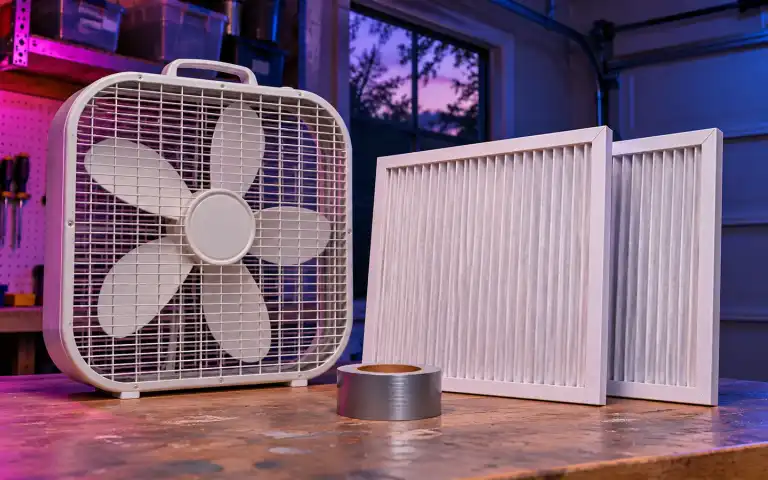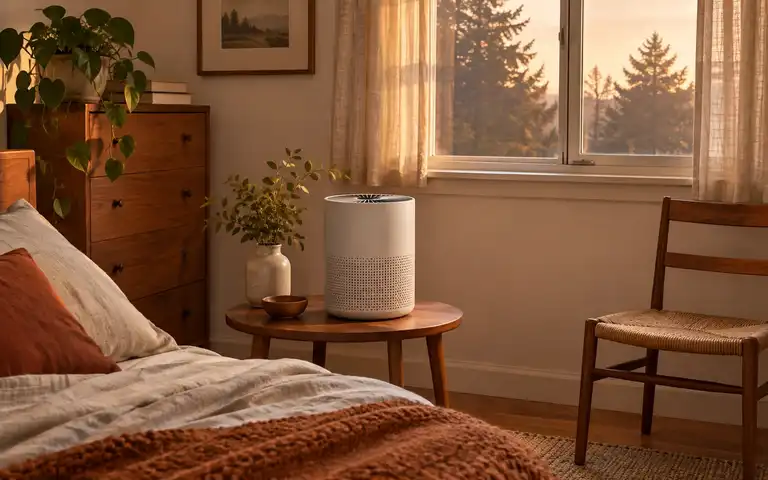
Bushfire smoke across eastern and southern Australia almost always arrives alongside 35–43 °C summer afternoons, creating a two-sided hazard: shutting every window blocks outdoor PM2.5 soot while turning an uncooled brick or weatherboard room into an oven. Guessing wrong on cooling equipment—specifically turning on a rooftop evaporative cooler—can fill the house with thick smoke faster than leaving a window cracked.
This engineering guide turns NSW Health bushfire protection rules and EPA Victoria Publication 1809 into an Australian metric setup plan: sizing True HEPA Clean Air Delivery Rate in m³/h, matching cooling systems safely, and knowing when heat requires leaving for a public air-conditioned building. For a broader North American overview of room layout and DIY box-fan builds, compare our wildfire cleaner-air room checklist and US imperial CADR sizing guide.
Cooling equipment comparison during bushfire smoke
Every Australian cooling system moves air differently. Before choosing which room becomes your cleaner-air zone, verify how its air path handles outdoor smoke.
| Cooling System | Air Path During Operation | Smoke-Day Rule | Main Risk or Limitation |
|---|---|---|---|
| Wall reverse-cycle split AC | Indoor head blows room air over cold indoor coil; outdoor compressor stays outside | Safe to run on cool/recirculate (close any rare fresh-air trickle vent) | Does not filter PM2.5 deeply on its own; pair with a portable True HEPA cleaner |
| Ducted refrigerated reverse-cycle AC | Return grille draws indoor hallway air through central fan and chilled coil | Safe on recirculate if external fresh-air intake damper is shut | Leaky return ducts in hot roof spaces can suck dusty attic smoke; tape gaps or isolate one room |
| Rooftop evaporative (“swamp”) cooler | Pulls 100% outdoor air through wet pads and pressurises the whole house | Turn OFF immediately and close/cover ceiling outlets if safe | Pumps outdoor PM2.5 smoke directly indoors; wet pads do NOT scrub fine smoke particles |
| Portable single-hose AC | Exhausts indoor air outside via window kit, pulling smoky air back through door gaps | Avoid during dense smoke; switch to dual-hose or public cool centre | Negative room pressure drags unfiltered outdoor smoke through cracks |
| Ceiling or pedestal fans | Circulates indoor air only | Safe to run alongside a HEPA unit (< 35 °C) | Above ~35–38 °C indoor dry-bulb air, blowing hot air speeds heat gain rather than cooling |
Scroll sideways to read the enlarged diagram.
Worked metric True HEPA sizing in m³/h
Under EPA Victoria Publication 1809, an effective portable air cleaner needs a True HEPA filter (capturing >= 99.95% of 0.3 µm particles under EN 1822 / ISO 29463 or 99.97% US HEPA), zero intentional ozone or ioniser function, and enough airflow to cycle the room roughly 5 times per hour (5 ACH) at an acceptable noise setting.
Australian retailers list Smoke CADR in either cubic metres per hour (m³/h) or US cubic feet per minute (CFM), sometimes alongside optimistic marketing room sizes tested at deafening turbo speeds. Convert reliably with CFM × 1.70 = m³/h, then size straight from room volume:
Worked calculation for an Australian bedroom or living room
- Measure room dimensions: Example standard bedroom or compact lounge at
4.2 m × 4.5 mwith a2.7 mAustralian ceiling height (18.9 m²floor area). - Calculate room volume (
m³):4.2 m × 4.5 m × 2.7 m = 51.03 m³(round to51 m³). - Multiply by 5 Air Changes per Hour:
51 m³ × 5 ACH = 255 m³/hminimum Smoke CADR (255 ÷ 1.70 = 150 CFM). - Add noise headroom: Because rated Smoke CADR applies at maximum fan speed (
55–65 dBA), pick a unit rated around350–450 m³/h(205–265 CFM) so medium-high sleep speed still delivers roughly255 m³/hovernight without keeping the household awake.
If a ceiling rises to 3.0 m in an older Queenslander or Victorian terrace, recalculate volume directly (18.9 m² × 3.0 m = 56.7 m³ × 5 = 284 m³/h) rather than trusting square-metre box labels meant for 2.4 m ceilings. Model electricity draw and five-year replacement HEPA cartridge bills across candidate units in our Air Purifier 5-Year Cost Calculator.
EPA Victoria Publication 1809 limits and heat evacuation
Portable HEPA purifiers solve one problem well and leave two hazards uncovered, as EPA Victoria highlights:
- Particles vs. gases: True HEPA media traps
PM2.5soot and ash efficiently, whereas standard thin carbon sheets saturate quickly against volatile organic gases (VOCs) and cannot remove carbon monoxide (CO). Once outdoorPM2.5drops into the Good range, open doors and windows wide to flush staleCO2and trapped smoke gases. - When no split AC is available: Sealing a brick or fibro room on a
40 °Cday without refrigerated cooling can push indoor heat stress past safe limits for babies, older adults, pregnant people, and heart or lung patients. NSW Health advises shifting early to an air-conditioned public library, shopping centre, or council smoke-relief centre instead of enduring dangerous indoor heat.
Whenever you step outdoors between the house and car or wait in smoky transit, a surgical blue mask or cloth face covering leaks around the nose bridge and fails to stop PM2.5. Use a properly fitted P2 (AS/NZS 1716) or N95 particulate respirator pressed firmly around the nose and over clean-shaven skin so air flows through the filter media rather than around facial gaps.
3M Aura 9205+ N95 Particulate Respirator, 20-count carton
Why it fits Fold-flat NIOSH N95 respirator rated at >=95% particulate filtration for short outdoor transits to air-conditioned relief centres during bushfire smoke; Australian buyers can choose local AS/NZS 1716 P2 equivalents, and protection depends strictly on a tight facial seal without beards.
Key trade-off Protection depends on proper selection, fit, and use; N95 filtration does not ensure a face seal. Follow 3M user instructions and applicable respiratory-protection requirements.
Specifications & research
Particulate respirator reference (check P2 / N95 fit). Source records checked on 2026-11-08. Manufacturer research, not hands-on testing.
- Approval
- NIOSH-approved N95; approval number TC-84A-8590 · Source checked 2026-11-08
- Filtration
- At least 95% filtration efficiency against certain non-oil-based particulate aerosols · Source checked 2026-11-08
- Pack identity
- 20 respirators per carton; 3M ID 7100232219; UPC 00638060430606 · Source checked 2026-11-08
Manufacturer documentation. Confirm exact 3M model specifications and household safety limits before buying.
Cleaner-air room setup checklist
Prepare these seven items before fire danger ratings spike so you are not searching hardware aisles in thick haze:
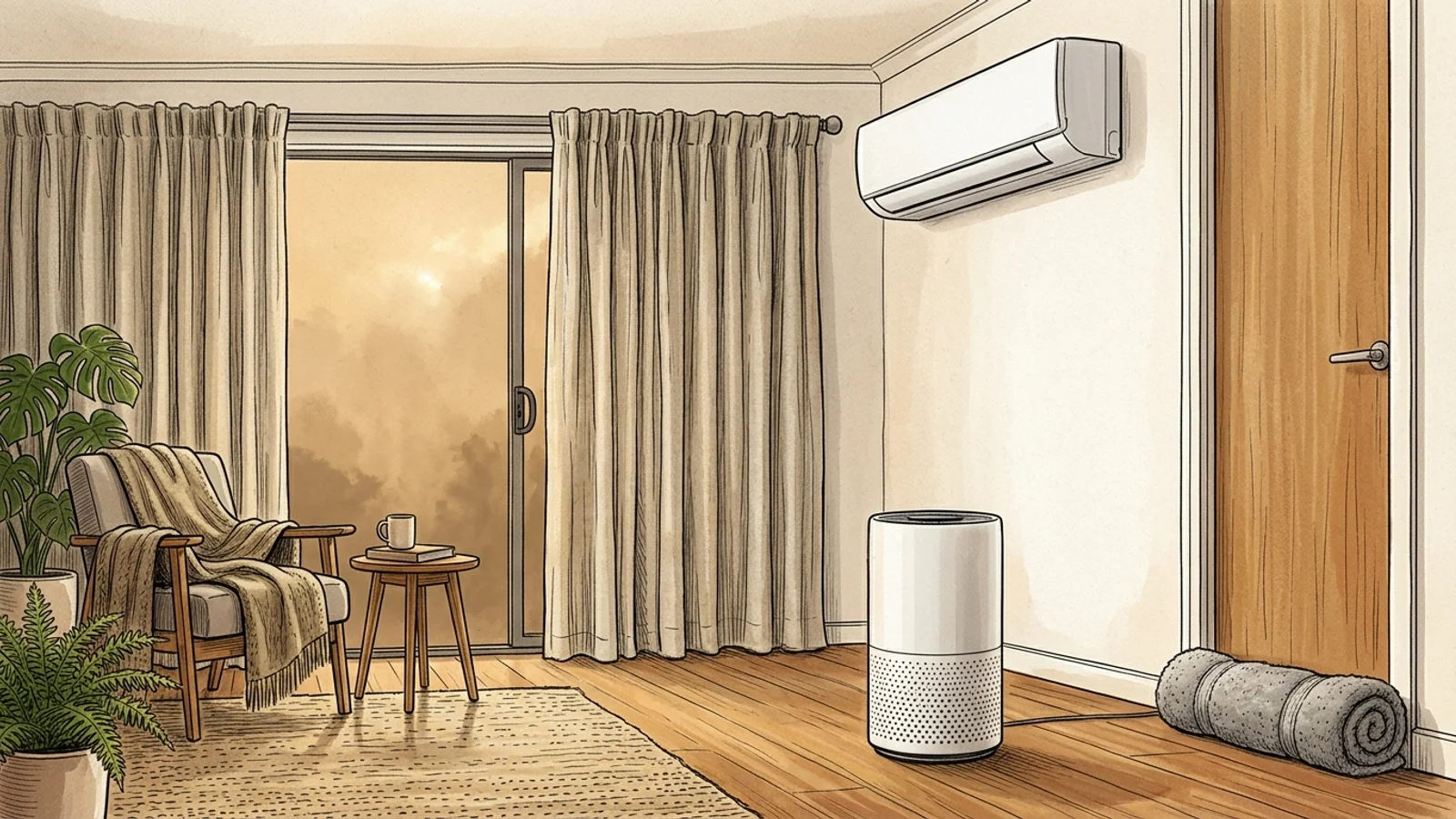
- Pick the right room: Choose one bedroom or living space that has a reverse-cycle split AC (or shaded aspect), few windows, no unsealed open fireplace, and space for every household member and pet.
- Verify cooling controls: Confirm the AC remote runs cool/recirculate without pulling outside air, switch rooftop evaporative coolers completely OFF, and cover ceiling evap vents from indoors only if safe to reach.
- Calculate your
m³/htarget: Measurelength × width × ceiling height × 5and confirm your True HEPA unit meets that Smoke CADR (m³/h) at a tolerable speed with ioniser / UV-ozone switched off. - Block obvious infiltration gaps: Close window latches, drop roller shutters or heavy curtains against radiant heat, and tuck a damp rolled towel along the bottom gap of the room door and any unused exhaust grille.
- Cut indoor particle sources: Skip frying or grilling on gas stoves, extinguish candles and incense, avoid vacuuming without a sealed HEPA vacuum, and keep pets indoors.
- Stage P2/N95 respirators and heat backup: Keep fitted P2 or N95 masks beside car keys, plus two litres of cool drinking water per person and a plan to leave early for a cool public venue if indoor temperatures climb without AC.
- Air out once outdoor smoke clears: Check official state air-quality readings (
EPA Victoria AirWatchorNSW DPE Air Quality), open windows briefly when air turns clean, and inspect the HEPA pre-filter for heavy soot load.