In this guide Jump to a section
- Find out what the building can supply without its pumps
- Hydrostatic Pressure & Water Loss Timeline by Building Height
- The 3 Mechanical Realities of Multi-Family Water Failure
- High-Rise Water Readiness Checklist
- When carrying or storing water is impractical
- Plan for other failures in a high-rise outage
Find out what the building can supply without its pumps
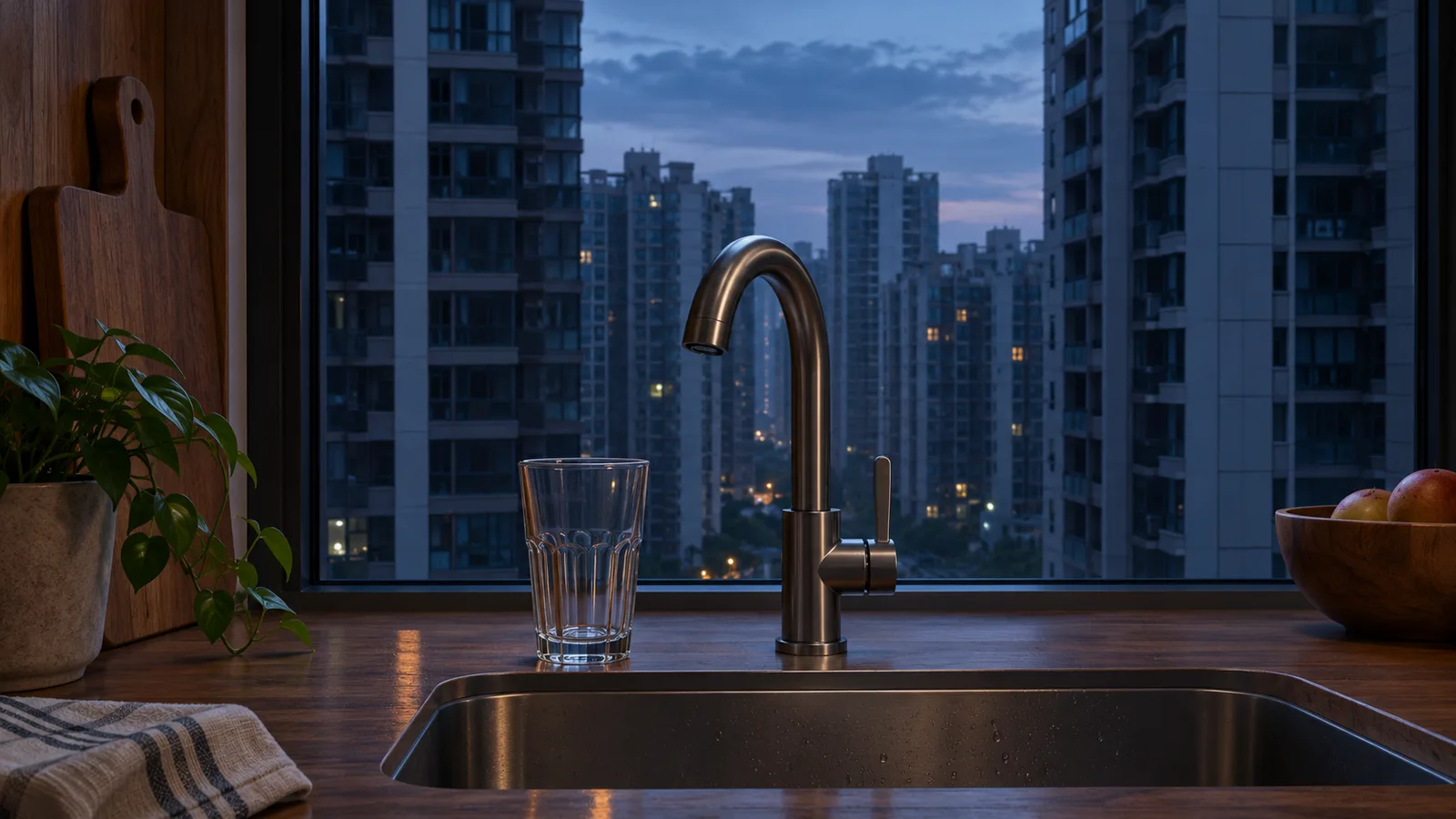
In multi-story residential buildings, municipal street water mains typically enter the basement at 45 to 65 PSI (3.1 to 4.5 bar). Because every vertical foot of water column exerts 0.433 PSI of downward backpressure (1.42 PSI per meter), city street pressure alone can only push water roughly 30 to 45 meters (100 to 150 feet) upward—leaving floors 4 and above completely dependent on electric domestic booster pumps in the basement.
When a neighborhood power outage strikes, those booster pumps stop instantly. Even if your high-rise has a backup diesel generator, building codes prioritize emergency stairwell lighting, fire alarms, and one firefighter elevator over domestic water pumps. Keep a WaterBOB 100-gallon bathtub bladder under your bathroom sink and fill it during the first 15 to 20 minutes of any outage while upper-floor risers still hold residual pressure, backed by pre-stored 3.5-gallon WaterBricks inside closets so you never have to haul 19 kg (42 lb) water jugs up dark stairwells.
Hydrostatic Pressure & Water Loss Timeline by Building Height
| Building Floor Level | Elevation Above Street Main | Static Head Loss (PSI) | Immediate Blackout Tap Behavior | Emergency Water Action Window |
|---|---|---|---|---|
| Floors 1 – 3 | 0 – 10m (0 – 33 ft) | 0 – 14 PSI | Street pressure usually keeps cold taps flowing (unless municipal pumps also fail) | Fill pots and jugs immediately in case city pumping stations lose power |
| Floors 4 – 8 | 12 – 25m (40 – 82 ft) | 17 – 36 PSI | Pressure drops to a trickle within 5–10 minutes as risers drain downward | Open cold tap immediately to capture residual riser volume before vacuum locks |
| Floors 9 – 20+ | 28 – 65m+ (92 – 215 ft+) | 40 – 93+ PSI | Cold & hot taps go dry within 2–5 minutes (unless roof gravity tank exists) | Fill WaterBOB in bathtub immediately; do not flush toilets with tap reserve |
The 3 Mechanical Realities of Multi-Family Water Failure
1. Why Backup Generators Rarely Run Domestic Water Pumps
Many high-rise residents assume their building’s basement diesel generator will keep faucets working during a blackout. Under NFPA 110 and municipal high-rise life-safety codes, emergency standby generators are legally sized to carry Emergency Systems (exit signs, stairwell smoke-control fans, fire alarm panels, and fire pumps) and Legally Required Standby Systems (sewage ejector pumps and one elevator car). Domestic potable water booster pumps are classified as Optional Standby Loads and are automatically shed by the building’s transfer switch to prevent overloading the generator.
2. How to Drain Residual Riser Water Into a Bathtub Bladder
If you live on the 6th floor of a 12-story building and the power goes out, thousands of gallons of clean drinking water are still sitting inside the vertical copper or PEX risers serving floors 7 through 12.
- Break the Vacuum Lock: As water drains down to lower floors, negative air pressure creates a vacuum at the top of the riser that stops flow. Opening your bathtub cold-water tap immediately after a blackout begins allows you to capture that descending water column—provided you line the tub with a sealed WaterBOB bladder first (unlined bathtubs leak around worn drain stoppers within 4 hours and expose water to soap scum and dust).
- Do Not Drain Electric Water Heaters Blindly: In-unit apartment electric water heaters hold 30 to 40 gallons of potable water, but never drain one until you flip its dedicated double-pole circuit breaker OFF; if grid power returns while the tank is empty, the upper heating element will burn out in 15 seconds.
3. The Stairwell Hauling Ergonomics Trap
A standard 5-gallon jerrycan (such as a Scepter WCG501) weighs 19.5 kg (43 lbs) when filled, and a 7-gallon Reliance Aqua-Tainer weighs 27.2 kg (60 lbs). Carrying 27 kg up eight flights of unlit, humid concrete stairs in summer heat causes rapid exhaustion and back injuries.
- The 13 kg (29 lb) Ceiling: Standardize apartment portable water containers around 3.5-gallon WaterBricks (13.2 kg / 29 lbs full) or 2.5-gallon collapsible jugs (9.5 kg / 21 lbs), and keep a folding tri-wheel stair-climbing hand truck (such as the UpCart Original) in your coat closet so one person can roll 35 liters (9 gallons) up stairs smoothly.
High-Rise Water Readiness Checklist
- Store 14 gallons of pre-filled water per person inside the unit: Use rectangular 3.5-gallon WaterBricks slid under bed frames or stacked at the bottom of linen closets (4 bricks = 14 gallons = 14 days of drinking water at 1 gallon/day).
- Keep one sealed WaterBOB box under the bathroom vanity: Verify your apartment has a standard alcove bathtub (if you only have a walk-in shower stall, skip the WaterBOB and add four extra WaterBricks).
- Tag your in-unit water heater breaker and shutoff valve: Label the water heater breaker in your subpanel so you can kill power before siphoning tank water.
- Pre-stage a siphon hose or WaterBOB hand pump: Municipal water distribution trucks during extended blackouts dispense water into whatever containers residents bring down to the lobby—keep two clean 3.5-gallon jugs with spigots ready for lobby refills.
When carrying or storing water is impractical
Do not overload apartment balconies or single closet shelves with 200+ gallons of concentrated water drums. While modern concrete high-rise floors are engineered for 40 to 100 lbs per square foot (psf) live loads, wooden-joist 3-story garden apartments can sag if you concentrate 800 kg (1,760 lbs) of water in a single 4-square-foot pantry footprint. Distribute WaterBricks evenly along load-bearing perimeter walls and under bed frames.
Plan for other failures in a high-rise outage
Use our browser-local Plan Your Apartment Water, Sanitation & Stairwell Hauling Load to model your exact household numbers before purchasing hardware. Compare detailed manufacturer specifications in our WaterBrick 3.5-Gallon Stackable Container Equipment Guide and UpCart Tri-Wheel Stair-Climbing Hand Truck Equipment Guide, and integrate this setup with our Complete Home Resilience Guide and Apartment & Multi-Family Emergency Preparedness.
Saratoga Farms 5-Gallon Stackable Water Containers (4-Pack, 20 Gal)
- Stacking when filled
- Yes
Why it fits Documented specification match for high rise apartment water loss booster pump outage planning, verify exact model compatibility, dimensions, and household capacity before ordering.
Key trade-off A filled 5-gallon jug holds ~41.7 lb of water plus container weight (~44 lb total); lift with care and distribute heavy packs across weight-bearing floors.
Specifications & research
Model alternative. Source records checked on 2026-11-12. Manufacturer research, not hands-on testing.
- Listed water capacity
- 20 US gal · Source checked 2026-11-12
- Empty container weight
- Not verified in this source record · Source checked 2026-11-12
- Stacking when filled
- Yes · Source checked 2026-11-12
Manufacturer documentation. Confirm the exact container, storage location, handling and cleaning instructions before buying.