In this guide Jump to a section
Check sunlight and mounting options
You do not need a house roof to recharge a 1,000Wh LiFePO4 portable power station during a multi-day blackout—provided you have a south- or west-facing apartment balcony or sun-exposed window ledge.
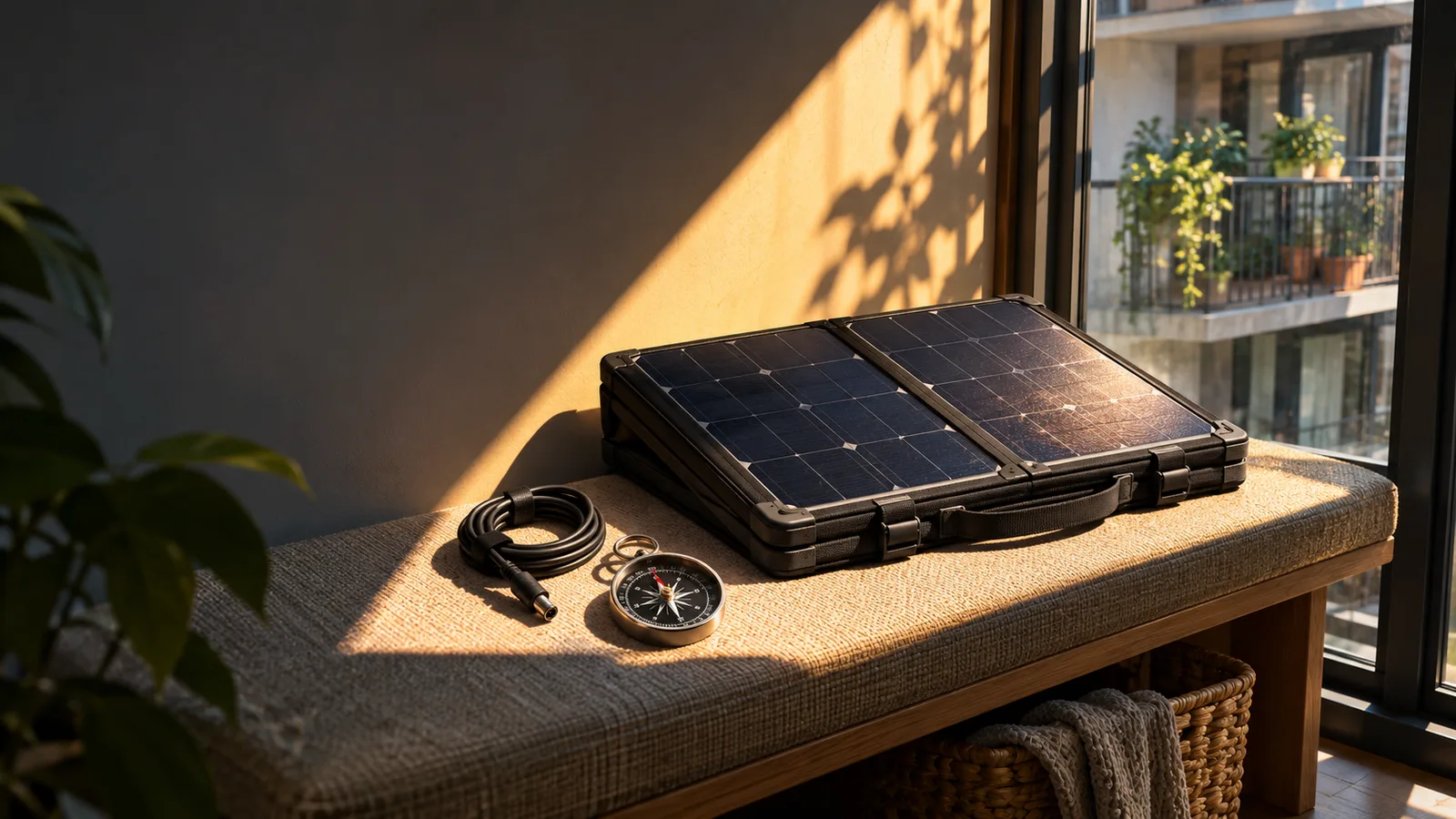
To harvest usable power without violating HOA/lease rules or overheating your battery, keep your power station indoors in the shade and route a flat MC4 window pass-through cable under your closed balcony door or window sash to an outdoor 100W to 200W folding solar panel angled at 40° to 55° toward the sun. Never place solar panels behind closed double-pane Low-E windows—metallic Low-E coatings cut solar harvest by 40% to 55%, turning a 200W panel into a 75W trickle charger.
Real-World Apartment Solar Harvest by Mounting Location (200W Rated Panel)
| Deployment Configuration | Peak Wattage Output | Daily Harvest (4 Sun-Hours) | Time to Recharge 1,000Wh Battery | Key Engineering Constraint |
|---|---|---|---|---|
| Balcony Floor / Railing (Unobstructed South Sun) | 145W – 170W | 580 – 680 Wh/day | ~1.5 to 2 Days | Requires wind tethering to railing |
| West-Facing Balcony (Afternoon Sun Only) | 120W – 150W | 350 – 450 Wh/day | ~2.5 Days | Zero morning harvest; peak from 1:00 PM–5:00 PM |
| Hung Vertically Flat on Railing (90° Angle) | 95W – 125W | 380 – 480 Wh/day | ~2.2 Days | Optimal in winter when sun sits low; loses 25% in summer |
| Indoors Behind Closed Low-E Double-Pane Glass | 55W – 85W | 200 – 300 Wh/day | 4 to 5+ Days | Low-E metallic window film reflects infrared/UV spectrum |
Three Engineering Rules for Apartment Balcony Solar
1. Use a Flat MC4 Window Pass-Through Cable
Leaving a balcony sliding door cracked open 3 cm to run thick round 10AWG solar wires lets in wildfire smoke, winter cold, and insects—and prevents you from locking the door. A 20 USD Flat Solar Pass-Through Cable uses ultra-thin tinned copper ribbon insulation (under 1.5mm thick) that lets you close and latch vinyl windows or sliding patio doors cleanly over the wire without crushing the conductor.
2. Defeat Balcony Overhang Shadows With Parallel Wiring
Apartment balconies sit underneath the concrete slab of the balcony above them, creating a sharp shadow line across the top half of your panel as the sun climbs overhead.
- In a standard series-wired solar panel, shading just 15% of the cells chokes current across the entire panel by 70% to 80%.
- The Fix: Either buy monocrystalline panels built with internal bypass diodes per cell string (such as the Anker PS200 or EcoFlow 220W), or pair two smaller 100W panels in parallel using MC4 Y-branch adapters so when the upper panel falls into balcony overhang shade, the lower railing-mounted panel keeps producing full current.
3. Secure Panels Against Wind Gusts
High-rise balconies experience Venturi wind acceleration between adjacent towers. Never lean an untethered folding solar panel on a 10th-floor balcony railing, a sudden 30 mph gust turns a 7 kg (15 lb) panel into a lethal falling projectile. Thread reusable heavy-duty silicone gear ties or paracord through the panel’s corner grommets directly to the metal balcony balusters.
Balcony Solar Setup Checklist
- Verify your power station’s Voc (Open-Circuit Voltage) limit: Single 100W–200W portable panels output ~18V–24V Voc, which is safe for every major 1kWh LFP station (EcoFlow DELTA 3, Anker C1000 Gen 2, BLUETTI AC180).
- Check lease rules on temporary unmounted gear: Most leases prohibit permanently bolting rigid glass panels to exterior stucco or railings, whereas setting out a folding portable panel on a chair or leaning it inside your balcony during a power outage requires zero permanent attachment.
- Keep the power station out of direct sunlight: Direct sun pushes LFP battery cell temperatures past 45°C (113°F), triggering BMS high-temperature charging shutoffs.
When the installation or expected output rules it out
If your apartment windows face strictly north (in the Northern Hemisphere) or sit at the bottom of a narrow courtyard canyon blocked by taller adjacent buildings all day, solar panels will generate less than 15W to 25W, skip solar panels completely and invest that 350 USD in a second 1,000Wh LFP expansion battery pre-charged from the wall before storms arrive.
Compare charging options for limited space
Use our browser-local Plan Your Apartment Water, Sanitation & Stairwell Hauling Load to model your exact household numbers before purchasing hardware. Compare detailed manufacturer specifications in our WaterBrick 3.5-Gallon Stackable Container Equipment Guide and UpCart Tri-Wheel Stair-Climbing Hand Truck Equipment Guide, and integrate this setup with our Complete Home Resilience Guide and Apartment & Multi-Family Emergency Preparedness.
High-Output Upgrade · 220W Bifacial
EcoFlow 220W Bifacial Solar Panel
- Open-circuit voltage (Voc)
- 21.5 V
Why it fits Documented specification match for balcony window solar charging for apartments planning, verify exact model compatibility, dimensions, and household capacity before ordering.
Key trade-off Manual ratings are under its stated standard test conditions: 1,000 W/m², AM1.5, 25°C. Front 220±5 W and rear 175±5 W are separate side ratings; do not add them as guaranteed or expected combined output. Rear capture depends on reflected light.
Specifications & research
Model alternative. Source records checked on 2026-10-25. Manufacturer research, not hands-on testing.
- Rated panel power
- 220 W · Source checked 2026-10-25
- Open-circuit voltage (Voc)
- 21.5 V · Source checked 2026-10-25
- Listed panel weight
- 15.4 lb · Source checked 2026-10-25
Manufacturer documentation. Check the exact station limits and keep the rear-side rating separate from the front-side nameplate; no universal compatibility is established.