In this guide Jump to a section
- Why winter stack effect pulls soil gas indoors
- Unit conversion math and detector uncertainty at 200 Bq/m³
- Why Health Canada requires a 91-day heating-season test
- Why HEPA air purifiers and dehumidifiers cannot remove radon
- Matching the fix to your reading and moisture profile
- Canada 91-day radon placement checklist
- Retesting after mitigation or envelope changes
Dry winter basement walls and a steady 35% indoor relative humidity reading tell you nothing about radon concentration. Across Canada, homeowners routinely invest in portable dehumidifiers and HEPA air scrubbers to fix musty basement air, assuming cleaner, drier rooms carry lower radiation risk. Radon-222 (Rn-222) behaves by entirely different fluid physics than mould spores or summer condensation.
Our general radon test-results guide explains U.S. EPA short-term versus long-term screening and how to keep a household test log. This guide focuses on Canadian building physics, Health Canada’s 200 Bq/m³ mitigation guideline, unit conversions (Bq/m³ to pCi/L), and why ventilation and depressurization behave oppositely below grade.
Why winter stack effect pulls soil gas indoors
During Canadian winters, heated indoor air is significantly less dense than sub-zero outdoor air. That warm air rises through stairwells and leaks out around recessed pot lights, plumbing stacks, and attic hatches. As warm air escapes near the roof, it creates a slight negative pressure (ΔP, typically -2 Pa to -10 Pa) across the basement slab and lower foundation walls.
Soil surrounding a concrete footing holds naturally occurring uranium decay gas (Rn-222). Whenever basement air pressure sits even a few pascals lower than soil-pore pressure, soil gas flows steadily upward through perimeter shrinkage cracks, sump pump basins, weeping tile cleanouts, and plumbing cutouts. Running a powerful kitchen range hood, dryer, or exhaust-only bathroom fan without makeup air deepens that negative ΔP and pulls even more soil gas through the concrete.
Basement moisture often spikes during warm, humid summer months for a separate physical reason: outdoor air carrying high absolute moisture slips into a cool 16 °C basement and condenses on bare concrete or cold water pipes, whereas bulk rain seepage enters through hydrostatic cracks. Fixing dampness protects framing and stops mould, yet dry soil around a sealed-looking finished rec room can still feed high radon levels all winter.
Unit conversion math and detector uncertainty at 200 Bq/m³
Canadian test labs and digital monitors report radon in becquerels per cubic metre (Bq/m³), whereas U.S. literature and many imported detectors display picocuries per litre (pCi/L). One picocurie per litre equals exactly 37 Bq/m³.
- Canadian guideline in U.S. units:
200 Bq/m³ ÷ 37 = 5.41 pCi/L. - U.S. EPA action level in Canadian units:
4.0 pCi/L × 37 = 148 Bq/m³(with2.0 pCi/L = 74 Bq/m³). - Detector uncertainty band (
±25%): Standard passive long-term alpha-track kits typically carry an analytical uncertainty near±25%. A home whose true heating-season average sits right at200 Bq/m³can return lab readings between150 Bq/m³and250 Bq/m³(often watched closely across the160–240 Bq/m³window).
Because lung-cancer risk scales roughly linearly with cumulative exposure and Health Canada identifies no harmless threshold, treat any confirmed reading between 150 Bq/m³ and 199 Bq/m³ as a prompt to verify detector placement or tighten slab openings rather than an all-clear certificate. Health Canada recommends taking action within two years when readings range between 200 and 600 Bq/m³, and within one year above 600 Bq/m³.
Why Health Canada requires a 91-day heating-season test
Radon concentrations swing by a factor of two to five between windy afternoons, snowmelt days, and open-window summer weeks. A 48-hour or 7-day charcoal snapshot cannot capture that seasonal average. Health Canada specifies a minimum 91-day (3-month) long-term test run during the heating season (typically October through April), when windows stay shut and winter stack effect reaches its sustained peak.
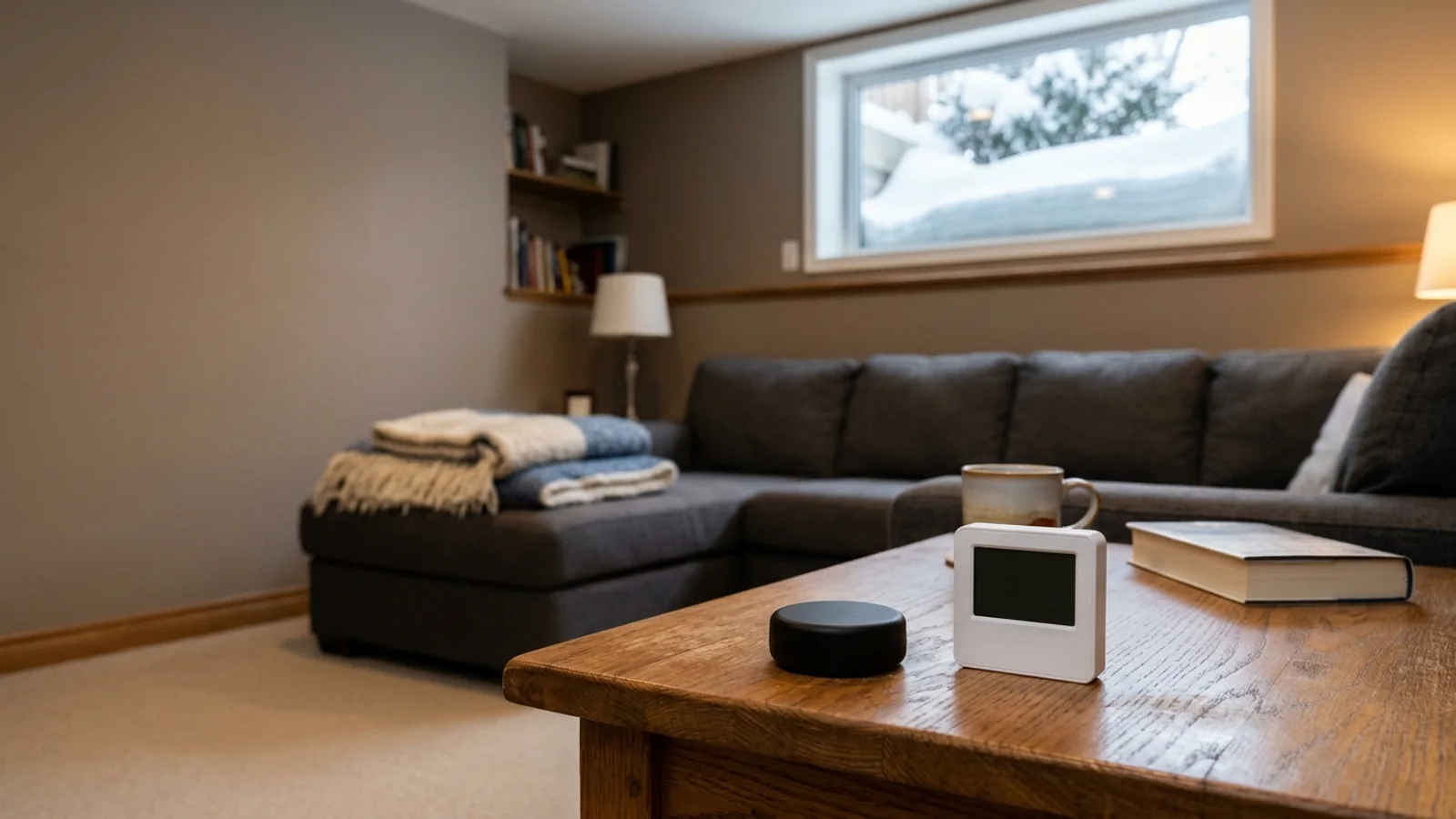
Place the detector in the lowest level of the home used for normal occupancy—more than 4 hours per day. If your basement holds a TV room, home office, guest suite, or bedroom used regularly, test that room. Do not hide a detector inside an unsealed sump pit, crawlspace, utility furnace closet, laundry room, bathroom, or kitchen, because localized air stagnation, floor drains, or steam skew the reading away from actual breathing-zone exposure.
Continuous digital monitors make it easy to watch how rainstorms, snow cover, or furnace fan settings shift daily levels across those three months. Keep a lab-processed alpha-track puck beside a digital monitor when you need formal C-NRPP documentation for a home renovation or sale.
Airthings Corentium Home 2 Radon Detector
Why it fits Tracks rolling 24-hour, 7-day, 30-day, and up to 1-year radon averages alongside temperature and relative humidity; use it to watch seasonal trends while relying on a C-NRPP-listed 91-day alpha-track lab test for formal documentation.
Key trade-off The first radon average is not available until 24 hours of sampling. Airthings recommends relying on at least a one-month long-term average for decisions because radon varies over short periods.
Specifications & research
Model alternative. Source records checked on 2026-11-08. Manufacturer research, not hands-on testing.
- Sensors
- Radon, temperature, and relative humidity · Source checked 2026-11-08
- Display averages
- Rolling 24-hour, 7-day, 30-day, and long-term (up to 1-year) radon averages, plus temperature and humidity · Source checked 2026-11-08
- Power
- 2 AA batteries; manufacturer estimate up to 3 years unconnected · Source checked 2026-11-08
Manufacturer documentation. Confirm exact Airthings model specifications and household safety limits before buying.
Why HEPA air purifiers and dehumidifiers cannot remove radon
A True HEPA filter captures airborne particles down to 0.3 µm—dust, pet dander, wildfire smoke, and a fraction of solid radon decay progeny (Po-218, Po-214) that cling to dust motes. However, radon gas itself (Rn-222) is a single-atom inert noble gas. Its atoms pass straight through pleated HEPA fibres and standard consumer carbon pre-filters without reacting or sticking.
Dehumidifiers condense water vapour on chilled coils (30%–55% RH per Health Canada indoor humidity guidance) to stop basement mould, but water condensation leaves Rn-222 concentration untouched. Relying on a portable purifier or dehumidifier to lower a 300 Bq/m³ basement leaves occupants breathing the full gas load.
Scroll sideways to read the enlarged diagram.
Matching the fix to your reading and moisture profile
Not every basement mitigation method works safely at high concentrations or high indoor humidity. Compare the main residential pathways below before ordering equipment or cutting concrete.
| Intervention | Physical mechanism | Typical role | Key limitation or failure mode |
|---|---|---|---|
| Gasketed sump lid & crack sealing | Blocks major air-entry pathways at the slab boundary | Supports ASD and cuts humid soil-vapour entry | Alone rarely cuts high radon enough because microscopic slab pores still leak under stack ΔP |
| Balanced HRV | Exchanges equal fresh outdoor air and stale indoor air through a heat-recovery core | Helps dilute borderline readings and manages winter humidity | Unbalanced HRVs (excess exhaust) worsen negative ΔP and raise radon; frozen cores block flow |
| Active Sub-Slab Depressurization (ASD) | Sealed PVC suction pipe + continuous inline fan creates lower pressure under gravel than in basement | Primary C-NRPP method for readings at or above 200 Bq/m³ | Requires professional slab communication testing and freeze/condensation protection on discharge pipe |
| Portable HEPA purifier | Captures airborne dust and smoke particles down to 0.3 µm | Removes wildfire smoke and allergens | Does not trap inert Rn-222 gas |
| Basement dehumidifier | Condenses airborne water vapour to target 30%–55% RH | Prevents summer condensation and basement mould | Does not alter soil-gas pressure or remove radon |
Canada 91-day radon placement checklist
Follow Health Canada’s placement rules so your 91-day winter reading reflects real breathing exposure instead of an artificial corner draft.
- Choose the lowest level of the home used more than 4 hours per day (such as a finished basement rec room or bedroom, not an unused cold cellar or sump closet).
- Mount or set the detector 0.8 m to 2 m (30 in to 6.5 ft) above the floor in the normal breathing zone, rather than directly on bare concrete.
- Keep at least 50 cm (20 in) from exterior walls and 40 cm (16 in) from interior walls, and stay clear of windows, exterior doors, supply registers, fireplaces, and dehumidifier exhaust vents.
- Verify the kit carries C-NRPP (Canadian National Radon Proficiency Program) recognition and record the exact start date, floor level, and room name before leaving it undisturbed for at least 91 heating-season days.
- Keep indoor winter humidity tuned to Health Canada guidance (typically
30%–55%, stepping down toward20%–30%during severe cold snaps to avoid window frost) while keeping HRV filters clean and balanced.
Retesting after mitigation or envelope changes
Installing an Active Sub-Slab Depressurization system does not mark the end of measurement. Wait at least 24 hours to a few days after fan startup as specified by your C-NRPP mitigator, confirm the U-tube manometer shows steady vacuum pressure across the suction pipe, and run a post-mitigation long-term test during the next heating season to confirm indoor levels now hold well below 200 Bq/m³.
Plan a fresh 91-day winter test whenever you finish an unfinished basement, replace single-pane windows with tight triple-pane units, air-seal an attic hatch, or change heating systems. Tightening the upper building envelope changes winter stack-effect pressure, and measuring the occupied basement afterward confirms your indoor air stays safe.