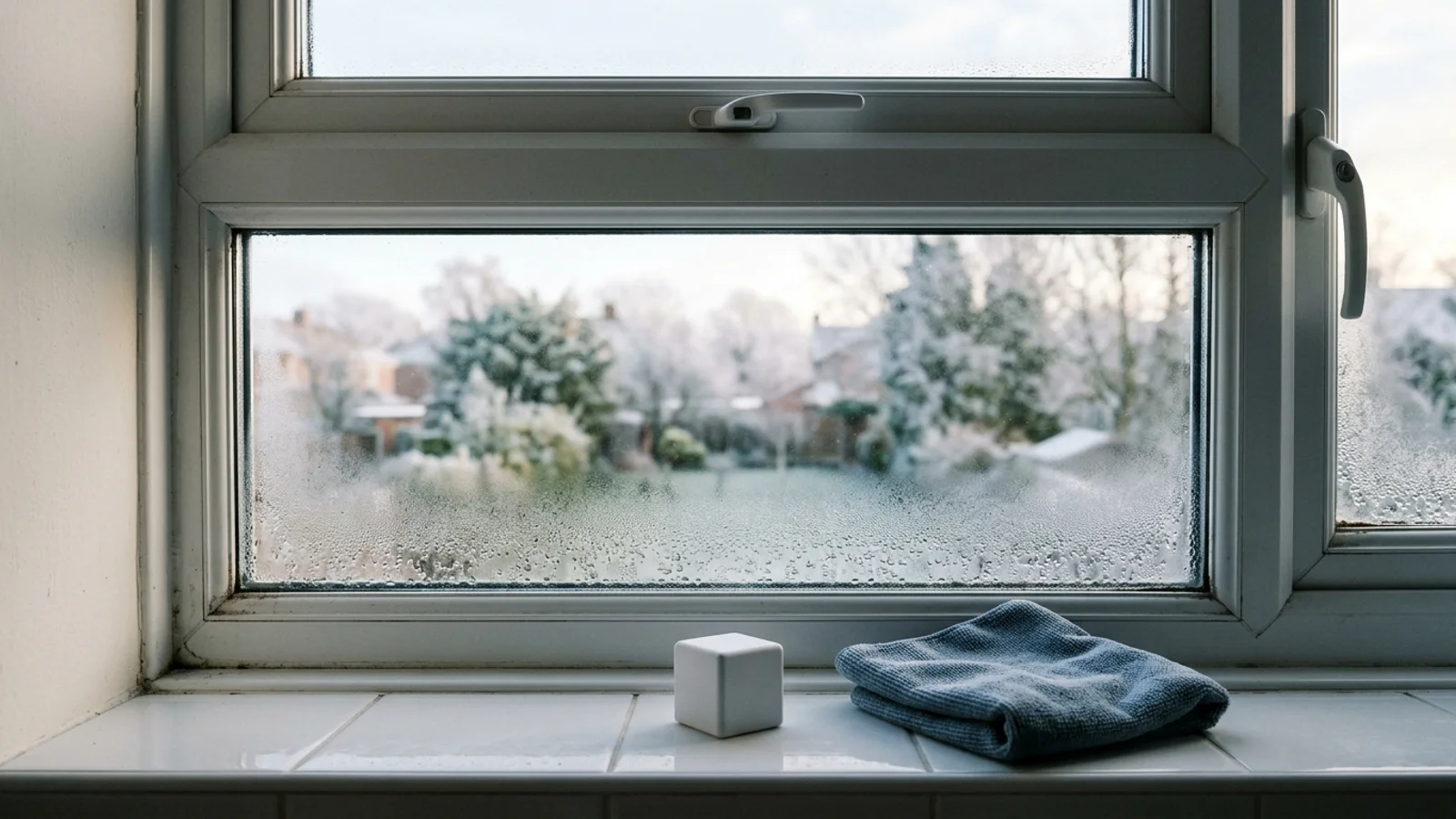
Wiping black spots off a cold bedroom window frame every November feels like a cleaning chore until the paint behind the chest of drawers begins to blister. In British winter housing, visible damp rarely comes from a single habit; cold thermal bridges in masonry walls, trickle vents painted shut, and weak bathroom extract fans trap household moisture indoors against freezing exterior surfaces.
This triage separates indoor condensation from penetrating rain and rising damp, checks whether your existing ventilation moves air, and calculates the electricity cost of compressor versus desiccant dehumidifiers. If you simply need a generic pane-by-pane droplet log before calling a window technician, use our window moisture observation guide; this UK winter triage covers extract-fan testing, building-fabric clues, and tenant repair records.
Health boundaries and UK housing duties
UK Government guidance from MHCLG, DHSC, and UKHSA links prolonged indoor damp and mould to respiratory inflammation, asthma flare-ups, and allergic reactions, especially in babies, older adults, and people with chronic lung conditions. Where Aspergillus spores trigger persistent wheeze, chest tightness, or coughing up mucus, the NHS Aspergillosis guidance advises prompt medical assessment rather than home scrubbing alone.
Renters frequently hear that condensation comes solely from drying laundry indoors or keeping windows shut. The Housing Ombudsman damp and mould learning resource explicitly rejects blaming tenant “lifestyle” when ventilation, insulation, or building fabric fails to cope with ordinary living moisture. Note that the Housing Ombudsman and England’s statutory Awaab’s Law framework govern England specifically; tenants in Scotland, Wales, and Northern Ireland hold parallel rights under devolved housing fitness standards and local council environmental health teams.
Three UK damp mechanisms compared
Before adjusting radiators or buying equipment, map where moisture sits on the building envelope. Condensation follows cold indoor surfaces, penetrating damp tracks external water entry, and rising damp climbs from ground level.
Scroll sideways to read the enlarged diagram.
Worked dew-point example for a UK bedroom
Condensation begins the moment warm, moisture-laden indoor air touches a surface colder than its dew point. Consider a typical UK bedroom kept at 18 °C with 70% relative humidity (RH) after two adults sleep with the door closed and trickle vents shut:
- Room condition:
T = 18 °C,RH = 70%. - Magnus-formula dew point:
Td ≈ 12.4 °C(calculated witha = 17.625,b = 243.04 °C). - Critical threshold: Any glazing edge, aluminium spacer bar, uninsulated concrete lintel, or external masonry corner below
12.4 °Ccollects liquid water overnight.
Lowering room humidity to 55% RH at the same 18 °C temperature drops the dew point to 8.8 °C, giving the window edge and outer wall corners 3.6 °C of extra margin before droplets form. Raising overnight background heat slightly from 15 °C to 18 °C helps only when moist air also leaves the room; warming a sealed room without air exchange lets the air hold more total water until it hits the first cold corner.
| Visual Clue | Likely Mechanism | Quick Field Check | Repair Owner / Next Action |
|---|---|---|---|
| Droplets along bottom glass seal each morning, dry by afternoon | Indoor condensation on cold glazing | Measure morning T and RH; check trickle vent airflow | Clear trickle vents, test extract fans, cut overnight moisture load |
| Fuzzy black mould in upper exterior corners or behind wardrobe | Thermal bridge plus trapped humid air | Pull furniture 50–75 mm off cold outer wall; check wall temperature feel | Boost steady heating + ventilation; landlord checks cavity/lintel insulation |
| Isolated brown-edged wet patch on chimney breast or mid-wall | Penetrating damp (or chimney condensation) | Photograph after heavy wind-driven rain; look outside at gutters and render | Landlord / roofer clears gutters, repairs pointing, flashing, or render |
| Tide mark up to 1 m on ground floor with white powdery salts and crumbling plaster | Bridged damp-proof course, rising damp, or subfloor pipe leak | Check exterior paving/flowerbed height against DPC line (aim for 150 mm clearance) | Landlord / qualified surveyor inspects DPC bridging, drains, and subfloor pipes |
Field tests for extract fans and trickle vents
A noisy bathroom fan often spins dust without exhausting steam. Run two five-minute physical checks before assuming your ventilation works.
First, run the A4 tissue-paper suction test on every kitchen and bathroom extract fan. Close the room door, switch the fan on, and hold a single flat sheet of toilet tissue against the extract grille:
- Pass: The fan pulls the tissue flat against the grille and holds it there unaided until you switch the fan off or close the overrun timer.
- Fail: The tissue flutters weakly or drops to the floor. Common UK failures include clogged insect mesh behind the grille, disconnected flex ducting in the loft void, a jammed external gravity flap, or a painted-over wall cowl.
Second, inspect window trickle vents and bathroom door undercuts. Hold the back of your wet hand or an incense stick near open trickle vents on a breezy day; you should feel gentle incoming air rather than stale dead air. Check the bottom gap under bathroom and kitchen doors: extract fans cannot pull air out of a sealed room unless roughly 10 mm of clearance exists beneath the door to let replacement air enter.
Also verify how the fan runs. A fan wired only to the light switch without a 15-to-20-minute overrun timer stops clearing steam the second you leave the bathroom, leaving several litres of hot-shower vapour inside the flat.
Dehumidifier running cost and cold-room limits
Portable dehumidifiers pull water out of indoor air when ventilation and background heat fall short, such as during freezing fog or in flats without outdoor drying space. Choosing the wrong technology wastes electricity in cold British rooms.
| Feature | Refrigerant (Compressor) Dehumidifier | Desiccant (Zeolite Rotor) Dehumidifier |
|---|---|---|
| Best room temperature | 16 °C and above (heated living rooms, bedrooms) | 1 °C to 15 °C (unheated utility rooms, porches, conservatories, garages) |
| Cold-weather failure mode | Evaporator coils ice up below ~15 °C; unit spends cycles defrosting and extracts very little water | Maintains steady extraction near freezing, though draws higher continuous wattage |
| Typical input power | 180 W to 250 W (example 220 W for a 12–20 L/day unit) | 350 W to 650 W (example 600 W on standard laundry/high mode) |
| Secondary effect | Slight warming (~220 W net heat) | Exhaust air leaves 5–10 °C warmer than intake (useful in cold drying rooms) |
Worked electricity calculation (kWh/day)
To compare daily electricity consumption across both unit types running for a 6-hour winter laundry or evening drying cycle:
- Compressor unit (
220 W):0.22 kW × 6 h = 1.32 kWh/day. - Desiccant unit (
600 W):0.60 kW × 6 h = 3.60 kWh/day.
At a 220 W compressor draw, a 6-hour evening cycle consumes 1.32 kWh, whereas a 600 W desiccant unit uses 3.60 kWh (2.73× the electricity) for the same runtime. Skip a desiccant model for a heated 19 °C living room, where a compressor machine extracts more litres per kWh; conversely, skip a compressor model in an unheated 9 °C conservatory or back porch where frost cycling drops extraction close to zero.
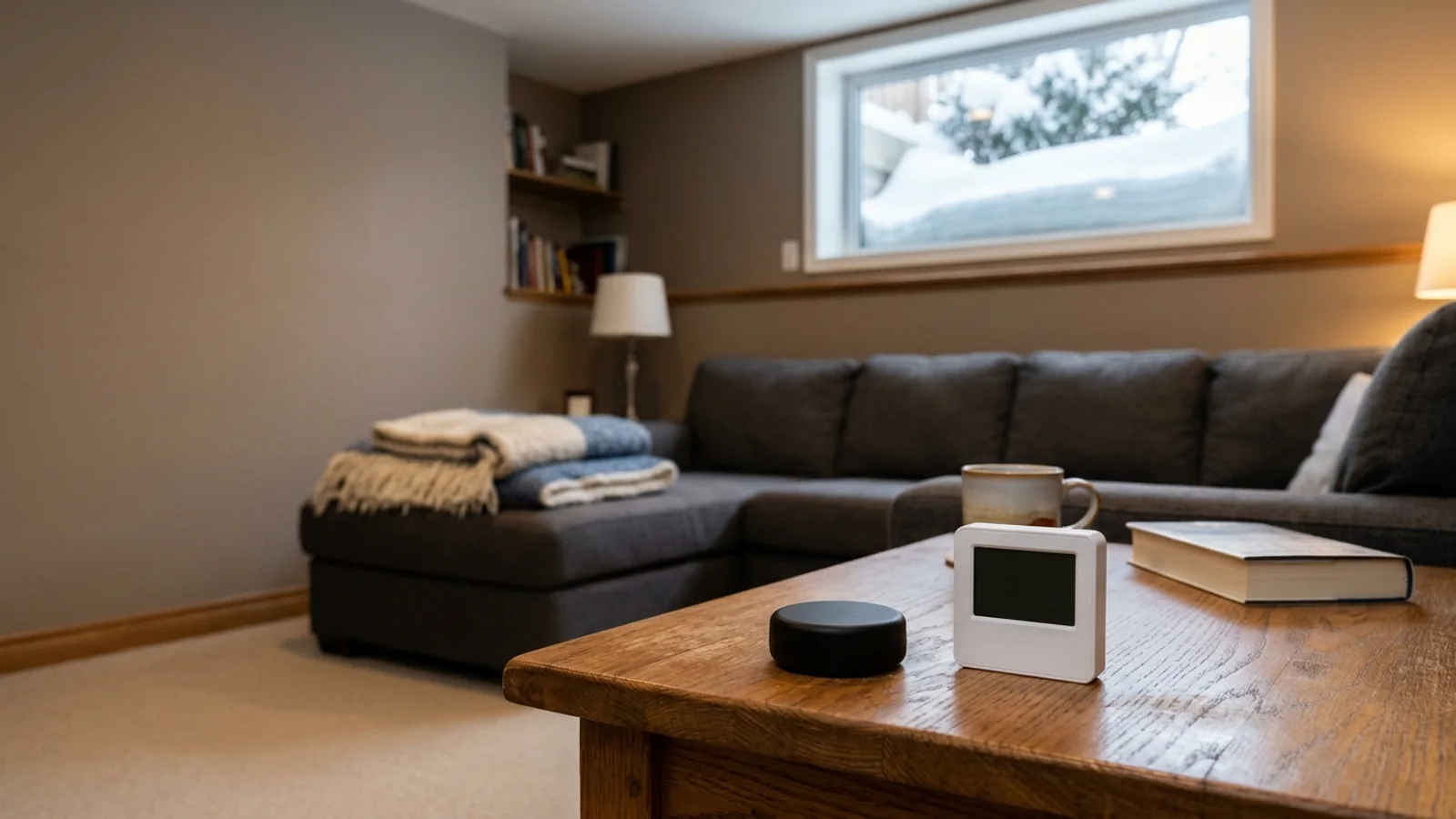
For basement or whole-floor sizing rules once you know your room temperature range, see our dehumidifier sizing and placement guide. Always verify room temperature and humidity with a calibrated or standalone digital hygrometer before purchasing capacity.
ThermoPro TP50 Digital Hygrometer & Indoor Thermometer
- Humidity range and accuracy
- 10% to 99% RH (±2% RH within 30–80% RH; ±3% RH outside)
Why it fits Tracks live indoor temperature, relative humidity (±2% RH across 30–80% RH), and 24-hour high/low peaks on a standalone AAA battery display so you can calculate dew point and log morning conditions without Wi-Fi.
Key trade-off Local spot-display and 24-hour high/low memory only — does not log multi-week timestamps or send mobile phone alerts when away from home.
Specifications & research
Room telemetry baseline. Source records checked on 2026-11-12. Manufacturer research, not hands-on testing.
- Temperature range and accuracy
- -58.0°F to 158.0°F (±1.0°F accuracy) · Source checked 2026-11-12
- Humidity range and accuracy
- 10% to 99% RH (±2% RH within 30–80% RH; ±3% RH outside) · Source checked 2026-11-12
- Mounting and power
- Magnetic back + tabletop stand; 1× AAA battery powered · Source checked 2026-11-12
Manufacturer documentation. Confirm exact ThermoPro model specifications and household safety limits before buying.
Seven-day tenant and homeowner inspection checklist
A 7-day dated record gives a landlord, managing agent, or building surveyor concrete evidence instead of vague complaints about steam. Log readings at the same morning and evening times for one full week:
- Day 1 baseline: Place a digital hygrometer 1 m off an external wall and away from radiators; record morning
°Cand% RHin the worst bedroom before opening curtains. - Extract-fan tissue check: Test kitchen cooker-hood and bathroom extract fans with a single sheet of toilet tissue; note pass/fail, noise, and whether the overrun timer runs at least 15 minutes after lights go off.
- Trickle vents and door undercuts: Check every window trickle vent slider is unlocked and unblocked by paint, and verify a ~
10 mmairflow gap beneath bathroom and kitchen doors. - Furniture standoff: Pull wardrobes, headboards, and bookshelves
50–75 mmaway from cold external walls and mark whether plaster behind them feels cold, damp, or crumbly. - Rain-correlation check: Photograph any mid-wall or ceiling stain after heavy rain, then inspect exterior gutters, downpipes, overflow pipes, and window sealant from ground level (never climb onto wet roofs or lean out upper windows).
- Ground-level DPC check: Walk the outside perimeter of ground-floor rooms to confirm soil, gravel, or decking sits at least
150 mmbelow the visible damp-proof course or airbricks. - 7-day summary packet: Bundle dated room photos, morning/evening
°Cand% RHrows, fan tissue results, and weather notes into one written repair request to your landlord or damp surveyor.
When DIY ventilation will not fix the damp
Wiping sills and running a dehumidifier cannot cure a leaking soil stack, blocked valley gutter, defective cavity-wall insulation, or bridged damp-proof course. Stop trying to manage structural damp through extra heating bills alone if wall stains expand after rain, skirting boards turn spongy, white salt crystals push through ground-floor paint, or relative humidity stays below 55% RH while plaster remains wet.
In rented homes in England, keep dated copies of your 7-day inspection log and written repair messages. If the landlord fails to inspect or fix persistent damp and mould within reasonable statutory timeframes, escalate to your local council’s environmental health team or, for social housing tenants, the Housing Ombudsman Service.