In this guide Jump to a section
- Engineering Baseline & Primary Fit: How to Power a 240V Submersible Well Pump
- Submersible 240V Well Pump Running vs. Startup Surge Sizing Table
- The “Batch-Pressurization” Fuel-Saving Trick for Well Owners
- Operational Boundaries & When to Skip: How to Power a 240V Submersible Well Pump
- Related Guides, Equipment & Planning Tools: How to Power a 240V Submersible Well Pump
Engineering Baseline & Primary Fit: How to Power a 240V Submersible Well Pump
If your rural or suburban home relies on a private deep-well pump, losing grid electricity means losing both power and running water simultaneously. Unlike a 120V kitchen refrigerator, residential submersible well pumps (buried 30 to 150+ meters underground) are hardwired 240-volt split-phase motors that demand 3x to 4x their running wattage for half a second to overcome underwater water-column inertia at startup.
A standard 120V portable power station or 2,200W suitcase generator cannot start or run a 240V well pump. To keep well water flowing during multi-day blackouts, wire your well pump’s double-pole 240V breaker into a 240V manual transfer switch (such as the Reliance Pro/Tran2 310C) and size a 240V L14-30 or 14-50R generator using the Locked-Rotor Surge table below.
Submersible 240V Well Pump Running vs. Startup Surge Sizing Table
| Well Pump Motor Horsepower | Running Wattage (240V) | Startup Surge (LRA Inrush) | Minimum Generator Size (Without Soft Start) | Minimum Generator Size (With Soft-Start Controller) |
|---|---|---|---|---|
| 1/2 HP (240V Submersible) | ~1,000W – 1,200W | 2,800W – 3,500W | 4,500W – 5,000W (240V) | 3,500W (240V) |
| 3/4 HP (240V Submersible) | ~1,400W – 1,650W | 3,800W – 4,800W | 6,500W – 7,500W (240V) | 4,500W (240V) |
| 1.0 HP (240V Submersible) | ~1,800W – 2,100W | 4,800W – 6,200W | 8,000W – 9,500W (240V) | 5,500W (240V) |
| 1.5 HP (240V Deep Well) | ~2,400W – 2,800W | 6,500W – 8,500W | 10,000W – 12,000W (240V) | 7,000W (240V) |
The “Batch-Pressurization” Fuel-Saving Trick for Well Owners
You do not need to leave a thirsty 9,000W generator roaring 24 hours a day just to have tap water:
- Keep your well pump’s transfer switch flipped
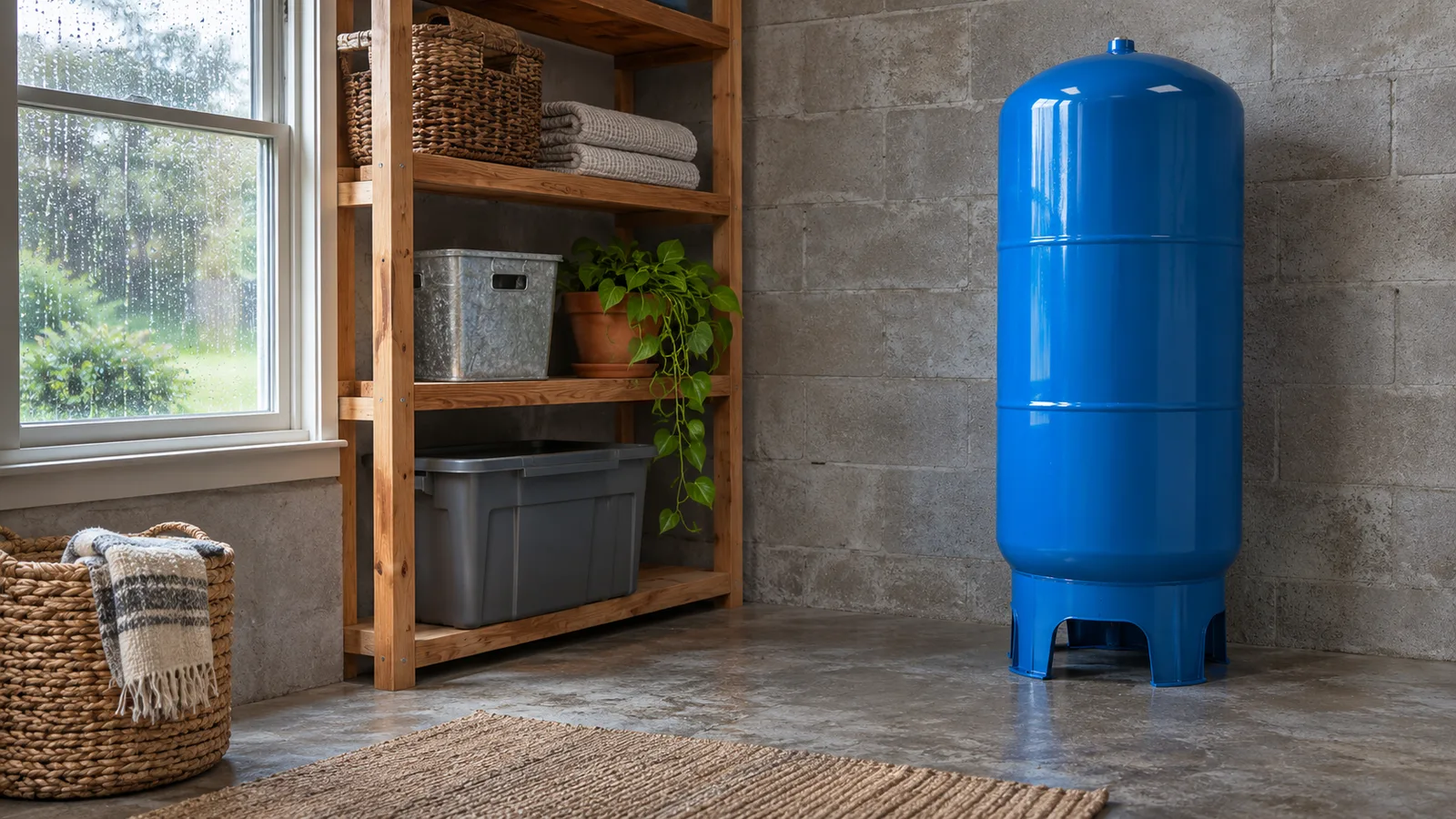
OFFduring the day while you use the 10 to 20 gallons of pressurized drawdown water stored inside your basement blue bladder pressure tank. - Twice a day (morning and evening), start your 240V generator, flip the well pump switch to
GENfor 5 to 10 minutes until the pressure gauge hits 60 PSI and clicks off—while simultaneously filling your kitchen pitchers and recharging your indoor LFP power stations—then shut the generator off completely.
Operational Boundaries & When to Skip: How to Power a 240V Submersible Well Pump
If you have a shallow well (< 7.5 meters / 25 feet static water level), installing a manual hand-lever pitcher pump (such as a Bison or Simple Pump) alongside your electric drop pipe gives you 100% fuel-free water access even if your generator breaks.
Related Guides, Equipment & Planning Tools: How to Power a 240V Submersible Well Pump
Use our browser-local Calculate Your Household Emergency Water Storage Volume to model your exact household numbers before purchasing hardware. Compare detailed manufacturer specifications in our British Berkefeld 8.5L Gravity Water Filter Equipment Guide and Katadyn Micropur MP1 Chlorine Dioxide Tablets Equipment Guide, and integrate this setup with our How to Calculate Emergency Water Storage for a Family of 4 and Emergency Water Purification Methods Compared.
XL Upgrade · 4 kWh 120V/240V Station
EcoFlow DELTA Pro 3
- Continuous AC output
- 4,000 W
Why it fits Documented specification match for well pump backup power 240v sizing guide planning, verify exact model compatibility, dimensions, and household capacity before ordering.
Key trade-off A single US DELTA Pro does not provide 240 V output. Two DELTA Pro units and a compatible separately sold Double Voltage Hub or Smart Home Panel are required; home-panel connections require qualified electrical work.
Specifications & research
Model alternative. Source records checked on 2026-08-20. Manufacturer research, not hands-on testing.
- Nominal capacity
- 4,096 Wh · Source checked 2026-08-20
- Continuous AC output
- 4,000 W · Source checked 2026-08-20
- Base-unit weight
- 113.54 lb · Source checked 2026-08-20
Manufacturer documentation. Confirm the exact model, connections, and load requirements before buying.