In this guideJump to a section
The quiet after a flush makes it easy to miss a toilet that starts running again ten minutes later. The sound and refill pattern can narrow what to check, but they do not name a failed part. Before buying anything, record the toilet brand and model and match the part in the maker’s own lookup.
The household water-use audit already includes EPA’s dye test for detecting a tank-to-bowl leak. This page goes one step further: it helps sort visible symptoms into fill/overflow versus flush-seal questions and gives you a model-specific service record. It is not a universal repair guide.
Observe the cycle before touching anything
Listen after one normal flush. If the design has a tank lid that can be lifted safely and easily, follow the maker’s instructions and observe without moving parts. Leave it alone if the lid is heavy, fixed, cracked, unfamiliar, or hard to reach. A tankless or pressure-assisted toilet may need a different service path; record the model and use its own manual.
| What you observe | Mechanism to ask the maker or plumber about | What the observation cannot prove |
|---|---|---|
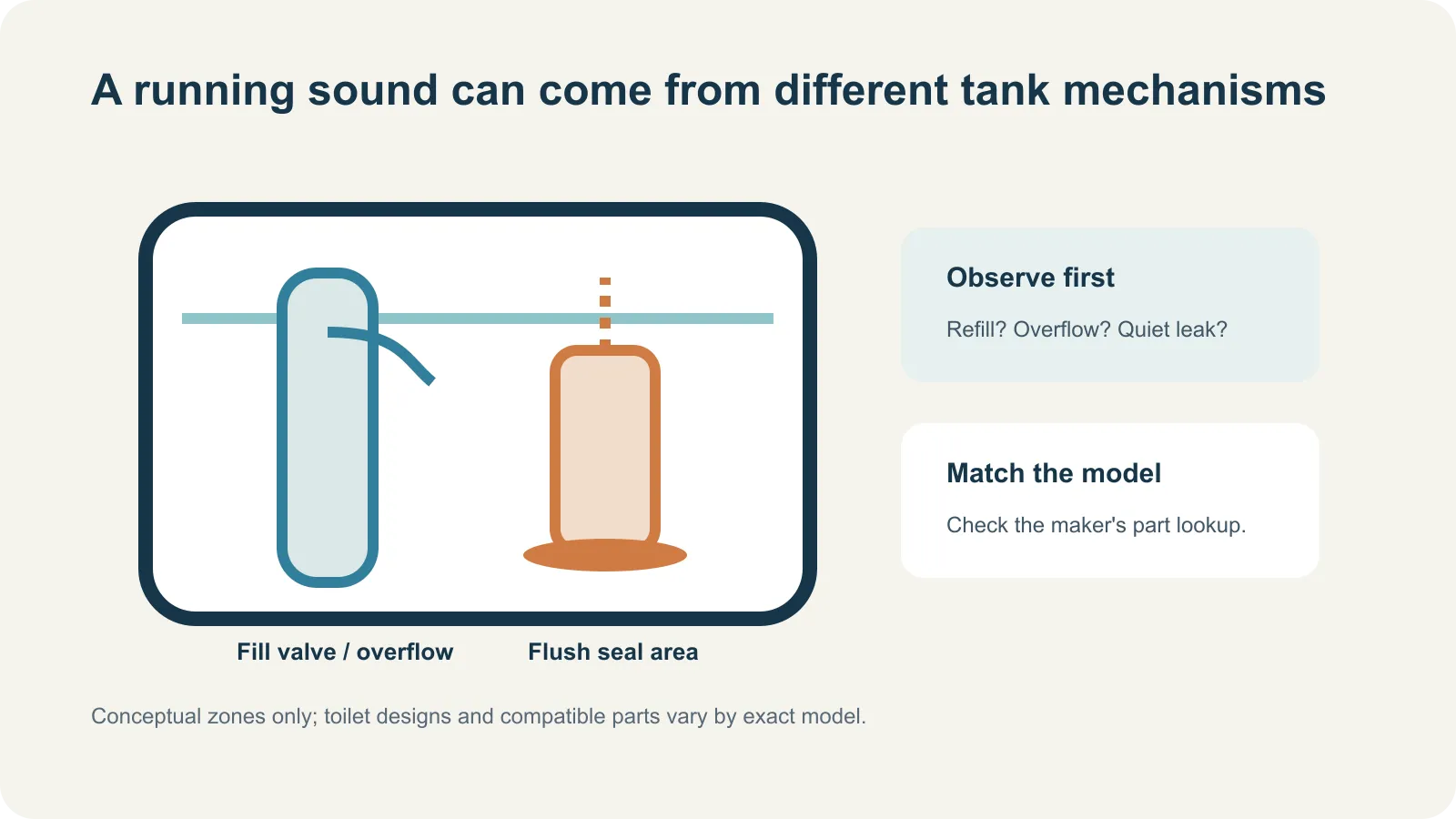
| Water seems to keep entering the tank, or the level reaches the overflow | Fill valve or water-level/overflow behavior | It does not prove the valve is defective; settings and designs differ |
| Toilet refills briefly after a quiet pause | Water may be slipping from tank to bowl past a flush seal, followed by a refill | It does not establish that a flapper, canister seal, or other part needs replacement |
| Running begins immediately after the flush and the lever does not return freely | Lever or chain movement may be part of the symptom | It does not prove an adjustment will fix the problem |
| A colored-water test shows color in the bowl before flushing | Tank-to-bowl leakage is present during that test | EPA’s test detects leakage; it does not identify the leaking component |
KOHLER Assist describes several possible causes on Kohler one- and two-piece toilets, including a binding lever, water reaching the overflow, or debris at the fill-valve cap. It says the replacement fill-valve part number varies with the toilet model. Treat these as maker-specific possibilities, not a diagnosis or instructions for other brands.
Check the model before selecting a part
Look for the brand and model number in the toilet paperwork or the manufacturer’s product-identification instructions. For a Kohler toilet, use Kohler Service & Replacement Parts to identify the product and consult its service-parts book or model page. For another brand, use that maker’s official model lookup and exact installation/service manual. If the model is missing or the product does not match the support page, ask the maker or a plumber rather than choosing by shape alone.
A familiar-looking flapper may have the wrong diameter, hinge, or chain arrangement. Canister seals, flush-valve assemblies, fill valves, and pressure-assisted parts also vary. Record the part number and manual revision before ordering; do not assume “universal” means compatible with this toilet.
Toilet service record
| Field | Record |
|---|---|
| Date | |
| Brand and complete model | |
| Tank type or visible style | |
| What happens after a normal flush | |
| Dye test result, if separately performed | |
| Maker source and exact part number checked | |
| Manager, maker or plumber response |
An entry such as “refills briefly after a quiet pause; model not confirmed; ask the manager” is useful without guessing which seal is defective.
If water is overflowing or running continuously, contact the owner/manager or a plumber about the next safe step. In a rental or shared building, do not make changes to the toilet or its water controls without permission. Once the source is confirmed, add the repair and follow-up meter check to the water-use audit; that guide’s meter record can help track usage, but it does not identify a toilet part.