In this guide Jump to a section
- Engineering Baseline & Primary Fit: How to Safely Drain 40 Gallons of Drinking
- Step-by-Step Water Heater Extraction Sequence
- Two Common Water Heater Drain Obstacles (And How to Fix Them)
- Readiness Checklist
- Operational Boundaries & When to Skip: How to Safely Drain 40 Gallons of Drinking
- Related Guides, Equipment & Planning Tools: How to Safely Drain 40 Gallons of Drinking
Engineering Baseline & Primary Fit: How to Safely Drain 40 Gallons of Drinking
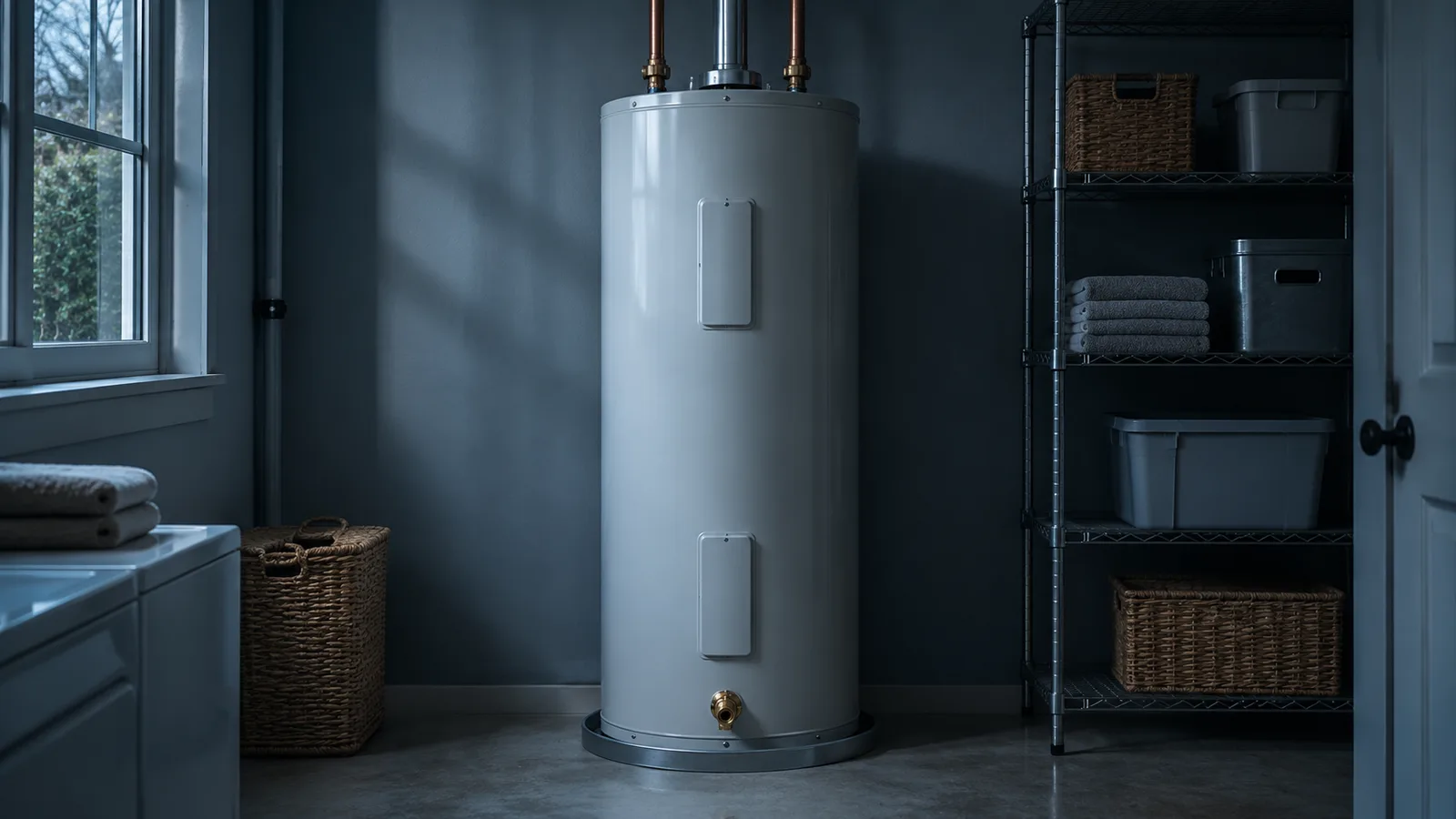
If an earthquake or hurricane severs municipal water mains before you fill your bathtub or jugs, your home’s tank-style water heater is an emergency reservoir holding 150 to 190 liters (40 to 50 gallons) of clean potable water.
However, draining it incorrectly can burn out electric heating elements, flood your utility closet, or trap water inside via vacuum lock. Follow this exact 5-step sequence: (1) cut power/gas to the heater first (flip the 240V breaker OFF or turn the gas thermostat dial to OFF); (2) close the cold-water inlet valve at the top of the tank so dirty street water cannot siphon back in; (3) attach a clean white food-grade RV drinking hose to the bottom drain valve; (4) open an upstairs hot-water faucet to break the vacuum lock; and (5) strain the water through a coffee filter or Sawyer Squeeze to catch harmless mineral scale from the bottom of the tank.
Step-by-Step Water Heater Extraction Sequence
| Step | Valve / Control Component | Exact Action | Critical Safety Reason |
|---|---|---|---|
| 1 | Electrical Breaker or Gas Control | Flip 240V double-pole breaker OFF (or turn gas valve dial to OFF) | Prevents dry-firing heating elements when power returns |
| 2 | Top Cold-Water Inlet Valve | Turn quarter-turn lever perpendicular (or clockwise) to CLOSED | Stops contaminated/depressurized city lines from siphoning into tank |
| 3 | Bottom Brass Drain Valve | Screw on a clean white NSF-61 drinking water hose routed to a pitcher | Avoids using dirty outdoor garden hoses containing rubber/lead leachates |
| 4 | Upstairs Hot-Water Faucet | Open the HOT tap on the highest floor of your house | Lets air enter the top of the tank to break vacuum lock so water flows |
| 5 | Sediment Filtration | Pour drained water through a coffee filter or 0.1-micron Sawyer filter | Removes harmless calcium carbonate flakes settled at the tank bottom |
Two Common Water Heater Drain Obstacles (And How to Fix Them)
- Clogged Plastic Factory Drain Valve: Many builder-grade water heaters ship with a cheap plastic bottom drain spigot whose narrow orifice clogs instantly with calcium sediment. If water barely trickles out even with an upstairs hot faucet open, close the drain valve, disconnect the hose, and gently poke a clean wooden skewer or stiff wire inside the open valve stem to clear the mineral crust (keeping a bucket right underneath).
- Sulfur / “Rotten Egg” Smell in Well-Water Tanks: If your home is on a private well and the tank’s magnesium anode rod reacts with sulfate bacteria, drained water may smell faintly of sulfur. Boiling the water for 1 minute or pouring it through a carbon filter (British Berkefeld / LifeStraw Home) removes the odor completely.
Readiness Checklist
- Store a dedicated 6-foot white food-grade RV hose + flathead screwdriver beside your water heater: Many brass water heater drain valves lack a wheel handle and require a flathead screwdriver or wrench to open the slot.
- Refill the tank completely BEFORE turning power or gas back on: When city water service returns, open the cold inlet valve and wait until a steady, air-free stream flows out of your upstairs hot faucet before restoring electricity or relighting the pilot.
Operational Boundaries & When to Skip: How to Safely Drain 40 Gallons of Drinking
Tankless (on-demand) water heaters (Rinnai, Navien, Rheem) contain only ~1 liter (1 quart) of water inside narrow copper heat-exchanger coils—they provide virtually zero emergency drinking reserve (though you should still drain that 1 liter during a winter blackout so the coils don’t freeze and crack).
Related Guides, Equipment & Planning Tools: How to Safely Drain 40 Gallons of Drinking
Use our browser-local Calculate Your Household Emergency Water Storage Volume to model your exact household numbers before purchasing hardware. Compare detailed manufacturer specifications in our British Berkefeld 8.5L Gravity Water Filter Equipment Guide and Katadyn Micropur MP1 Chlorine Dioxide Tablets Equipment Guide, and integrate this setup with our How to Calculate Emergency Water Storage for a Family of 4 and Emergency Water Purification Methods Compared.
WaterBOB 100-Gallon Food-Grade Emergency Bathtub Water Containment Bladder
- Filled total weight
- ~380 kg (835 lbs)
Why it fits Documented specification match for how to drain water heater for emergency drinking water planning—verify exact model compatibility, dimensions, and household capacity before ordering.
Key trade-off The WaterBOB is strictly a single-use emergency bladder. Because the narrow 5 cm fill port prevents thorough scrubbing and air-drying inside the collapsed film, moisture trapped inside after draining will breed biofilm and mold. Discard the liner after the emergency ends and replace it with a fresh sealed box.
Specifications & research
Model alternative. Source records checked on 2026-11-16. Manufacturer research, not hands-on testing.
- Maximum capacity
- 378 Liters (100 Gallons) · Source checked 2026-11-16
- Filled total weight
- ~380 kg (835 lbs) · Source checked 2026-11-16
- Liner material
- BPA-Free FDA Food-Grade 12-Mil LLDPE · Source checked 2026-11-16
Manufacturer documentation. Confirm exact WaterBOB model specifications and household safety limits before buying.