In this guideJump to a section
An apartment resident usually cannot install a transfer switch, rewire branch circuits or place a fuel generator on a balcony. But that does not make every outage solution unavailable. The useful question is which small, verified household function can be backed up safely without altering shared equipment.
For broader household supplies and communication planning, see apartment emergency preparedness. For router wattage and runtime, see backup power for electronics.
Match the equipment to the task
| Household need | Portable option to evaluate | What it cannot guarantee |
|---|---|---|
| Phone contact and short alerts | Correctly rated power bank and charging cable | Mobile network availability or unlimited charging |
| Nighttime navigation | Battery or rechargeable LED flashlight | Building stairwell or exit-lighting service |
| Internet gateway | Compatible UPS sized for all required network hardware | Outside ISP/ONT service or live cell coverage |
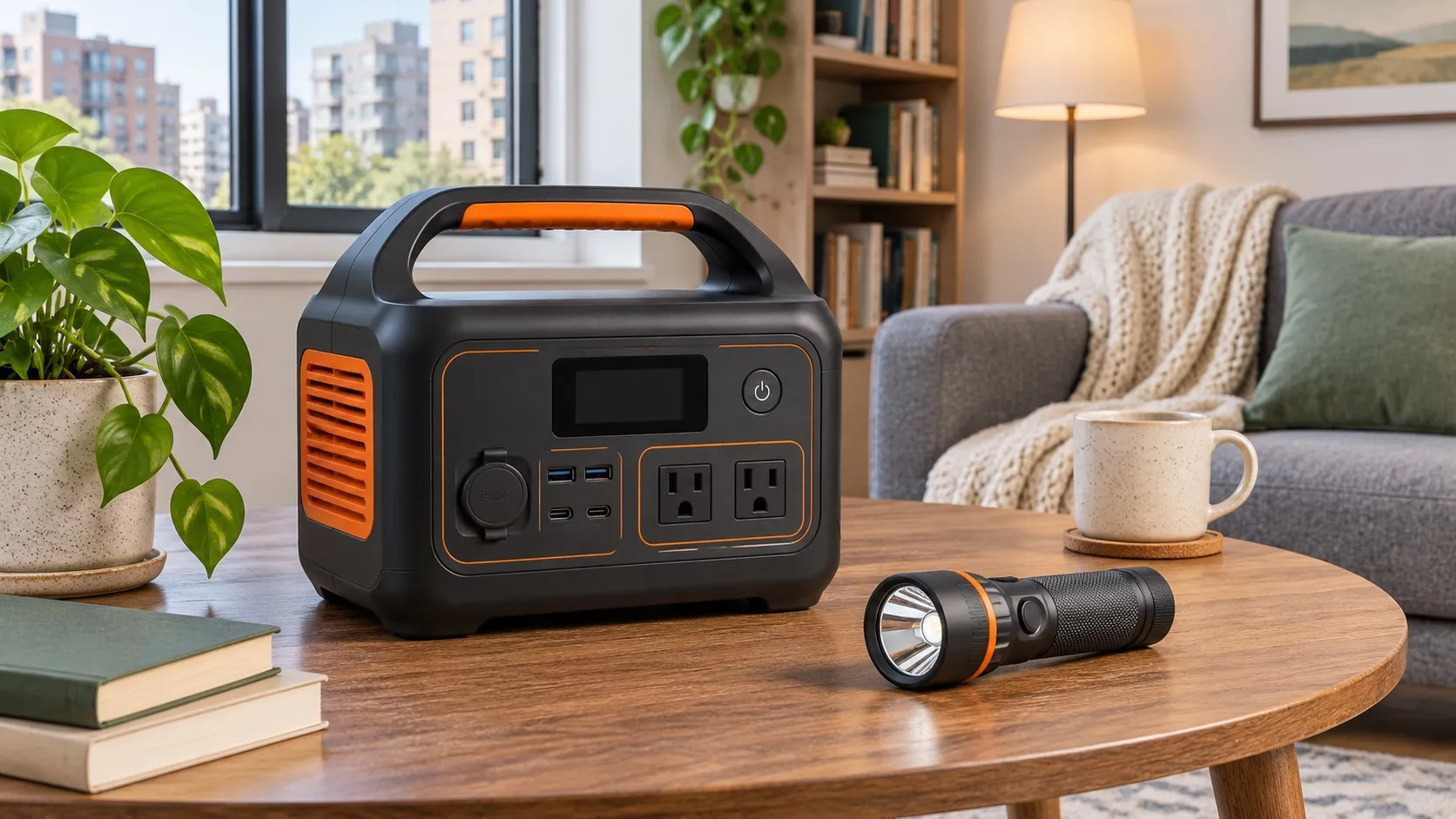
| Selected low-watt AC appliance | Portable listed battery station with compatible output | Motor startup, every socket, or continuous large heating |
| Elevator, building pump or corridor | Building management’s approved backup plan | A personal station powering shared building equipment |
Before an outage, list the small loads that matter to your household and check each device’s label and maker-approved charging instructions. A backup source is useful only when its output, connector and permitted use fit the specific load.
Three power outages can look identical
During ISP failure, backup electricity will not restore upstream internet. During router power failure, a properly sized compatible UPS may help while its battery lasts. During building power failure, powered doors, water pressure, elevators and HVAC may all have separate limitations. Ask management what is backed up; a personal battery does not provide permission to open utility cabinets.
For an essential powered medical or mobility device, work with the device supplier and care team on an approved backup and accessible relocation plan. Do not rely on an untested consumer station or blog runtime calculation.
Fuel is not an apartment workaround
The CDC power-outage safety guidance warns that generators, grills and camping stoves release deadly carbon monoxide. Never operate a generator inside an apartment. CDC says a generator must be outdoors at least 20 feet from every window, door and vent; building and local rules also control. A balcony is not automatically a safe or permitted location. Never use a charcoal grill, hibachi, lantern or portable camping stove inside a home.
A portable battery is different because it is not burning fuel, but damaged batteries and unsuitable chargers still create fire/electrical hazards. Do not block exits, use unsafe extension leads, or connect a station’s AC outlet to a wall receptacle to power the apartment.
Medium · 1 kWh Core Baseline
EcoFlow DELTA 3
- Continuous AC output
- 1,800 W
Operates completely emission-free indoors, delivering 1,800 W pure sine wave power to run refrigerators, medical devices, and laptops without violating lease combustion rules.
Check first: Use the exact DELTA 3 (EF-DL-H10-3) manual; do not transfer specifications from DELTA 3 Plus or DELTA 3 Classic variants.
Specifications & research
1,024 Wh indoor-safe apartment battery. Source records checked on 2026-10-04. Manufacturer research, not hands-on testing.
- Nominal capacity
- 1,024 Wh · Source checked 2026-10-04
- Continuous AC output
- 1,800 W · Source checked 2026-10-04
- Base-unit weight
- 27.6 lb · Source checked 2026-10-04
Manufacturer documentation. Confirm the exact model, connections, and load requirements before buying.
Medium · 1 kWh Rapid-Charge LFP
Anker SOLIX C1000 Gen 2
- Continuous AC output
- 2,000 W
Compact design fits into standard apartment closets with sub-30dB low-noise operation, suitable for bedroom CPAP machines and living space lighting.
Check first: The manual describes SurgePad up to 2,400 W, says it works better with heat-generating loads, does not support precision instruments or strict-voltage devices, and does not operate in bypass mode. Do not use this as a general motor-start or surge rating.
Specifications & research
1,056 Wh whisper-quiet LiFePO4 station. Source records checked between 2026-10-04 and 2026-10-22. Manufacturer research, not hands-on testing.
- Nominal capacity
- 1,024 Wh · Source checked 2026-10-22
- Continuous AC output
- 2,000 W · Source checked 2026-10-22
- Base-unit weight
- 24.9 lb · Source checked 2026-10-04
Manufacturer documentation. Confirm the exact model, connections, and load requirements before buying.
Compact Lantern · AA Battery Room Light
Streamlight Siege AA Lantern (AA version; not Siege X / D-cell Siege)
- Battery
- 3 AA alkaline cells, sold separately
Rugged, diffused LED illumination eliminates open-flame candle fire risks in apartments, delivering 200 lumens with emergency red SOS signaling mode.
Check first: Battery runtime varies with cell condition and use; no rechargeability is built into the AA model.
Specifications & research
Compact battery LED lantern for indoor navigation. Source records checked on 2026-10-25. Manufacturer research, not hands-on testing.
- Listed light output and modes
- White: 200/100/50 lm high/medium/low; red 0.7 lm · Source checked 2026-10-25
- Battery
- 3 AA alkaline cells, sold separately · Source checked 2026-10-25
- Manufacturer runtime by mode
- White: 7/15.5/37 h high/medium/low; red steady: 192 h; SOS: 288 h · Source checked 2026-10-25
Manufacturer documentation. Keep individual task lighting and device charging separate from shared room illumination.
Renter backup power load card
| Load/model | Actual input W or Wh/day | Backup option and compatible outlet | Verified safe runtime | Building/owner limitation |
|---|---|---|---|---|
| Phone(s) | ||||
| Router + ONT, if in unit | ||||
| Light or approved appliance | ||||
| Essential care needs |
Test only ordinary low-risk loads according to the maker’s instructions and record realistic conditions. Stop if the equipment overheats, trips protection or has visible damage.
Next action: list two critical small loads and calculate their separate power paths before buying anything.