In this guide Jump to a section
- Compare messaging, SOS, and service plans
- Satellite Communicators vs. Smartphone Satellite Services Compared (2026)
- Why Cross-Linked Iridium Satellites Beat Bent-Pipe Networks in Disasters
- Satellite Comms Readiness & Field Troubleshooting
- Where satellite features have limits
- Put satellite messaging into an outage plan
Compare messaging, SOS, and service plans
During Category 5 hurricanes, major earthquakes, and wide-area wildfires, cellular networks fail in two waves: first, millions of callers saturate voice channels within 15 minutes; second, cell tower backup generators run dry 8 to 36 hours into the blackout.
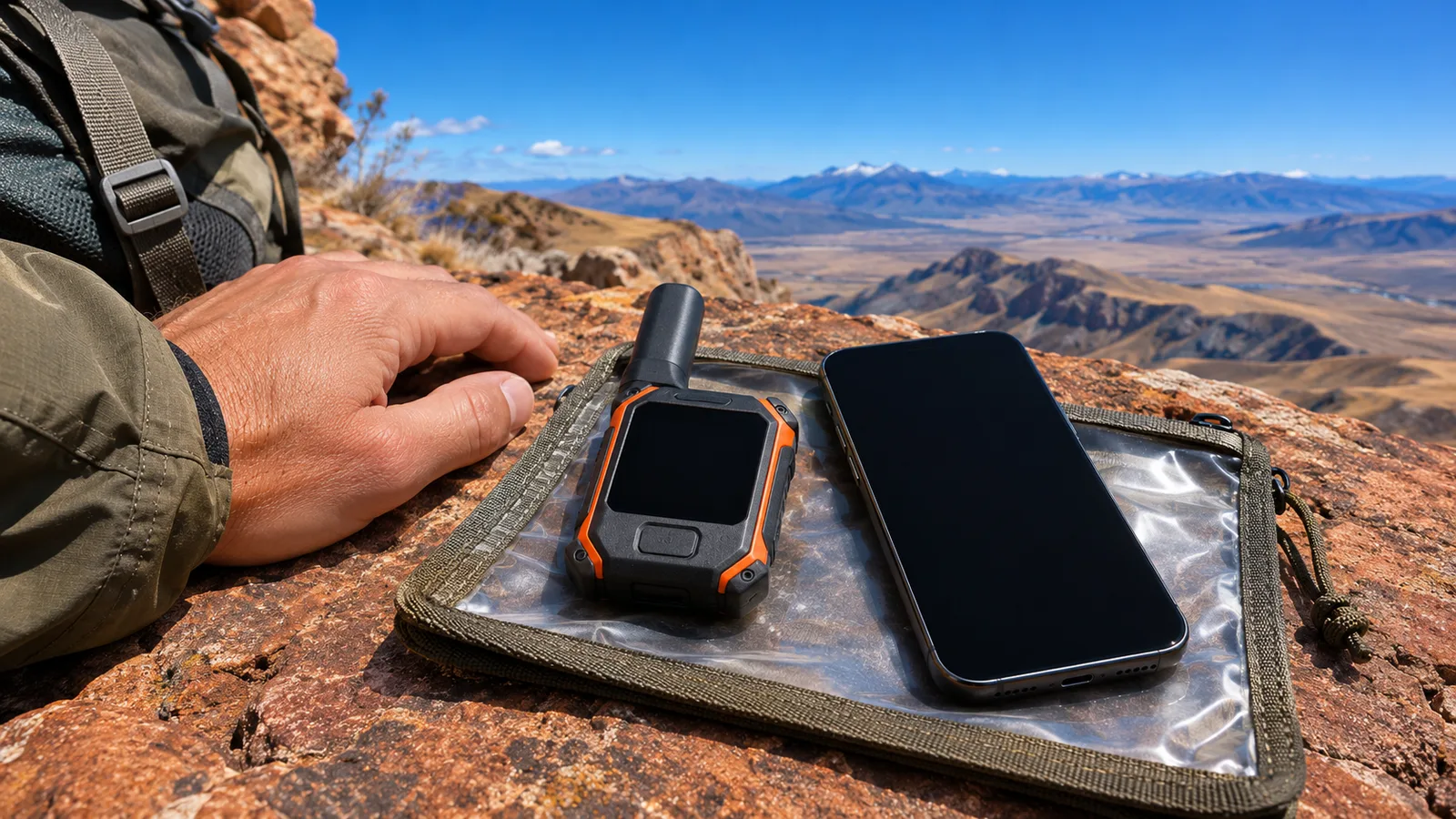
While Apple iPhone 14+ Satellite SOS / Messages via Satellite (Globalstar) and T-Mobile T-Satellite (Starlink Direct-to-Cell) now let modern smartphones send basic off-grid texts, smartphones have fragile glass screens, 12-to-18-hour batteries, and—in Apple’s case—zero coverage above 62° north latitude (northern Alaska and Scandinavia). For mission-critical family emergency kits, pair your phone with a dedicated Iridium-network satellite communicator: the Garmin inReach Mini 2 (100g, 14-day battery, standalone screen + SOS) or ZOLEO (entry-tier hardware, seamless Wi-Fi/cellular/satellite SMS routing).
Satellite Communicators vs. Smartphone Satellite Services Compared (2026)
| Device / Service | Satellite Constellation | Global Coverage Footprint | Battery Life (Off-Grid) | Standalone Operation Without Phone? | Durability & Rating | Plan Structure |
|---|---|---|---|---|---|---|
| Garmin inReach Mini 2 | Iridium (66 Cross-Linked LEO) | 100% Global (Pole-to-Pole) | Up to 14 Days (10-min tracking) | Yes (Full screen, presets, TracBack & SOS) | IPX7 Submersible + MIL-STD-810 | Suspendable monthly plan |
| Garmin inReach Messenger Plus | Iridium (66 Cross-Linked LEO) | 100% Global (Pole-to-Pole) | Up to 25 Days | Yes (Supports photos & 30s voice notes) | IPX7 Submersible | Suspendable monthly plan |
| ZOLEO Satellite Communicator | Iridium (66 Cross-Linked LEO) | 100% Global (Pole-to-Pole) | ~8 Days (200+ hrs) | SOS & Check-In buttons only (Text via phone) | IP68 Dust/Waterproof | Suspendable monthly plan |
| Apple iPhone 14–18 Satellite SOS | Globalstar (Bent-Pipe LEO) | US, Canada, Europe, Japan, AU (Fails >62°N) | ~12–18 Hrs (Phone battery) | No (Requires intact, charged iPhone) | Standard IP68 glass smartphone | Included with eligible iPhone activation |
| T-Mobile T-Satellite (Starlink) | SpaceX Starlink V2 Direct-to-Cell | Continental US, Hawaii, parts of AK & coastal | Standard phone battery | No (Uses standard LTE/5G phone modem) | Standard smartphone | Included on eligible plans or paid add-on |
Why Cross-Linked Iridium Satellites Beat Bent-Pipe Networks in Disasters
- Zero Local Ground-Gateway Dependency: Globalstar satellites operate as “bent-pipe” mirrors—they must maintain simultaneous line-of-sight to both your iPhone and a regional terrestrial ground station within ~1,500 km to complete a message. Iridium’s 66 satellites communicate directly with one another in orbit via Ka-band inter-satellite links, routing your SOS or family text completely around devastated hurricane or earthquake zones to active ground stations thousands of miles away.
- True Standalone Survival Hardware: If your iPhone screen shatters during an earthquake or shuts down in -20°C (-4°F) blizzard cold, the Garmin inReach Mini 2 continues transmitting preset check-ins, receiving family replies, and coordinating two-way rescue dispatch on its own internal 14-day battery.
Garmin inReach Mini 2 Two-Way Iridium Satellite Communicator
- Battery life
- Up to 14 Days (10-min tracking) / 30 Days (30-min mode)
Why it fits Garmin's 100-gram inReach Mini 2 operates standalone over Iridium's 66-satellite cross-linked LEO network with a sunlight-readable screen, physical SOS button, IPX7 waterproofing, and up to 14 days of battery life at 10-minute tracking; requires a clear sky view and active satellite subscription.
Key trade-off Requires an active Garmin satellite subscription (starting at ~14.99 USD/month) and an unobstructed outdoor sky view—step outside concrete buildings or dense tree cover for 45 seconds when transmitting messages.
Specifications & research
Standalone 14-day Iridium SOS communicator. Source records checked on 2026-11-16. Manufacturer research, not hands-on testing.
- Satellite network
- Iridium 66-Satellite Cross-Linked LEO Mesh · Source checked 2026-11-16
- Battery life
- Up to 14 Days (10-min tracking) / 30 Days (30-min mode) · Source checked 2026-11-16
- Weight dimensions
- 100 Grams (3.5 oz) / 9.9 x 5.2 x 2.6 cm (3.9" x 2.04" x 1.03") · Source checked 2026-11-16
Manufacturer documentation. Confirm exact Garmin model specifications and household safety limits before buying.
Satellite Comms Readiness & Field Troubleshooting
- Why iPhone Satellite Lock Takes 60–90 Seconds: Unlike Iridium handhelds with omnidirectional helical antennas, smartphones have tiny internal antennas that require manually pointing the top edge of the phone toward a moving satellite overhead. Always step into an open street intersection away from tall buildings and trees.
- Test Both Systems Before an Emergency: Send a free test loop message via
[email protected]on your Garmin, and run Apple’s built-in demo (Settings → Emergency SOS → Try Demo) outdoors with your family so everyone knows how satellite acquisition works under calm conditions.
Where satellite features have limits
L-band and Direct-to-Cell handheld satellite links cannot penetrate reinforced concrete basements, subway tunnels, or thick old-growth forest canopies, you must step outdoors with a clear sky view for 30 to 90 seconds to let queued messages transmit.
Before choosing a device, separate the communication job: an emergency request to responders, a routine message to family, a location check-in, an unattended two-way messenger, or a receive-only hazard broadcast. Apple documents Emergency SOS via satellite and Messages via satellite as separate features with distinct availability requirements; verify the exact device, software, country and service conditions for the feature you need (Emergency SOS via satellite, Messages via satellite). A satellite text option does not replace local evacuation instructions or a receive-only warning source.
Household satellite verification card
Record these items for each person who may rely on a phone or communicator, then repeat the check after changing devices, plans or software:
| Record | Confirm before leaving coverage |
|---|---|
| Device | Exact handset or communicator model and current software or firmware |
| Feature | Whether the intended task is Emergency SOS, ordinary contact messaging, check-in, or tracking |
| Eligibility | Current country, carrier, account and service conditions for that feature |
| Practice | Date the intended user tried the manufacturer’s demo or documented test process outdoors |
| Fallback | What the household will do if the device is uncharged, blocked from sky view, or the feature is unavailable |
For a dedicated communicator, distinguish device controls from app-dependent functions. Garmin’s inReach Mini 2 manual and ZOLEO’s user guide describe their respective operation; verify the current manual and service status for the exact unit you own.
Put satellite messaging into an outage plan
Use our browser-local Calculate Your Off-Grid Comms & Starlink Mini Battery Budget to model your exact household numbers before purchasing hardware. Compare detailed manufacturer specifications in our Radioddity GM-30 5W GMRS Handheld Radio Equipment Guide and Garmin inReach Mini 2 Satellite Communicator Equipment Guide, and integrate this setup with our Household Emergency Communication Guide and Restore Home Internet & Wi-Fi After an Outage.