Why Is My Electric Bill So High? Compare Daily Use First
Compare billing days, kWh per day and charge details to find the next useful question. Use worked examples before buying equipment to solve a high bill.
A bigger bill can come from more days, more electricity each day, different charges, or several changes at once. Put the current statement beside a comparable previous one. The goal is to identify which part changed before blaming the refrigerator or buying a replacement appliance.
Divide energy by days before comparing totals
Electricity use is measured in kilowatt-hours, or kWh. For each bill, divide its total kWh by the number of days it covers. Duke Energy’s bill-comparison guidance recommends checking both the billing-cycle length and average daily use. Its article is older; the method remains useful without adopting its historical prices.
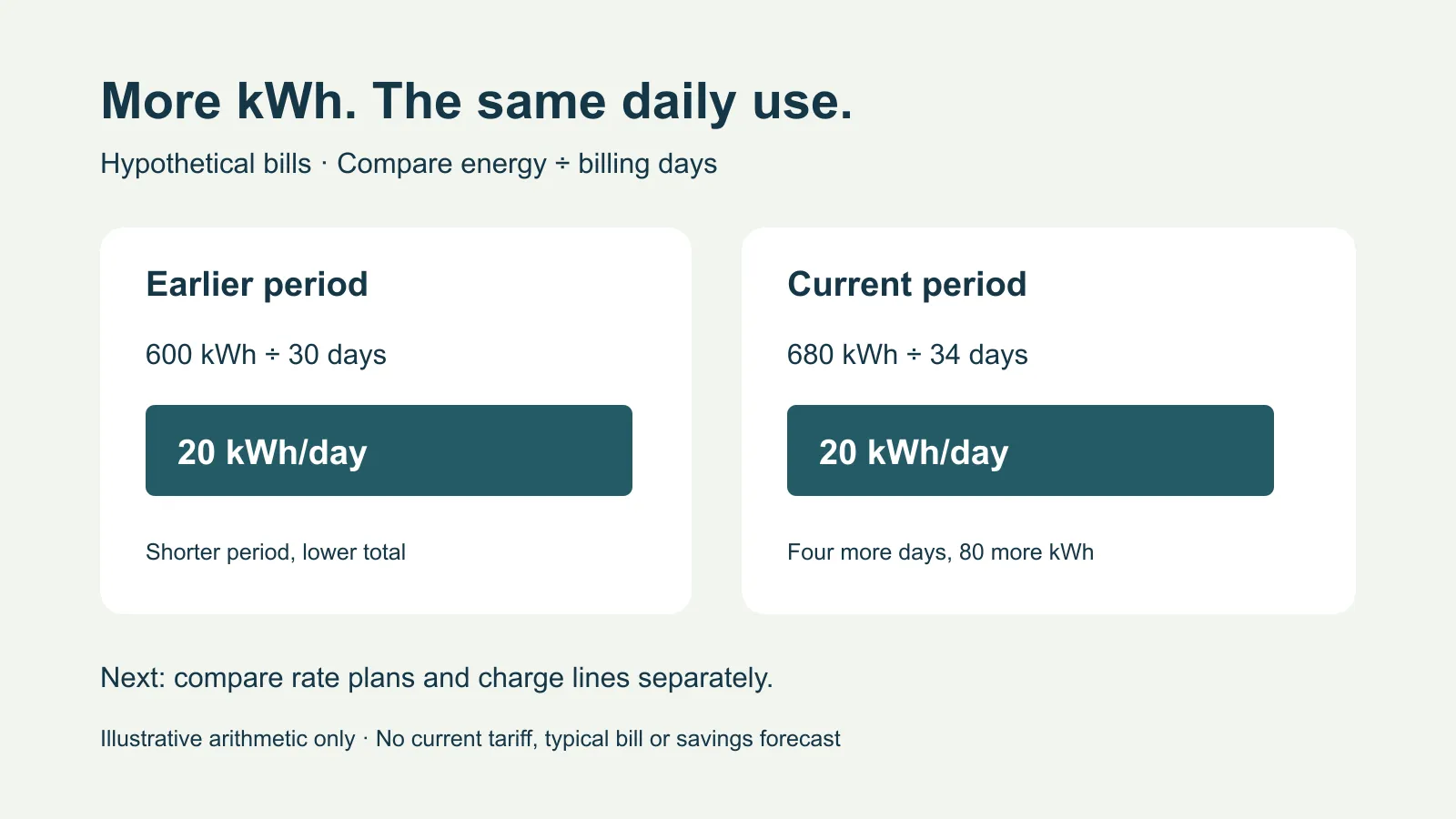
Consider these hypothetical statements:
| Billing period | Total energy | Average daily use |
|---|---|---|
| Earlier: 30 days | 600 kWh | 600 ÷ 30 = 20 kWh/day |
| Current: 34 days | 680 kWh | 680 ÷ 34 = 20 kWh/day |
The second statement contains 80 more kWh, a 13.3% increase, yet daily use is unchanged. The extra four days explain the energy-total difference. They do not necessarily explain the entire dollar difference: rates and other charge lines still need comparison.
Now change the current example to 900 kWh over 30 days. That is 30 kWh/day, 50% above the earlier 20. Here there is a daily-use difference to investigate. Neither calculation identifies its cause. A household with electric heating during a cold spell needs a different comparison from the same household during mild weather.
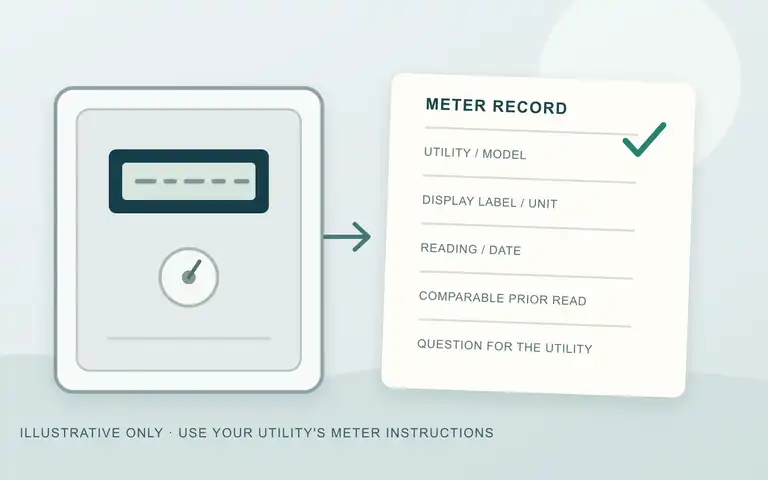
If you want to compare an accessible meter display with your records, use the electric meter-reading guide. It identifies the utility-specific register and keeps cumulative kWh separate from current kW.
Separate the bill from the amount paid
Use the electricity charge details for the period, not only the balance due. Check whether the statement includes a previous balance, credit, adjustment, another fuel, an estimate or a budget-payment amount. If a label is unclear, ask the serving utility what it represents rather than treating it as measured new electricity use.
Record the rate-plan name and compare applicable energy, delivery and other itemized charges. EIA explains that published average electricity prices are not utility tariffs; rates may depend on how much or when electricity is used. A national cents-per-kWh average cannot validate your bill.
Dividing total dollars by kWh gives a blended figure for the charges you included. It is not necessarily the price of the next kWh, particularly when fixed charges, credits, tiering or time-of-use rates are involved. Ask the utility to identify the relevant rate change or line item if daily use is similar but charges differ.
If daily use rose, look for when it changed
Use available daily or hourly history in the utility’s normal account tools. Compare dates with changes you already know: hotter or colder weather, guests, a new appliance, vehicle charging, or different operating hours. A matching date suggests a question to check, not proof that one device caused the increase.
Weather can affect both electricity demand and prices, as EIA’s price-factor overview explains. Keep those separate: more heating hours is a usage question; a changed tariff is a charge question. Do not shut down medically necessary equipment, required ventilation or freeze protection to run an experiment.
Two-bill comparison
| Field | Earlier period / current period |
|---|---|
| Period dates and number of days | |
| Electricity kWh and average kWh/day | |
| Actual/estimated label or unclear reading status | |
| Rate plan and relevant charge lines | |
| Credits, adjustments or previous balance | |
| Comparable weather and household changes | |
| Date/time pattern in available usage history | |
| One question for the utility or assessor |
For the first worked example, the useful question is: “Both periods averaged 20 kWh/day. Which charge lines explain the dollar change?” For the second: “Daily use rose from 20 to 30 kWh. Does the usage history show when, and are these readings actual or estimated?” Keep account numbers and statements private when sharing the comparison outside the utility’s authorized channel.
If this review leads to backup-power planning, start a separate Essential Loads Worksheet. A whole-house monthly bill does not identify the loads that must run together, motor startup demand, or the battery capacity needed during an outage.