Essential-load backup power system
Essential-Load Backup Power Worksheet
Verify essential devices, daily energy, and the limits of your backup setup.
How this worksheet saves
Entries save in this browser, not in an account or analytics. Avoid confidential details on a shared device; clear the draft when finished. Print or save a PDF for a separate copy.
Your working copy
No entries yet
-
1. Calculate
-
2. Verify
-
3. Practice
Step 1
Define the outage and non-negotiable loads
Write the household outcome first
Step 2
Running and starting loads
For each device, estimate daily energy as running watts × hours actually running per day. For loads that cycle, use representative measured watt-hours when available instead of treating the load as continuously on. Record starting watts separately when a motor, compressor, or pump has them. Do not substitute a generic online estimate when the device label or manual is available.
| Device and priority | Running W | Starting W | Hours / day | Wh / day | Source checked |
|---|---|---|---|---|---|
| |
How does the source define this value?
|
Record the exact label, manual, model, or measurement source.
| |||
| |
How does the source define this value?
|
Record the exact label, manual, model, or measurement source.
| |||
| |
How does the source define this value?
|
Record the exact label, manual, model, or measurement source.
| |||
| |
How does the source define this value?
|
Record the exact label, manual, model, or measurement source.
| |||
| |
How does the source define this value?
|
Record the exact label, manual, model, or measurement source.
| |||
| |
How does the source define this value?
|
Record the exact label, manual, model, or measurement source.
| |||
| |
How does the source define this value?
|
Record the exact label, manual, model, or measurement source.
| |||
| |
How does the source define this value?
|
Record the exact label, manual, model, or measurement source.
| |||
| |
How does the source define this value?
|
Record the exact label, manual, model, or measurement source.
| |||
| |
How does the source define this value?
|
Record the exact label, manual, model, or measurement source.
| |||
| Simultaneous running total | Highest starting case | Daily energy total |
Entered-demand scenarios
Include only devices you expect to run together. A one-device start case assumes one selected motor starts while the other selected devices remain at their entered running demand. The coincident case adds every selected startup increment; it is a separate overlap scenario, not a prediction that devices will start together. Values are arithmetic from your entries, not a minimum generator size, a product fit, or approval to connect or operate equipment. Displayed totals round up to the next whole watt so formatting cannot understate the entered arithmetic.
Automatic cycling, overlapping starts, voltage and phase, VA and power factor, startup duration, voltage drop, outlet and connection limits, fuel derating, and safe operation still require the exact device and generator manuals and, where needed, a qualified professional. A source note does not verify a rating. Do not convert amps, VA, or locked-rotor current to watts here.
Manufacturer documents describe starting demand differently. Use the device-specific source and choose its stated basis. The linked guides explain terminology and include approximate example values; those examples are not evidence for your exact device. Use its label, manual, or a representative measurement. Honda power management and Champion generator sizing chart.
Step 3
Document the adjustments and weakest condition
Step 4
Choose and verify a safe backup path
| Path | Capacity / output checked | Connection and location | Fuel / recharge plan | Manual and safety limit |
|---|---|---|---|---|
| Battery power station | ||||
| Portable generator | ||||
| Solar recharge | ||||
| Grid / vehicle fallback |
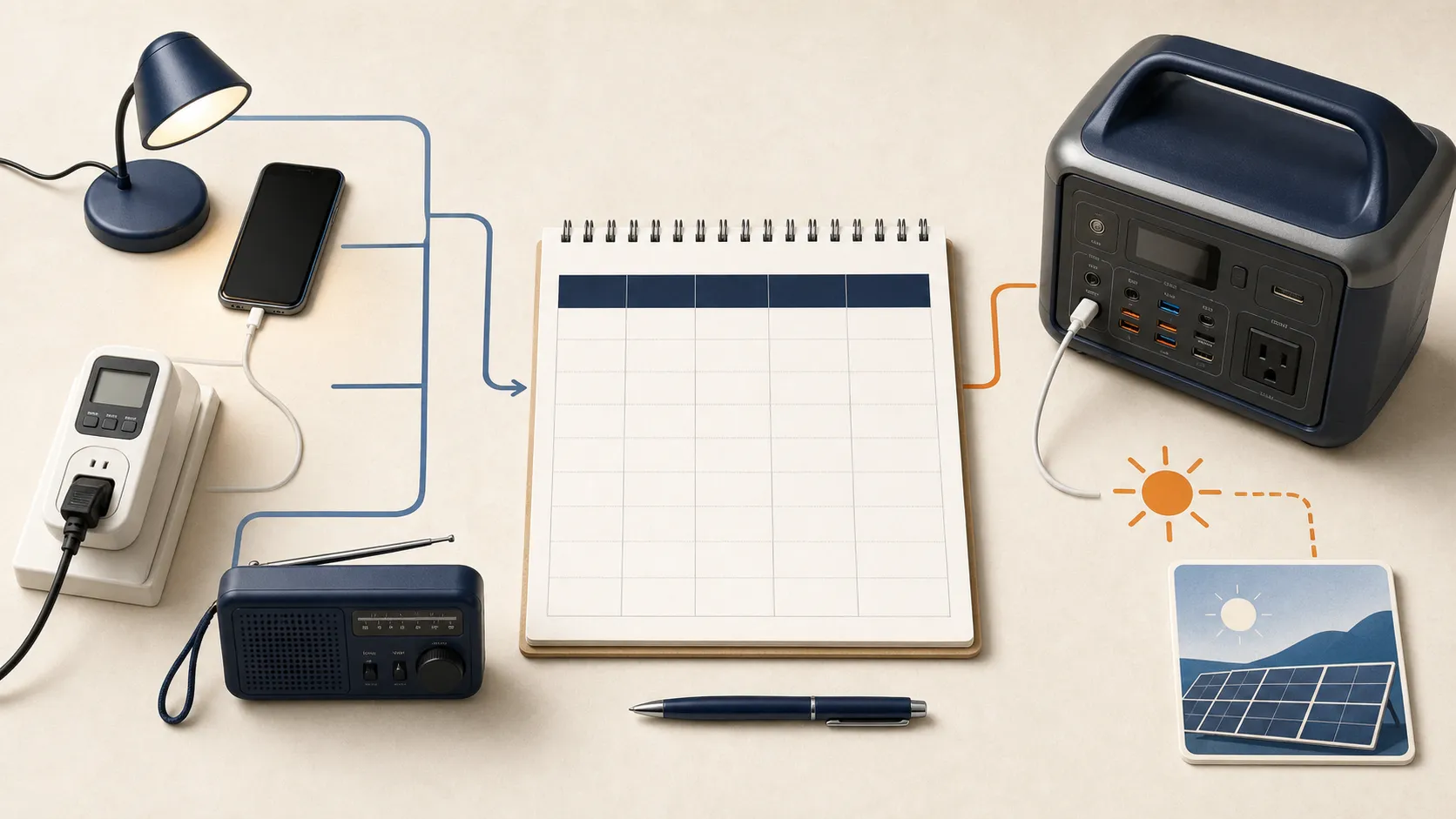
Show the worksheet planning illustration
Next action
Keep this plan usable after today.
Review the source details, practice the setup, and update this copy as conditions change. Methodology reviewed October 2, 2026.