Water Softener vs. Water Filter: Match the System to the Problem
Separate hardness scale from a water-quality concern before choosing a softener or filter, then verify any treatment claim against current water data and the exact model.
White scale on a faucet and a contaminant notice on a water report are different problems. A softener can address water hardness, while “filter” describes a family of systems with different purposes. Before comparing equipment, name the issue and the evidence that supports it.
The water quality report guide helps interpret community-system results. For suspected lead or another specific contaminant, use qualified local testing and the relevant health guidance rather than choosing by the word “filter.”
Treatment decision table
| What you notice or know | What it may point to | Useful next evidence | What the category alone does not establish |
|---|---|---|---|
| Scale on fixtures, soap that is hard to rinse, or a hard-water result | Hardness minerals such as calcium and magnesium | Water utility report or an appropriate hardness test; check whether the issue is local or whole-house | A health hazard or a need to treat drinking water |
| A named chemical in a utility notice or lab result | A specific contaminant question | Exact contaminant, concentration, sample date and source; utility or health department advice | That any generic filter or softener removes it |
| A concern about germs after an incident | An advisory or source-safety question | Current notice, water source, and public-health instructions | That a softener or routine carbon filter makes water safe |
| No measured concern, but a product is being considered | A possible preference or maintenance choice | Why treatment is wanted, operating burden, and exact model claim | That additional treatment is necessary |
EPA explains that common ion-exchange softeners exchange calcium and magnesium ions for sodium or potassium ions. The regeneration cycle uses water and salt. This process is designed around hardness, not as a general emergency disinfection step.
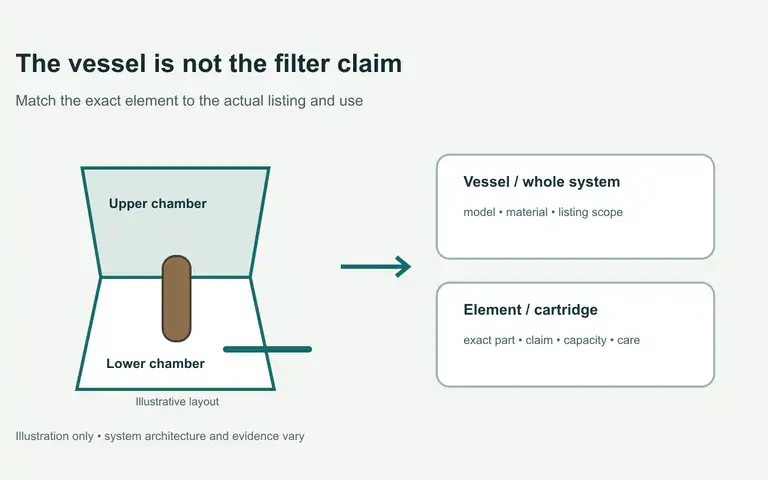
CDC explains that household treatment technologies vary. Some filters target particles, some media target certain chemicals, and other systems address different concerns. Confirm the exact model and claim for the substance in question; “water filter” is not a performance specification.
Ask one question before choosing a system
Write a one-sentence problem statement: “I want to address __, based on __.” The evidence might be a utility report, a certified laboratory result, a current public notice, or a specific household nuisance that is not a health claim.
If the blank is “lead,” “nitrate,” PFAS, bacteria, or another named contaminant, identify the source result first. EPA’s home drinking water testing guidance directs households to state-certified laboratories. The appropriate sample and lab depend on the question. A vague taste or scale observation is not a substitute for that test.
If the issue is only mineral scale, compare softener maintenance and water use with the value of addressing hardness. EPA notes that cation-exchange systems regenerate and consume both salt and water. Check local plumbing and wastewater constraints and the system manual before changing an existing installation.
Verify a specific treatment claim
Before relying on equipment for a drinking-water concern, record:
- The exact contaminant or property to address.
- Where the water comes from and when it was tested or reported.
- Exact system model and cartridge or media identifiers.
- The model’s stated or certified claim for that specific concern.
- Rated service capacity, maintenance interval, and operating requirements.
- Which authority or qualified professional should answer remaining questions.
Do not infer a health benefit from reduced scale, improved taste, a brand label, a standard number, or an equipment category. NSF notes that certification standards include specific claims, so look for the exact product and the exact reduction statement.
When the water is under an advisory
A current boil-water, do-not-drink, or do-not-use notice is a separate situation. Follow the issuing utility or health department’s directions for that notice. CDC says a home filter does not remove the need to boil tap water during a boil-water advisory unless local officials state otherwise; a softener is not a substitute for advisory instructions. If officials suspect chemicals or toxins, boiling may not make water safe. Use the emergency water safety guide for source and advisory boundaries.
Write down the decision
| Question | Household record |
|---|---|
| What is the concern: hardness, named contaminant, germs/advisory, or preference? | |
| What result or notice supports it, and from what date? | |
| Who can confirm the result or recommend an appropriate test? | |
| What exact system claim matches the concern? | |
| What are the ongoing water, salt, cartridge, or service requirements? | |
| What would make us stop and ask the utility, lab, maker, or licensed professional? |
If evidence does not name a problem, pause the purchase decision and ask the utility what its report covers. If there is an active advisory, use its instructions first and do not rely on a routine treatment device as a workaround.
For a routine treatment question involving dissolved substances, the reverse-osmosis versus distillation comparison separates process capabilities, claim-specific certification and operating burden.