In this guide Jump to a section
- Why EPA’s LCRI 10 ppb action level still requires household checks
- Step 1: Check your service-line material
- Step 2: Arrange certified laboratory testing (why strips fall short)
- Step 3: Verify NSF/ANSI 53 or 58 claims and avoid the NSF 372 trap
- Protecting infants and hot-water temperature limits
- Daily lead-reduction habits checklist
- Frequently asked questions
Why EPA’s LCRI 10 ppb action level still requires household checks
Under EPA’s Lead and Copper Rule Improvements (LCRI), with full system compliance generally taking effect November 1, 2027, the utility monitoring action level drops to 10 ppb, paired with mandatory 10-year replacement timelines for most lead and qualifying galvanized service lines. Crucially, that 10 ppb threshold is a system-wide regulatory trigger for utilities, not a safe concentration for an individual kitchen sink. EPA sets the health-based Maximum Contaminant Level Goal (MCLG) for lead at zero, and the American Academy of Pediatrics recommends school drinking-water outlets stay below 1 ppb.
Lead enters tap water invisibly through pre-1986 lead service laterals, lead solder joints, and aging brass valves or pre-2014 faucets, with zero color, odor, or taste. Because lead exists as both dissolved ions and solid corrosion flakes breaking off interior pipe scale, concentrations swing unpredictably from day to day after water sits stagnant overnight or after nearby street excavation vibrates pipes. Never boil water suspected of containing lead: evaporating steam leaves heavy metal dissolved behind and raises concentration. Always draw cold tap water for drinking, cooking, and mixing infant formula.
Step 1: Check your service-line material
Begin with your water utility’s public service-line inventory map or customer lookup tool, since utilities must maintain and report these records or flag unknown segments for inspection. If the utility lists your service line as unknown, a licensed plumber can inspect the basement or crawlspace pipe entry safely without disturbing fragile seals.
Surface inspection offers helpful preliminary clues where the service line enters your foundation before the shutoff valve, yet never treat a surface check alone as proof that underground pipe or interior solder is lead-free: lead-lined galvanized steel, hidden brass couplers, and underground splices can sit out of sight. Follow EPA’s Protect Your Tap guidance rather than scraping suspect pipe aggressively.
Step 2: Arrange certified laboratory testing (why strips fall short)
Rapid colorimetric dip strips sold in hardware aisles cannot substitute for laboratory lead analysis. Strip pads typically lack sensitivity below ~15–20 ppb and cannot digest solid particulate lead flakes trapped in tap water, meaning a strip can show “safe” even when concentrations exceed 1 to 10+ ppb.
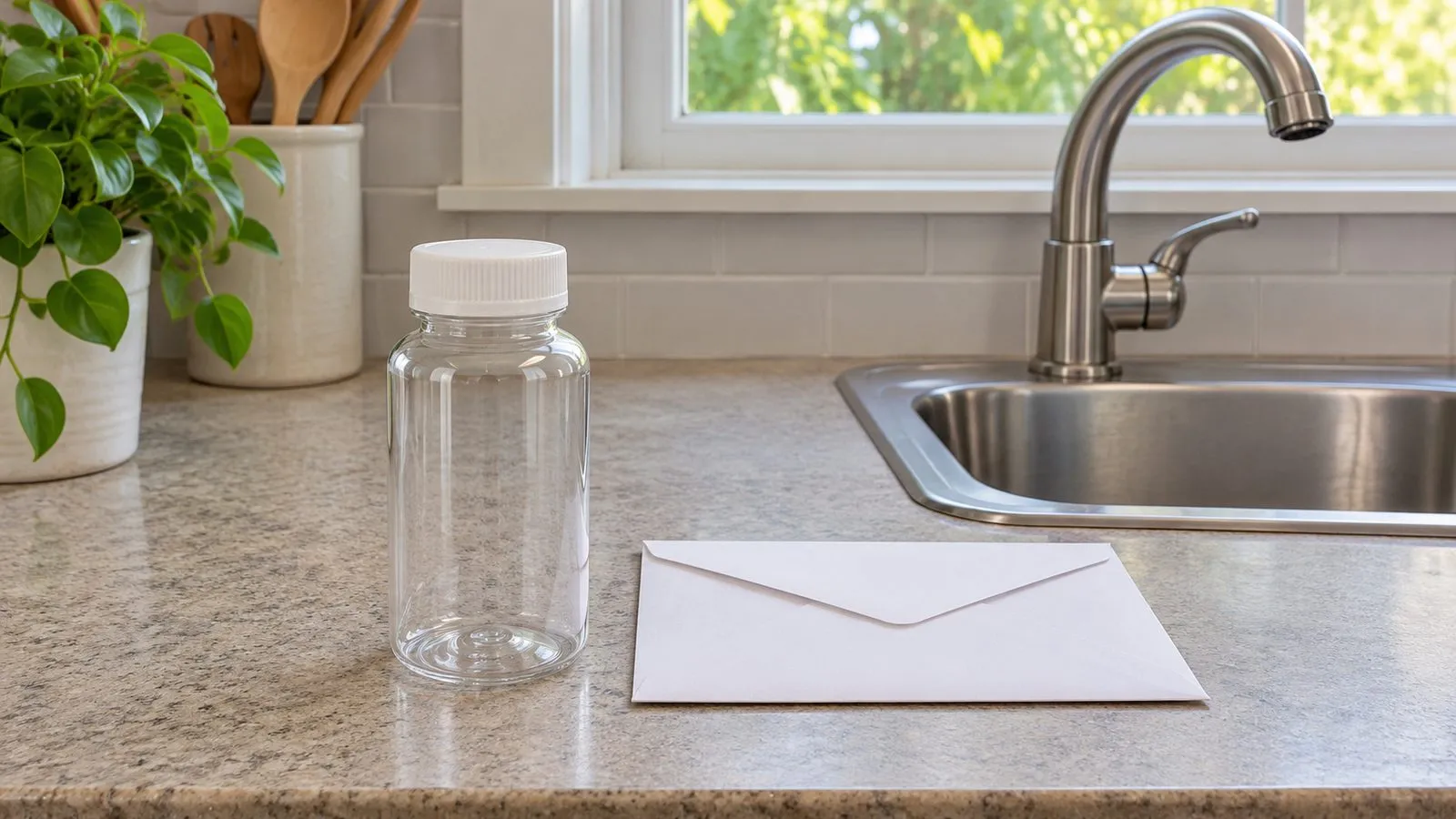
Instead, obtain either a utility-coordinated lead sample or an independent test from a state-certified drinking-water laboratory using EPA Method 200.8 (ICP-MS) with low reporting limits (often 0.5 to 1.0 ppb). Follow your utility’s or lab’s exact bottle directions:
| Sampling Protocol | How Collection Works | What It Measures (and Its Boundary) |
|---|---|---|
| First-draw sample (utility or lab bottle) | Collected from cold kitchen tap after at least 6 hours of stagnation without removing or cleaning the aerator first | Measures lead leaching from faucet brass, stops, and interior plumbing closest to that tap; a single draw cannot prove future stability |
| Paired fifth-liter regulatory sample | Five sequential 1-liter draws collected under specific EPA/utility LCRI rules at qualifying lead-service-line addresses | Regulatory system-monitoring protocol designed to catch water stagnant inside underground lead service laterals rather than interior brass |
| Screening strip kit | 60-second colorimetric paper check for general hardness, pH, or copper plumbing trends | Cannot reliably detect low-ppb dissolved or particulate lead; never use strips to clear drinking water or baby formula |
Because laboratory sampling relies on exact bottle sequence and flow rate, ask your water authority whether they provide free home test kits before hiring a private lab. When mailing samples to a certified private laboratory, label each bottle clearly (such as first-draw vs. utility-instructed post-flush sample) and verify the analytical report lists EPA Method 200.8 (ICP-MS) rather than screening-level colorimetric methods.
If you want a quick screening check for general water-chemistry factors such as pH and hardness (aggressive acidic soft water corrodes brass and solder faster) while awaiting certified ICP-MS lab kits, pair it explicitly with certified laboratory testing rather than replacing the lab.
Why stagnation time and aerators alter lab readings
A cold-water pipe holding half a gallon of stagnant tap water overnight collects far more leached metal per liter than water pulled three minutes later after fresh street water arrives. Cleaning debris off a faucet aerator screen right before collecting a regulatory sample can artificially wipe away lead-bearing particulate flakes that would normally enter drinking water, whereas letting cold water flush unchecked hides interior faucet brass contributions completely. Matching your bottle order, stagnation hold, and aerator instructions precisely to your certified laboratory or utility sheet keeps results diagnostic rather than misleading.
Varify 17-in-1 Home Drinking Water Test Kit
Why it fits Helpful solely as a rapid screening check for pH, total hardness, and general copper/iron corrosion trends; strip tests do NOT reliably measure low-ppb dissolved or particulate lead and never replace state-certified EPA Method 200.8 ICP-MS laboratory lead testing.
Key trade-off A screening kit cannot establish that water is safe to drink; use a certified laboratory for reliable testing and follow local health guidance.
Specifications & research
General water chemistry screening strips only. Source records checked on 2026-11-04. Manufacturer research, not hands-on testing.
- Parameters tested
- Manufacturer-listed water screening parameters; confirm the exact kit label · Source checked 2026-11-04
- Test count
- Test strips and separate bacteria tests; verify the current kit contents · Source checked 2026-11-04
- Readout speed
- 60 seconds for strip parameters; 48 hours for bacteria culture · Source checked 2026-11-04
Manufacturer documentation. Confirm exact Varify model specifications and household safety limits before buying.
Step 3: Verify NSF/ANSI 53 or 58 claims and avoid the NSF 372 trap
Many buyers accidentally purchase filters bearing NSF/ANSI 372 (“Lead-Free”) or NSF/ANSI 42 (“Aesthetic Chlorine”) thinking they strip incoming lead:
- NSF/ANSI 372 means only that the product’s own wetted metal and plastic parts contain
<= 0.25%weighted-average lead so the housing itself won’t leach lead. It does not filter lead arriving from street pipes. - NSF/ANSI 42 covers taste, odor, and coarse particulates unless paired separately with an explicit NSF/ANSI 53 or NSF/ANSI 58 Total Lead reduction listing.
Under modernized NSF/ANSI 53, certified filters are challenged against 150 ppb Total Lead (70% dissolved, 30% particulate 0.1–1.2 µm) across both acidic (pH 6.5) and alkaline (pH 8.5) water and must reduce effluent to <= 5 ppb throughout rated gallon capacity. Verify the exact model and replacement cartridge SKU in NSF, WQA, or IAPMO directories or EPA’s certified lead-filter tool.
| Certified Lead Filtration Format | Key Verification Standards | Relative Cost Tier & Cartridge Cadence | Best Household Fit |
|---|---|---|---|
| NSF 53 pitcher (with certified lead cartridge) | NSF/ANSI 53 (Total Lead) + NSF 42 Class I particulate | Low upfront cost; 40–120 gal cartridge life | Renters, apartments, or fast interim protection while waiting for lab results |
| Faucet-mount NSF 53 unit | NSF/ANSI 53 (Lead & Cysts) + NSF 42 | Low upfront cost; ~100 gal (~3 months) | Standard threaded kitchen faucets (usually incompatible with pull-down sprayers) |
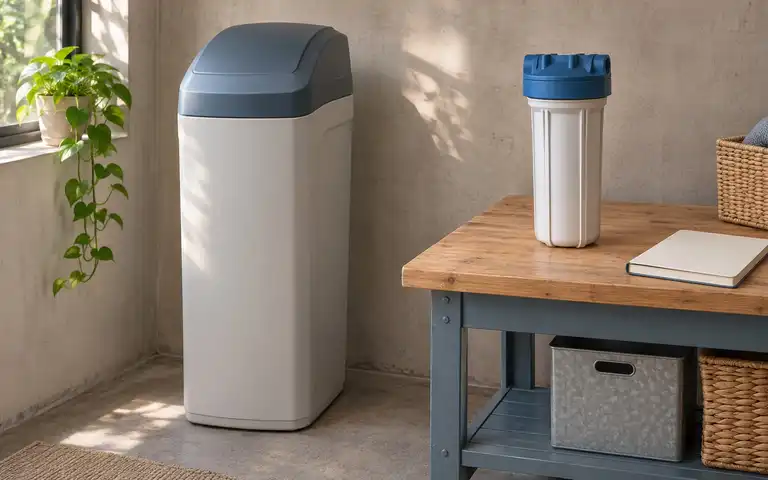
| Under-sink direct carbon block | NSF/ANSI 53 (Lead, VOCs, Cysts) + NSF 42 | Moderate cost; 500–1,500 gal (6–12 months) | Full-flow cold drinking/cooking tap upgrades without wastewater loss |
| Reverse osmosis (under-sink / countertop) | NSF/ANSI 58 (Lead, TDS, Arsenic, PFAS) + NSF 53 | High upfront cost; 12–24 month membrane + 6–12 mo pre-filters | Households addressing dissolved metals, nitrates, or PFAS simultaneously |
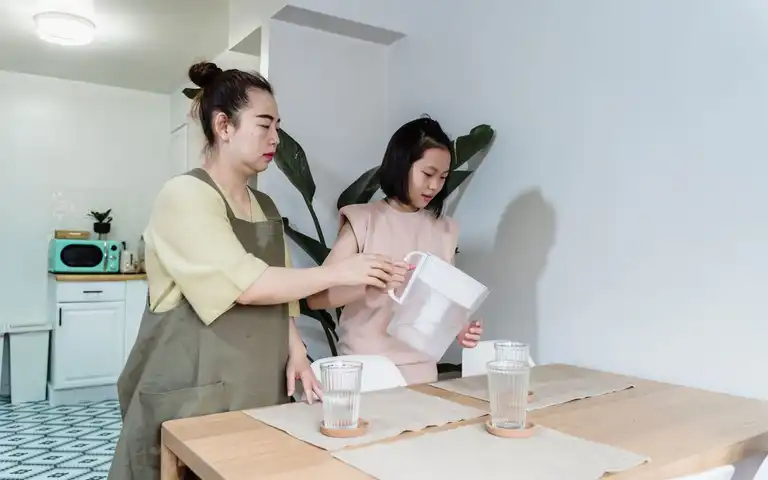
Verify the replacement cartridge specifically, because on multi-tier pitcher brands, only the certified lead-reduction cartridge meets NSF/ANSI 53 lead claims, whereas standard taste-and-odor filters do not. Standard coconut-shell granular carbon reduces chlorine taste and odor without stripping dissolved ionic lead or sub-micron lead scale flakes.
When setting household replacement reminders, track either rated gallons or calendar months, whichever comes first. Pouring household tap water slowly avoids bypassing dense carbon-block pores, and replacing expired cartridges prevents contaminant breakthrough or bacterial fouling inside damp housings. Pay close attention after nearby street construction, water-main breaks, hydrant flushing, or partial service-line repairs: physical pipe vibration sheds fragile particulate lead scale into household cold lines, which clogs standard filters faster while demanding verified Class I particulate filtration (0.5–1.0 micron) paired with utility-guided cold tap flushing until turbidity and metals clear cleanly.
Brita Metro 6-Cup Pitcher with Elite Filter
- Rated filter life
- 120 gallons or approximately 6 months per Elite filter
Why it fits Equipped specifically with the Brita Elite cartridge (120 gal / ~6 months), this pitcher carries WQA NSF/ANSI lead, chlorine, and microplastic reduction claims for municipal water—do not swap to the standard white Brita filter, which lacks Elite lead claims.
Key trade-off Municipal tap-water taste and contaminant-reduction pitcher only; does NOT disinfect microbiologically unsafe water, boil-advisory pathogens, viruses, or high-TDS salt water.
Specifications & research
Pitcher paired with WQA-certified Brita Elite filter. Source records checked on 2026-11-12. Manufacturer research, not hands-on testing.
- Pitcher capacity
- 6 cups (small refrigerator-door footprint) · Source checked 2026-11-12
- Filter standard claims
- WQA certified to NSF/ANSI claims with included Brita Elite filter for lead, chlorine, microplastics, and selected pharmaceuticals · Source checked 2026-11-12
- Rated filter life
- 120 gallons or approximately 6 months per Elite filter · Source checked 2026-11-12
Manufacturer documentation. Confirm exact Brita model specifications and household safety limits before buying.
Protecting infants and hot-water temperature limits
Point-of-use activated carbon pitchers and faucet attachments are rated strictly for cold municipal tap water. Running warm or hot tap water through a lead cartridge not only leaches additional dissolved lead out of household water heaters and brass mixing valves, but also exceeds filter media operating temperature limits and softens internal polymer channels, permitting unfiltered bypass flow. Always chill cold filtered tap water in clean pitchers before warming baby bottles or soup pots on the stove. When laboratory results remain pending or tap levels exceed utility safety thresholds, prepare infant formula exclusively with commercially bottled water or sterile ready-to-feed liquid following local health-department instructions.
Daily lead-reduction habits checklist
Combine certified filtration with low-effort plumbing maintenance:
- Use cold water exclusively for drinking, cooking, soups, coffee, and infant formula, never drawing hot tap water that dissolves lead faster from solder and brass.
- Clean faucet aerator screens every 3 to 6 months after collecting any required water samples, rinsing out mineral grit and trapped lead particles.
- Follow utility flushing guidance after overnight stagnation, vacations, or nearby street construction before drawing unfiltered water for brushing teeth.
- Replace cartridges strictly on rated gallons or months so adsorbed metals never risk breakthrough or restricted flow.
- Document lead service-line status by saving your utility map printout, plumber inspection notes, and certified lab results alongside replacement schedules.
For whole-home planning steps and utility replacement programs, see our lead in tap water home action plan and NSF 42 vs. 53 certification guide.
Frequently asked questions
Does boiling tap water remove lead?
No. Because lead does not evaporate with steam, boiling tap water leaves lead behind in less liquid and increases concentration. Always start with cold water and filter through a verified NSF/ANSI 53 or 58 unit when certified lead reduction is needed.
Does a fifth-liter sample prove whether I have a lead service line?
No. EPA’s paired first- and fifth-liter sampling method is a regulatory water-system test used at qualifying sites rather than a standalone household pipe locator. Ask your utility for its service-line inventory record and customer testing protocol.