In this guide Jump to a section
- Engineering Baseline & Primary Fit: Chlorine Dioxide vs. Iodine vs. Bleach Tab
- Chemical Water Disinfectants Compared
- Why the 4-Hour Wait Time Matters (And How to Plan Around It)
- Kit Integration Checklist
- Operational Boundaries & When to Skip: Chlorine Dioxide vs. Iodine vs. Bleach Tab
- Related Guides, Equipment & Planning Tools: Chlorine Dioxide vs. Iodine vs. Bleach Tab
Engineering Baseline & Primary Fit: Chlorine Dioxide vs. Iodine vs. Bleach Tab
When assembling a 72-hour evacuation go-bag or glovebox emergency kit, skip brown glass bottles of iodine tablets and miniature dropper bottles of liquid bleach. Neither iodine nor household sodium hypochlorite can penetrate the tough outer shell of encysted Cryptosporidium parasites—the leading cause of severe, dehydrating diarrheal illness in contaminated surface water and flood-compromised municipal systems.
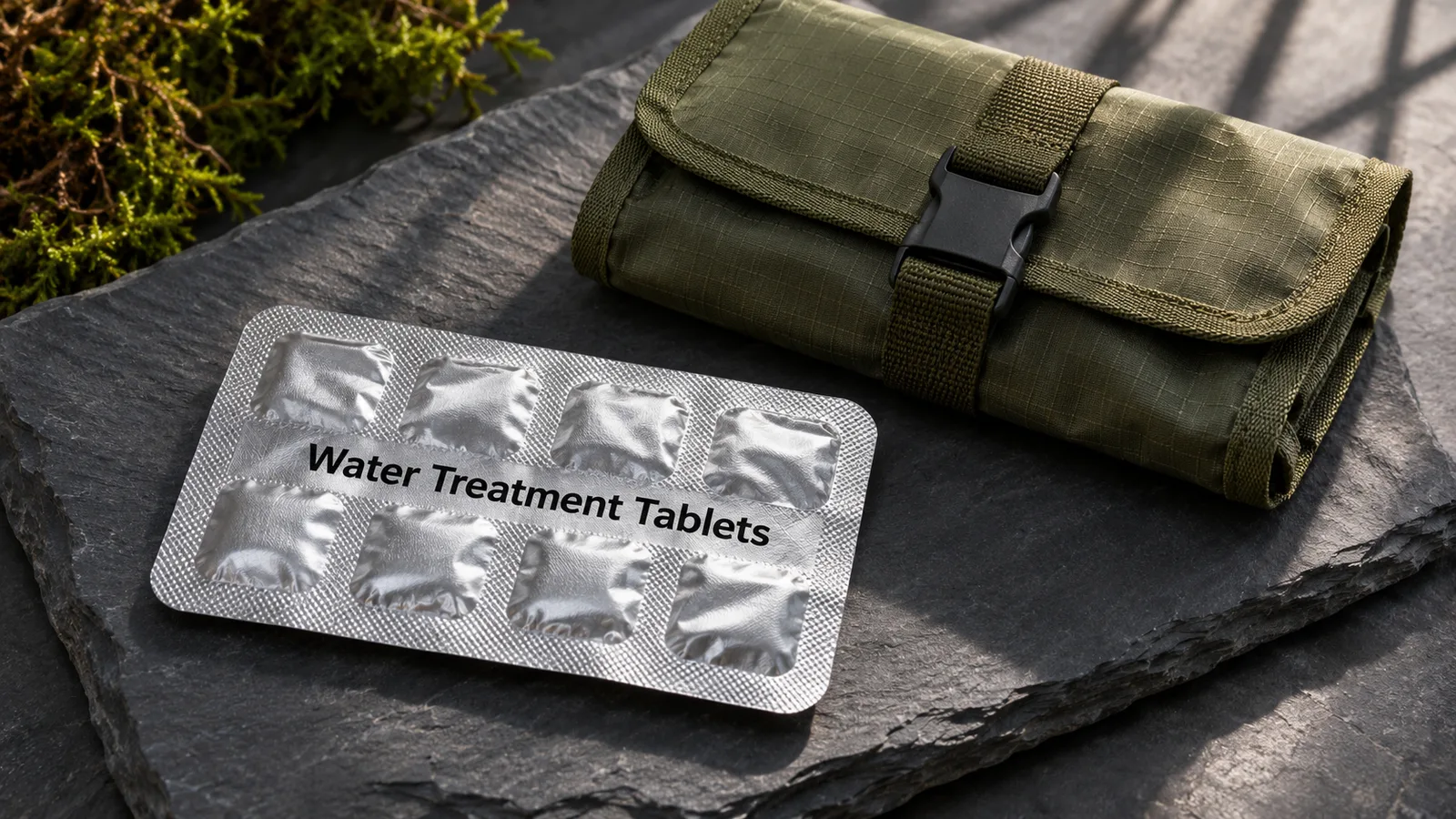
Standardize exclusively on EPA-registered Chlorine Dioxide ($ClO_2$) tablets (such as Katadyn Micropur MP1) or two-part liquid Aquamira drops. Unlike bleach, chlorine dioxide acts as a dissolved selective oxidizer that penetrates Cryptosporidium oocysts, leaves zero unpleasant chemical aftertaste, and stays shelf-stable inside individual foil blister packs for 4 to 5 years across extreme temperatures.
Chemical Water Disinfectants Compared
| Disinfectant Chemistry | Kills Bacteria & Viruses? | Kills Giardia Cysts? | Kills Cryptosporidium? | Wait Time (Clear 20°C / 68°F Water) | Shelf Life & Temperature Stability |
|---|---|---|---|---|---|
| Chlorine Dioxide Tablets (Katadyn Micropur MP1) | Yes (99.99%+) | Yes (30 min) | YES (4 Hours EPA Registered) | 15 min (Bacteria/Virus) / 4 Hrs (Crypto) | 4–5 Years in foil blisters (Heat/freeze stable) |
| Two-Part Liquid ClO2 (Aquamira Drops) | Yes (99.99%+) | Yes (30 min) | YES (4 Hours) | 5 min pre-mix + 15 min–4 hrs | 4 Years unopened bottles |
| Liquid Household Bleach (Sodium Hypochlorite) | Yes (99.99%+) | Moderate (60+ min) | NO (Fails against Crypto cysts) | 30 Minutes | 6–12 Months (Degrades rapidly in heat) |
| Tetraglycine Hydroperiodide (Iodine Tablets) | Yes | Poor in cold water | NO (Fails against Crypto cysts) | 30–60 Minutes | 2–3 Years (Degrades fast once bottle opens) |
Why the 4-Hour Wait Time Matters (And How to Plan Around It)
Many users misread the back of a Katadyn Micropur MP1 box and drink treated water after 15 minutes.
- 15 Minutes: Kills bacteria (E. coli, Cholera) and enteric viruses (Norovirus, Rotavirus) in clear, room-temperature water.
- 30 Minutes: Kills Giardia lamblia cysts in clear water above 20°C (68°F).
- 4 Hours (240 Minutes): Required by EPA registration to guarantee 99.9% inactivation of thick-walled Cryptosporidium oocysts, especially in cold (<10°C / 50°F) or slightly turbid water.
- Pro Field Workflow: Carry two 1-liter wide-mouth water bottles. Drink from Bottle A while Bottle B sits in your backpack side pocket undergoing its 4-hour Chlorine Dioxide treatment—creating a continuous rotation of fully purified water without ever waiting thirsty.
Kit Integration Checklist
- Store a pre-treatment coffee filter or bandana with your MP1 tablets: Chlorine dioxide works fastest in clear water; straining pond or floodwater through a coffee filter first removes organic sediment that consumes $ClO_2$ gas.
- Avoid iodine if pregnant or managing thyroid conditions: Iodine tablets are contraindicated for pregnant women, infants, and anyone with thyroid disorders—another decisive reason to standardize on Chlorine Dioxide.
Operational Boundaries & When to Skip: Chlorine Dioxide vs. Iodine vs. Bleach Tab
Chemical tablets neutralize biological pathogens (viruses, bacteria, protozoa), but do not remove dissolved lead, arsenic, PFAS, gasoline, or agricultural pesticides. If industrial or urban chemical runoff is suspected, filter chemically treated water through an activated-carbon/ion-exchange purifier (such as a Grayl GeoPress or British Berkefeld Ultra Sterasyl).
Related Guides, Equipment & Planning Tools: Chlorine Dioxide vs. Iodine vs. Bleach Tab
Use our browser-local Calculate Your Household Emergency Water Storage Volume to model your exact household numbers before purchasing hardware. Compare detailed manufacturer specifications in our British Berkefeld 8.5L Gravity Water Filter Equipment Guide and Katadyn Micropur MP1 Chlorine Dioxide Tablets Equipment Guide, and integrate this setup with our How to Calculate Emergency Water Storage for a Family of 4 and Emergency Water Purification Methods Compared.
Aquatabs 397mg Emergency Water Purification Tablets (100-Pack)
Why it fits Documented specification match for chlorine dioxide vs iodine vs bleach water tablets planning, verify exact model compatibility, dimensions, and household capacity before ordering.
Key trade-off Wait a full 30 minutes after dissolution; chemical disinfection alone has limited efficacy against Cryptosporidium oocysts, so pair with a 0.1-micron hollow-fiber filter on high-risk surface water.
Specifications & research
Model alternative. Source records checked on 2026-11-12. Manufacturer research, not hands-on testing.
- Active ingredient and dose
- 397 mg Sodium Dichloroisocyanurate (NaDCC) per effervescent tablet · Source checked 2026-11-12
- Treatment capacity
- 1 tablet treats up to 15 L (~4 US gallons / 16 quarts) of visually clear water · Source checked 2026-11-12
- Standards and registration
- U.S. EPA registered and certified to NSF/ANSI Standard 60 · Source checked 2026-11-12
Manufacturer documentation. Confirm exact Aquatabs model specifications and household safety limits before buying.