How Many Phone Charges Can a Power Bank Provide?
Estimate phone recharges from power-bank watt-hours and the exact phone battery capacity, then account for the fact that label math is only an upper bound.
In this guideJump to a section
A bank labelled 20,000 mAh can look enormous beside a phone battery labelled in a different unit. The useful comparison starts with the voltage basis and watt-hours, then asks how much energy reaches the phone in the way you actually use it. The example below makes each assumption visible instead of promising a fixed number of charges.
Convert mAh to Wh before comparing
Nokia’s power-bank FAQ distinguishes advertised capacity from useful phone charges. Milliamp-hours describe charge at a stated voltage. Power-bank brands commonly advertise a cell- side mAh rating, while a phone battery may state capacity at its own nominal voltage. Those mAh figures cannot be divided directly unless the voltage basis is the same.
Use:
Wh = (mAh ÷ 1,000) × voltage in volts
For example, a hypothetical bank rated 20,000 mAh at 3.7 V has about 74 Wh of nominal cell energy: 20 Ah × 3.7 V = 74 Wh. If a phone battery is listed as 15 Wh, then 74 ÷ 15 is about 4.9 ideal battery-equivalents. That does not mean the bank will deliver five full phone charges.
If the phone label lists only mAh, use its rated battery voltage to convert it too. If the bank’s capacity voltage is not stated, check the manufacturer’s specifications rather than assuming it.
Show the assumption instead of hiding a loss factor
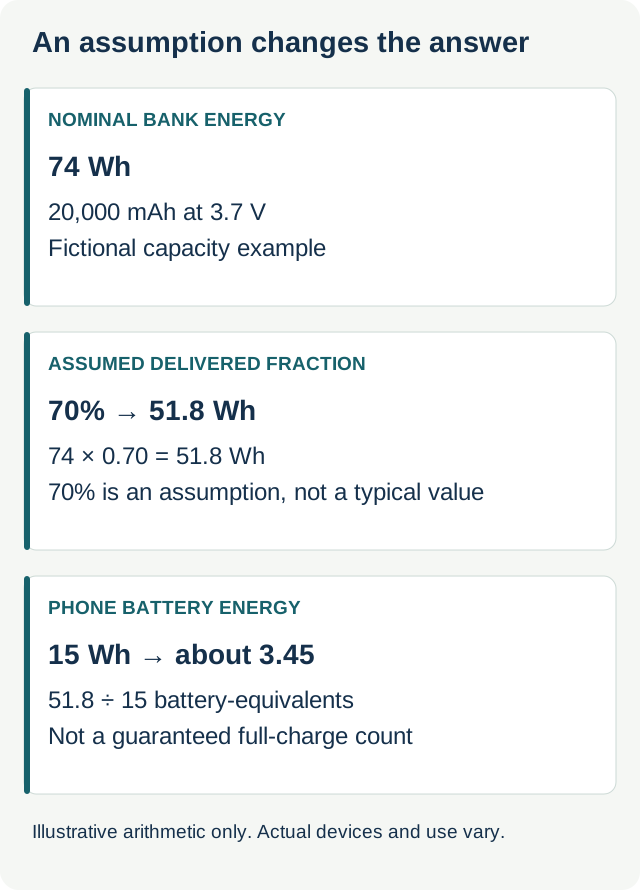
Using the invented 74 Wh bank / 15 Wh phone above, suppose 70% of the bank’s nominal energy ultimately reaches the phone battery. The conditional result is 74 × 0.70 ÷ 15 ≈ 3.45 battery-equivalents. At a different assumed delivered fraction of 85%, it is about 4.19. These are two arithmetic scenarios, not a measured range or a claim that 70–85% is typical. A product-specific output-capacity rating or a repeatable test is stronger evidence than choosing a convenient percentage.
Do not substitute the USB output voltage for the cell voltage when converting the advertised cell-side mAh figure. For example, treating 20,000 mAh as though it were specified at 5 V would produce 100 Wh rather than the 74 Wh example at 3.7 V. The missing voltage basis changes the result before losses are considered.
Why the actual count is lower
Energy is lost when the bank converts its internal battery output for USB charging and when the phone converts incoming power for its battery. The phone also consumes power during charging, and charging behavior changes with temperature, battery state, cable, charger protocol, and device condition. Apple’s battery guidance gives device-specific examples of temperature and use affecting battery behavior; it does not supply a universal bank efficiency. A phone may slow or stop charging as it approaches full, so partial top-ups will not match a sequence of full empty-to-full cycles.
For planning, treat the ratio as a ceiling and leave margin. If the bank’s label gives both mAh and Wh, use the stated Wh for comparison; if those figures seem inconsistent, ask the manufacturer. For outage use, decide how many days of communication you need and test your own phone and cable with the bank before relying on it. This household charge estimate is separate from airline carry-on rules; see the dedicated power-bank air-travel guide for the travel question.
Keep a household charging record
| Record | Example of what to note |
|---|---|
| Equipment | Exact bank, phone, cable, and port; battery condition |
| Starting state | Bank indicator and phone percentage before charging |
| Use during charging | Screen off, navigation running, calls, or another repeatable pattern |
| Ending state | Phone percentage reached, elapsed time, and remaining bank indication |
| Planning result | Whether the combination met the actual day’s communication need, with a reserve |
This is a practical readiness check, not a laboratory capacity measurement. Phone percentages and bank indicator bars are estimates, and adding partial-charge percentages does not measure watt-hours. Repeat the same use pattern and keep reserve for cold, aging batteries, or heavier communication rather than relying on the ideal division alone.
If a phone or laptop charges more slowly than expected, check the USB-C PD charger, cable and device chain. A fitting connector does not establish a shared charging profile.