Power Banks on Planes: Check the Wh Label and Pack It Safely
Check a power bank's watt-hour rating, carry-on status, terminal protection, and airline rules before flying with a spare lithium battery.
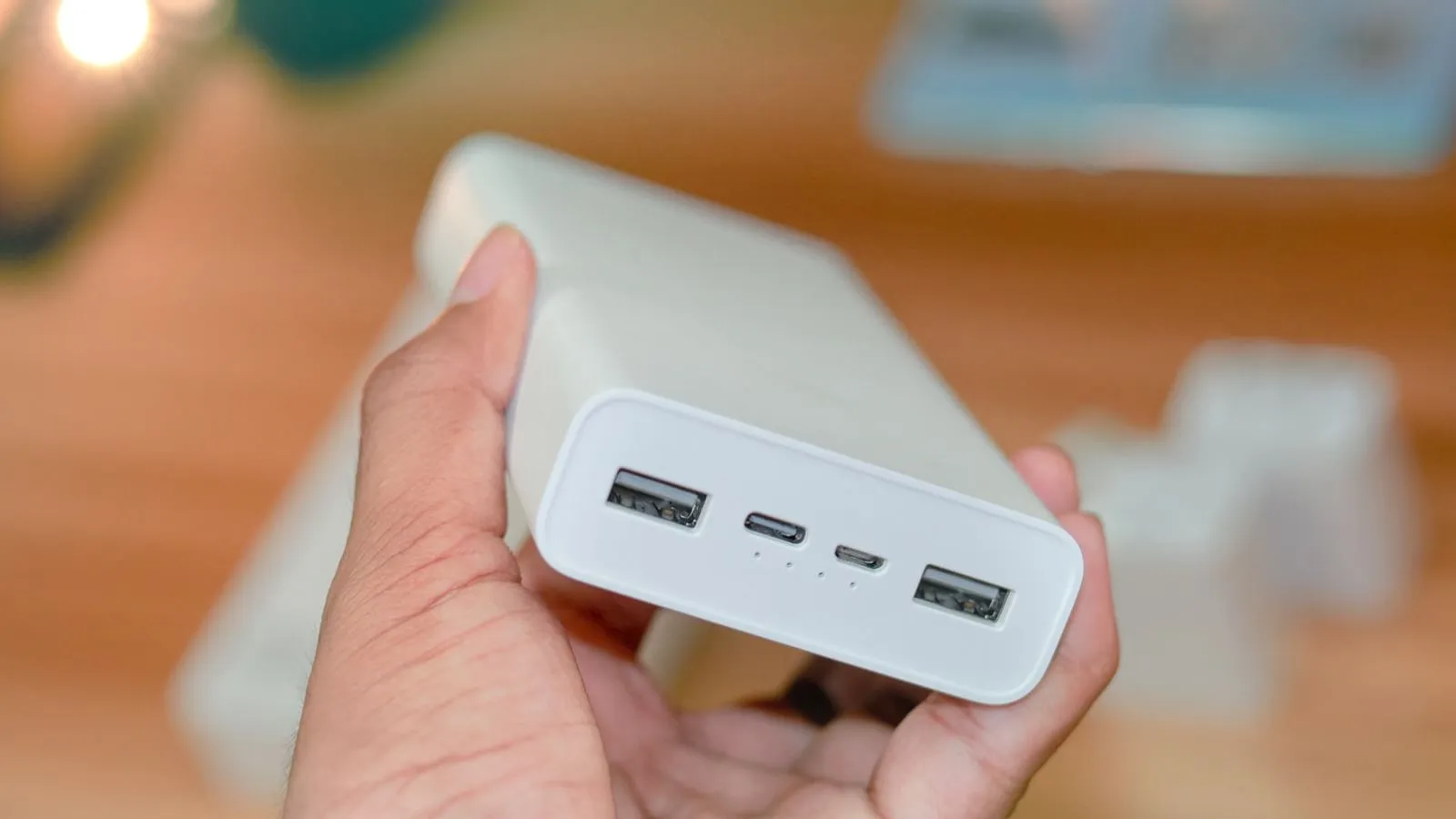
In this guideJump to a section
Before putting a power bank in a suitcase, check its watt-hour (Wh) rating and how you will carry it. The FAA’s current PackSafe lithium-battery guidance says spare lithium-ion power banks must stay in carry-on baggage, with terminals protected against short circuit. If your carry-on is taken at the gate, remove the power bank and keep it with you in the cabin.
Find the Wh rating on the power bank
Look for a printed Wh value on the battery itself. The FAA notes that newer lithium-ion batteries often show this rating. If the label gives voltage and amp-hours instead, multiply the nominal battery voltage by amp-hours to estimate watt-hours:
Wh = volts × amp-hours (Ah)
For example, a label showing 3.7 V and 20 Ah gives 74 Wh (3.7 × 20). If capacity is printed in milliamp-hours, divide mAh by 1,000 to convert to Ah first. Use the battery’s stated nominal voltage, not the USB output voltage. If the label is missing, unreadable, or lists conflicting capacities, do not guess—ask the maker or airline before travel.
Capacity numbers on a retail package may describe several cells or a marketing comparison rather than the rating printed on the battery. The FAA’s rule applies to the lithium battery’s Wh rating, so use the battery label and the manufacturer’s documentation. Keep a photo of both if the printed mark is hard to read, but do not assume a phone’s USB output or charging voltage is the battery’s nominal voltage.
Apply the current FAA limits
The FAA’s PackSafe page, last updated August 11, 2026, states that spare lithium-ion batteries up to 100 Wh may be carried in passenger baggage. A spare battery over 100 Wh and up to 160 Wh requires airline approval, with a limit of two of those larger spare batteries per person. Many airlines set stricter quantity or Wh limits, so the carrier’s current policy also matters. The FAA’s passenger resources also show why a power bank should remain accessible if a carry-on is gate-checked.
| Label rating | FAA baseline for a spare power bank | What to do |
|---|---|---|
| Up to 100 Wh | Allowed within the FAA baseline | Check the airline’s current quantity rules |
| Over 100 Wh up to 160 Wh | Airline approval required; up to two larger spares | Get approval before arriving at the airport |
| Over 160 Wh | Not permitted as passenger baggage under the FAA passenger guidance | Do not take it to the airport as baggage |
| Unknown Wh rating | Capacity has not been verified | Obtain the maker’s rating and confirm airline acceptance before packing |
| Damaged or recalled | Do not pack it as a travel spare | Follow the recall, manufacturer, and local safe-handling guidance |
The limits above describe the U.S. FAA baseline for spare batteries. Your carrier can be more restrictive. International itineraries can add other rules; verify each operating airline and destination authority before packing.
Pack the spare so the terminals cannot short
Keep a spare power bank in the cabin, not checked baggage. Protect its terminals from metal objects and damage. The FAA lists examples such as original packaging, a battery case, a protective sleeve, or an individual bag; use packaging that fits securely and keeps exposed contacts from touching keys or coins.
If an airline checks your carry-on at the boarding gate or planeside, take out the power bank and keep it with you. Do not pack a damaged or recalled battery. If a battery becomes hot, swollen, smoky, or starts to burn during flight, alert the crew immediately; the FAA says flight crews are trained to respond to lithium-battery incidents.
If your itinerary includes a connection, check every airline operating a segment, including codeshares where the operating carrier may set the baggage procedure. Leave enough time to remove a battery if a bag is tagged at the gate. Keep the power bank accessible rather than buried under items you cannot safely move in a crowded boarding line. A power station is a different, much larger product category; consult the FAA passenger materials before considering one, since many exceed passenger baggage limits.
Power-bank travel checklist
- Photograph or write down the power bank’s model and Wh label.
- If calculating Wh, save the label voltage and Ah figures and the arithmetic.
- Check the current rule for each airline on the itinerary, especially if over 100 Wh.
- Pack the spare in carry-on baggage with terminals protected from short circuit.
- Put it somewhere easy to remove if the bag is gate-checked.
- Do not pack a damaged or recalled power bank. A capacity approval is not clearance for a damaged battery.
- If the Wh mark is missing or unreadable, obtain the maker’s documentation and confirm airline acceptance before packing; do not guess the rating.
FAA pages can change, and airlines may tighten limits. Recheck before each flight rather than saving a screenshot as a permanent rule. This guide covers spare power banks on U.S. passenger flights; it does not determine whether a particular product is recalled or accepted on an international itinerary.