When an electrical feeder drops in the middle of the night, human eyes require 20 to 30 minutes of dark adaptation for retinal rhodopsin pigments to reach maximum light sensitivity. Activating a 1,000-lumen tactical flashlight in a pitch-black living room instantly constricts pupils, destroys night vision, casts harsh blinding shadows, and burns through internal lithium batteries in under 90 minutes. In an extended blackout, raw lumen output is your enemy; runtime efficiency, beam diffusion, and hands-free control govern household safety.
The U.S. Fire Administration urges households to use battery-powered lights instead of candles during an outage. Candles cause an estimated 7,400 residential structure fires annually, introducing open flame hazards into rooms where flammable blankets, curtains, or disoriented children and pets are present. Modern LED lighting eliminates fire hazards completely, but only when you match the right optical form factor to specific household recovery tasks.
Give each light a job
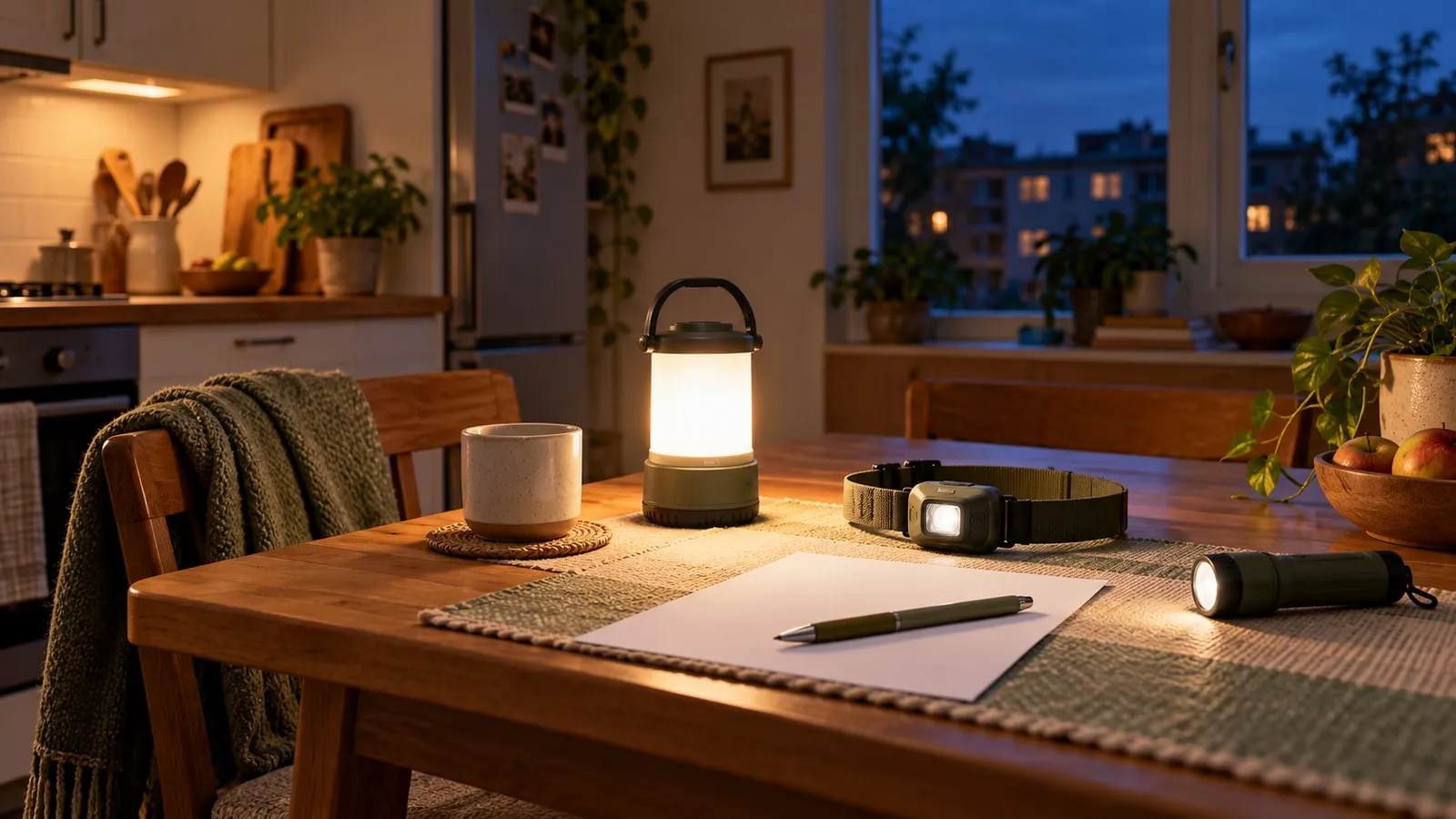
Effective home emergency lighting relies on functional segmentation. No single lighting device solves every outage task. Requiring an occupant to hold a flashlight between their teeth while changing a breaker, administering insulin, or carrying firewood creates frustration and dropped equipment.
Allocate hardware across three non-overlapping household assignments:
| Lighting Category | Core Household Job | Optical Beam Profile | Optimal Brightness Window | Critical Physical Requirement |
|---|---|---|---|---|
| Headlamp | Hands-free mechanical work, cooking, first aid, route navigation | Wide flood or blended spot/flood aimed where eyes look | 20 to 60 lumens (low/med) | Elastic strap stability; red-light mode to preserve dark adaptation |
| Diffused Lantern | Shared ambient illumination for communal rooms (kitchen, living room) | 360-degree frosted radial diffusion; downward reflector | 80 to 200 lumens | Flat base stability; folding handle for ceiling hook suspension |
| Handheld Flashlight | Bedside immediate-reach light, outdoor perimeter checks | Focused center spot with modest peripheral spill | 50 to 300 lumens | Tactile mechanical push-button (not multi-click sequence); roll-prevention bezel |
Two documented examples, with different purposes
Examining real manufacturer specifications highlights the distinct engineering tradeoffs between personal task lighting and communal area illumination.
The Black Diamond Spot 400 represents a benchmark dual-fuel hands-free task light. Engineered with both an optical spot lens and a wide proximity flood emitter, it accepts either three standard AAA alkaline/NiMH batteries or Black Diamond’s proprietary 1,500mAh lithium-ion rechargeable BD 1500 cell. In low proximity mode (6 lumens), it delivers up to 225 hours of continuous runtime on alkaline cells. In standard medium mode (200 lumens), runtime drops to 8 hours. The unit includes a digital lockout feature to prevent accidental battery discharge inside an emergency bag and retains an IPX8 waterproof submersible rating.
The Goal Zero Lighthouse 600 illustrates rechargeable communal room lighting. Drawing power from an internal 18.7Wh (5,200mAh at 3.6V) lithium-ion cell, it provides 360-degree diffused lighting or 180-degree directional lighting to conserve energy. On its single-side low setting (approx. 20 lumens), it delivers 180 hours of continuous runtime. On full 360-degree high mode (600 lumens), runtime plunges to 2.5 hours. It incorporates a folding hand crank that provides approximately 10 minutes of low light per 1 minute of vigorous cranking (at 120 RPM), along with a 1.5A USB-A output port for emergency phone top-offs.
Family Lantern · 600 lm Dual-Zone + Crank
Goal Zero Lighthouse 600
- Battery
- 18.98 Wh (3.65 V, 5,200 mAh) Li-ion NMC
Consider this rechargeable lantern when adjustable shared light fits the job and you can maintain its charge. Compare its mode-specific runtime and operating limits in the model guide; choose another setup when you need user-replaceable cells or a different handling arrangement.
Check first: The 7.5 W USB output is limited; the lantern is not a substitute for a dedicated phone power bank or household backup-power system.
Specifications & research
Shared-room lighting example. Source records checked on 2026-10-24. Manufacturer research, not hands-on testing.
- Listed light output and modes
- 600 lm; one or both lighting sides can be selected · Source checked 2026-10-24
- Battery
- 18.98 Wh (3.65 V, 5,200 mAh) Li-ion NMC · Source checked 2026-10-24
- Manufacturer runtime by mode
- One side: 5 h high / 320 h low; both sides: 2.5 h high / 180 h low · Source checked 2026-10-24
Manufacturer documentation. Keep individual task lighting and device charging separate from shared room illumination.
Hands-Free · 400 lm Dual-Fuel Headlamp
Black Diamond Spot 400
- Listed weight
- 86 g with AAA or 72 g with BD 1500 battery
Matches the personal task-light role above with 6 lm low proximity, 200 lm medium, 400 lm max, red night-vision mode, digital button lockout, and IPX8 water resistance.
Check first: The manufacturer page currently shows this SKU out of stock and says it cannot ship to California, New York, or Colorado. This is not an availability promise; check current restrictions before any future offer.
Specifications & research
Dual-fuel hands-free headlamp (400 lm · 3×AAA or BD 1500). Source records checked on 2026-10-05. Manufacturer research, not hands-on testing.
- Listed light output and modes
- 400 lm maximum; 200 lm medium; 6 lm low · Source checked 2026-10-05
- Power source
- Three AAA batteries included or separately sold BD 1500 rechargeable Li-ion battery · Source checked 2026-10-05
- Listed weight
- 86 g with AAA or 72 g with BD 1500 battery · Source checked 2026-10-05
Manufacturer documentation. Check personal fit and dexterity directly; this model is not a universal accessibility solution.
Compact Lantern · AA Battery Room Light
Streamlight Siege AA Lantern (AA version; not Siege X / D-cell Siege)
- Battery
- 3 AA alkaline cells, sold separately
Provides 360-degree diffused room light (50 lm low for 37 hours; 200 lm high for 7 hours) plus red LED night modes using three standard AA batteries instead of an internal lithium pack.
Check first: Battery runtime varies with cell condition and use; no rechargeability is built into the AA model.
Specifications & research
Replaceable-cell compact lantern (200 lm · 3×AA). Source records checked on 2026-10-25. Manufacturer research, not hands-on testing.
- Listed light output and modes
- White: 200/100/50 lm high/medium/low; red 0.7 lm · Source checked 2026-10-25
- Battery
- 3 AA alkaline cells, sold separately · Source checked 2026-10-25
- Manufacturer runtime by mode
- White: 7/15.5/37 h high/medium/low; red steady: 192 h; SOS: 288 h · Source checked 2026-10-25
Manufacturer documentation. Keep individual task lighting and device charging separate from shared room illumination.
Compare runtime at the brightness you need
Manufacturer marketing claims routinely display two numbers in bold packaging font: “1,000 Lumens!” and “100 Hours Runtime!” What consumers frequently miss is that the 1,000-lumen output lasts for 90 seconds before thermal protection circuitry aggressively steps power down, while the 100-hour runtime is measured exclusively on a 2-lumen “firefly” or “moonlight” mode that is too dim to read a prescription medicine label.
The American National Standards Institute (ANSI) / NEMA FL1 standard governs flashlight performance ratings. Under ANSI FL1, runtime is measured from the moment the light is energized until the light output falls to 10% of its initial value. A flashlight rated for 500 lumens that drops to 51 lumens after 30 minutes still counts all subsequent dim hours toward its total “advertised runtime.”
Worked Energy Sizing: 72-Hour Household Outage Lighting Budget
To size emergency batteries accurately, calculate the real watt-hour consumption of household lighting across a typical 3-day (72-hour) power failure for a family of four:
-
Personal Headlamps (2 Adults × 4 hours active evening use per night × 3 nights = 24 operating hours total):
- Operating Mode: 35 lumens medium flood
- Average Power Draw = 0.45 Watts per headlamp
- Total Energy Consumed = 24 hours × 0.45 W = 10.8 Watt-hours (Wh)
- Battery Requirement: 1 standard AAA alkaline holds approx. 1.25 Wh. A 3-cell headlamp holds 3.75 Wh, easily delivering 8.3 hours of runtime. Two sets of spare AAA batteries per headlamp cover the entire outage.
-
Communal Living Room Lantern (1 unit × 5 hours evening family gathering per night × 3 nights = 15 operating hours total):
- Operating Mode: 120 lumens 180-degree diffused light
- Average Power Draw = 1.4 Watts
- Total Energy Consumed = 15 hours × 1.4 W = 21.0 Watt-hours (Wh)
- Battery Requirement: A 26Wh internal lithium pack (or 4 D-cell alkaline batteries providing 4 × 15 Wh = 60 Wh) provides surplus capacity with zero mid-outage recharging required.
-
Hallway Nightlight / Sentry Light (1 unit × 8 hours overnight sleep window per night × 3 nights = 24 operating hours total):
- Operating Mode: 5 lumens ultra-low navigation light
- Average Power Draw = 0.08 Watts
- Total Energy Consumed = 24 hours × 0.08 W = 1.92 Watt-hours (Wh)
Total 3-day household lighting energy budget = 10.8 Wh + 21.0 Wh + 1.92 Wh = 33.72 Watt-hours.
A single 10,000mAh (37Wh) portable USB power bank contains sufficient electrical energy to power your entire household’s emergency lighting needs for three full days, provided you operate lights at sensible task-appropriate lumens.
Battery Chemistry Comparison for Outage Lights
Selecting the correct battery chemistry prevents ruinous corrosion and cold-weather capacity failure:
| Chemistry Type | Typical Shelf Life | Low-Temperature Threshold | Acid / Electrolyte Leakage Risk | Best Household Application |
|---|---|---|---|---|
| Standard Alkaline (Zn/MnO2) | 5 to 7 years | Fails below 32°F (0°C); loses 60% capacity | Severe Risk: Discharges potassium hydroxide, destroying battery contacts | High-drain devices used frequently; never store long-term inside lights |
| Lithium Primaries (Li/FeS2, Energizer Ultimate) | 20 years | Functions down to -40°F (-40°C) | Zero Leakage: Solid hermetic seal eliminates corrosion | Gold standard for emergency kits, winter car kits, and rarely opened lights |
| NiMH Rechargeable (Eneloop) | Retains 70% charge at 5 years | Operates reliably down to 14°F (-10°C) | Zero leakage under normal storage | Household recharge cycles; pre-charged emergency spares |
| Lithium-Ion (18650 / 21700 / LiPo) | 3 to 5 years (500 cycles) | Discharges down to -4°F; cannot freeze charge | Low leakage; requires periodic 6-month top-off | High-capacity modern lanterns and high-performance headlamps |
Placement and power record
The most technically advanced emergency lantern is utterly useless if it sits locked in a plastic bin behind winter tires in a detached garage when utility power cuts out. Staging outage lighting requires establishing permanent, accessible physical home stations before emergencies occur.
Populated Household Outage Lighting Staging Matrix
| Station / Location | Assigned Light Format | Hardware Spec & Power Source | Verified Runtime at Target Mode | Operating Limit / Who Should Skip It |
|---|---|---|---|---|
| Master & Kids Bedside | Compact 90-degree right-angle headlamp or sentry torch | 1x AA / 14500 cell (Energizer Ultimate Lithium L91) | 35 lumens for 18 hours; moonlight 1 lumen for 120 hours | Skip lights with complex multi-tap electronic buttons. In the dark, a disoriented child or senior needs an instant physical switch. |
| Kitchen Countertop | Radial frosted LED lantern with magnetic hanging base | Integrated 5,200mAh USB-C lithium pack + folding crank | 150 lumens for 12 hours (360°); 60 lumens for 28 hours (180°) | Fails if kept unplugged for >9 months. Internal lithium cells self-discharge 2-3% monthly; recharge every 6 months. |
| Electrical Service Panel | Magnetic-base work light or dedicated headlamp | 3x AAA Energizer Lithium cells (hanging directly on panel) | 50 lumens wide flood for 22 hours | Skip alkaline cells in cold basements/garages. Cold garage temperatures degrade alkaline voltage, causing dim flickering during winter. |
| Primary Stairway Hall | Auto-sensing plug-in emergency power-failure nightlight | Internal NiMH battery constantly trickle-charged via 120V outlet | 15 lumens for 4 hours upon grid power cutoff | Skip non-grounded loose outlets. Must sit firmly in an unobstructed wall socket where occupants will not kick or dislodge it. |
| Family Go-Bag / Evac | Compact dual-fuel headlamp with IPX8 waterproof rating | BD 1500 Li-ion pack + 3x AAA lithium spare sleeve | 40 lumens for 35 hours (AAA); 400 lumens burst for 2.5 hours | Fails if physical electronic lockout is not engaged. Accidental compression against clothes inside bags turns light on, draining it to 0%. |
Operational Inspection Routine
Every six months—aligned with daylight saving time changes—complete this 5-minute household lighting verification:
- Test the Bedside Reach: In complete darkness, verify that every family member can extend their hand from their normal sleeping position and grab an emergency light within 5 seconds without rising from bed.
- Check for Battery Corrosion: Open the battery compartments of all alkaline-powered devices. If white crystalline crust (potassium carbonate) appears on springs or contacts, scrub with a vinegar-dipped cotton swab or discard the ruined appliance. Replace with leak-proof lithium primaries.
- Verify USB-C Rechargeable Levels: Connect rechargeable lanterns and power stations to USB-C chargers until internal state-of-charge LEDs indicate 100% full capacity.
- Inspect Headband Elasticity: Elastic straps degrade over time in humid or hot closets. Replace stretched or slack bands so headlamps remain secure during household movement.
Methodical placement, combined with realistic low-lumen power management, ensures your home remains safe, navigable, and calm throughout any grid failure.