In this guideJump to a section
A power station can recharge during an outage only when its exact model accepts an available source. Check the manual before buying an adapter or planning around a charge-time claim.
Compare the source with the station’s input
| Recharge path | What the exact manual must confirm | What can change the plan |
|---|---|---|
| AC outlet | Voltage/frequency, power limit, cable, temperature and charging mode | Grid availability, input setting, and battery state |
| Generator through AC input | Compatible AC output and approved operating conditions in both manuals | Fuel, runtime, weather limits, noise, and safe outdoor placement |
| Vehicle outlet | Input range/current, approved cable, and when the socket is live | Vehicle rating, ignition state, battery condition, and time |
| Solar panel | Voltage, current/power ceilings, connector, polarity, and supported configuration | Sun, shade, temperature, orientation, and input priority |
| Dedicated charger/accessory | Exact station port, accessory, cable, and compatibility statement | Installation requirements and model limits |
These are not universal ports. The BLUETTI AC180 manual lists AC, solar, vehicle, and generator charging; its solar limit is 12–60 V open-circuit, 10 A, and 500 W. The EcoFlow DELTA 3 U.S. manual lists 11–60 V, 15 A, and 500 W for solar; 12 V/8 A for car input; and up to 1,500 W AC input. These figures apply only to those exact models (BLUETTI AC180 manual; EcoFlow DELTA 3 manual).
A generator is an AC source only for models that allow it. The CDC says to run portable generators outdoors, more than 20 feet from doors, windows, and vents, and to use working battery or battery-backup CO alarms; follow both manuals (CDC generator safety). Some vehicle sockets require the engine to run. Never run a car in an attached garage, even with its door open (CDC carbon monoxide guidance).
Worked check: one station, three possible sources
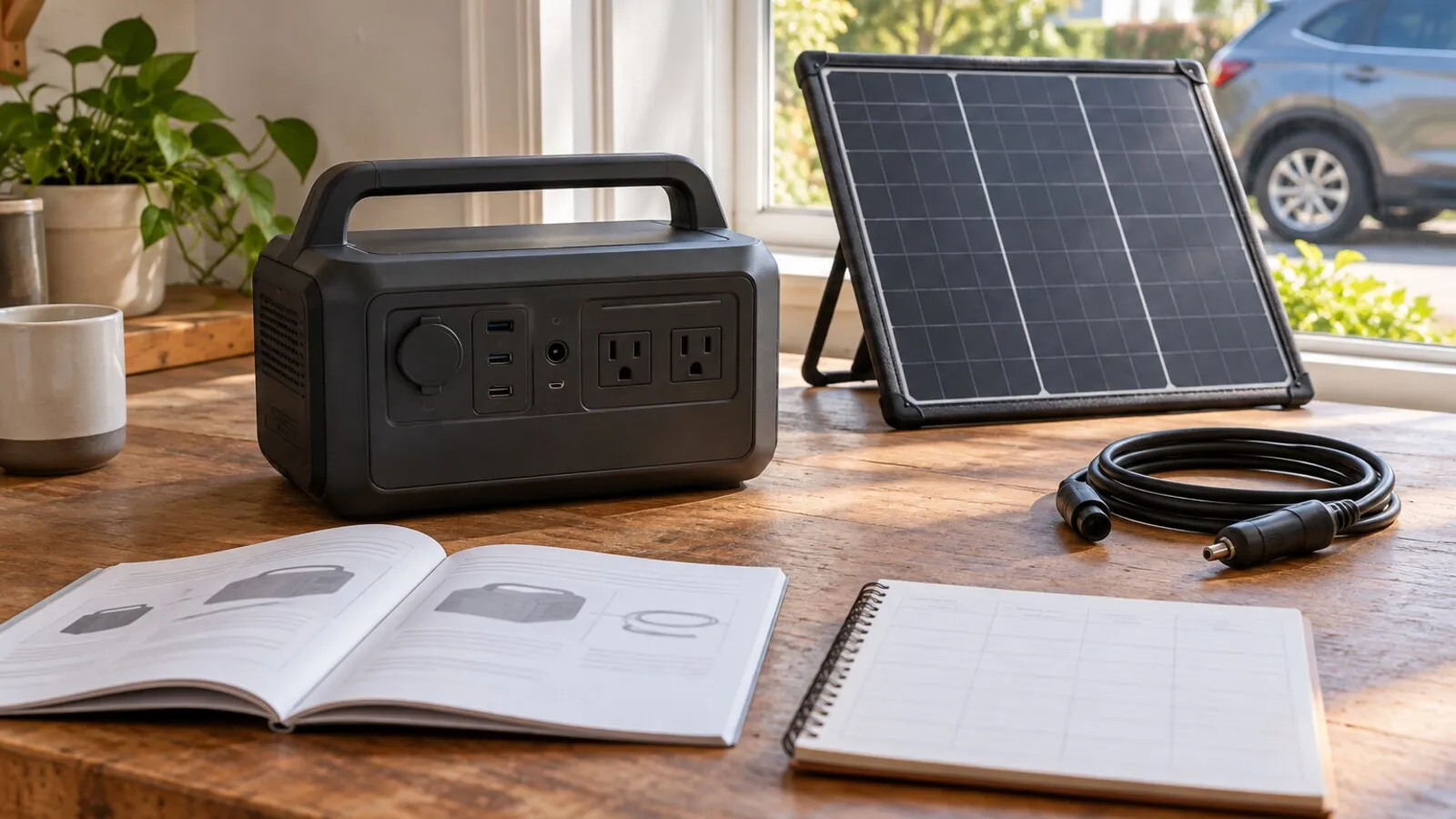
Suppose a household has a U.S. EcoFlow DELTA 3, a solar panel, and a vehicle during an outage. The manual uses its XT60 input for solar or car charging and lists separate limits. Check the panel labels against the solar rules and the vehicle socket against the car-input instructions. Do not assume both can be used at once unless the manual permits it.
It also describes AC charging and model-specific devices at the extra-battery port. A compatible expansion battery adds storage; a listed smart generator or alternator charger may supply a documented charging path. An expansion battery is not a generic recharge source.
A 500 W solar-input ceiling is not an all-day 500 W supply or a promised charge rate. Sun, temperature, battery state, other inputs, and charging controls change actual input. For panel labels, use the solar compatibility checklist.
Make a one-line recharge record
Before relying on a method, note:
- Exact station model, region, and manual revision.
- Input name and port; required cable or approved accessory.
- Voltage range, current ceiling, power ceiling, and temperature limits.
- Whether another input may be connected at the same time, and its priority.
- Where the source will be available and what could make it unavailable.
- The manual’s stated charging-time conditions, if you need a time estimate.
Do not divide battery watt-hours by maximum input watts and treat the result as a promised charge time: input varies with source, charge curve, losses, and device controls. If a connection is unclear, leave it disconnected and ask the manufacturer. This article does not cover connecting station outputs to household wiring.