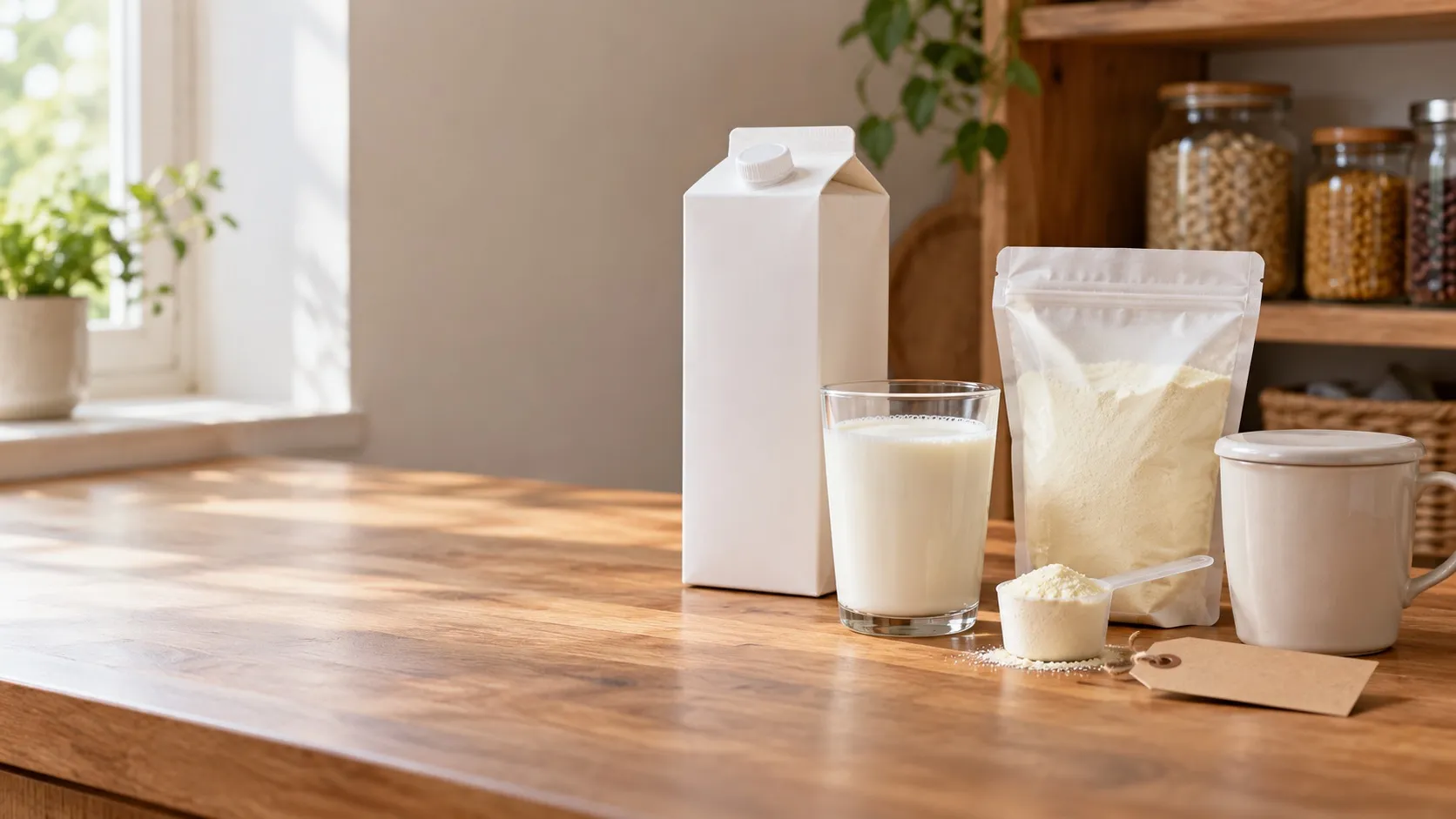
Fresh fluid milk consists of approximately 87% water, 4% milkfat, 3.2% protein, and 5% lactose. Because fluid water activity (Aw = 0.99) creates an ideal microbial growth medium, standard pasteurized milk spoils within hours above 40°F (4.4°C). When utility blackouts disrupt mechanical refrigeration, pantry milk storage hinges on two divergent preservation technologies: commercial sterilization in sterile aseptic cartons (UHT milk) or complete dehydration of the water fraction (powdered milk).
Choosing between these formats is a physical engineering tradeoff between storage weight, potable water reserves, and post-opening bacterial kinetics. Storing a 32 oz UHT carton locks up zero prep water but forces an immediate consumption countdown once unsealed. Conversely, powdered milk offers multi-year pantry longevity at one-tenth the shipping weight, but demands dedicated drinking water reserves to prepare.
Microbial thermal death time and aseptic processing physics
Commercial milk shelf stability depends on thermal destruction of vegetative bacterial pathogens and resistant bacterial endospores, primarily Clostridium botulinum and Bacillus cereus.
Standard High-Temperature Short-Time (HTST) pasteurization heats milk to 161°F (71.7°C) for 15 seconds. While HTST eliminates active pathogens, it does not destroy bacterial spores. Surviving psychrotrophic spores germinate under refrigeration, giving HTST milk a strict refrigerated shelf life of 14 to 21 days.
Ultra-High Temperature (UHT) processing elevates milk to 280°F to 302°F (138°C to 150°C) under pressurized steam injection for 2 to 6 seconds, followed by rapid flash-cooling. This intense thermal kinetic energy achieves commercial sterility (a minimum 12-decimal reduction in heat-resistant spores). The sterile liquid is packed immediately into pre-sterilized, multi-layer aseptic containers. These composite cartons feature six protective laminations:
- Outer polyethylene layers: Protect against external humidity and mechanical scuffing.
- Cardboard core: Provides structural rigidity and shape memory.
- Aluminum foil barrier: Prevents oxygen diffusion and UV light penetration, halting photo-oxidation of riboflavin and lipid rancidity.
- Inner polyethylene contact layer: Creates a food-safe liquid seal.
As long as the multi-layer hermetic seal remains unpunctured, an unopened UHT carton prevents microbial growth at ambient temperatures below 75°F (24°C) for 6 to 9 months. However, the moment the plastic pour spout or foil membrane is pierced, atmospheric oxygen and airborne bacteria enter. The internal liquid is no longer sterile; it reverts instantly to perishable fluid milk.
Dehydrated milk powder relies on an entirely different physical boundary: moisture removal. Skim milk is concentrated via vacuum evaporators to roughly 45% to 50% solids, then atomized into a spray-drying chamber heated to 300°F to 400°F (149°C to 204°C). Moisture evaporates within seconds, yielding dry granules with less than 4% total moisture. This depresses the water activity below Aw = 0.20. Bacteria and fungi cannot metabolize or replicate below Aw = 0.60. Sealed inside airtight #10 steel cans with oxygen absorbers, nonfat dry milk (NFDM) remains biochemically stable for 10 to 20 years.
Worked reconstitution math, storage density, and water budget
Evaluating shelf-stable dairy requires calculating both dry matter reconstitution ratios and the physical volume impact on your home storage footprint.
Reconstitution ratios and water requirements
Nonfat dry milk has an uncompressed bulk density of approximately 0.38 g/cm³. Standard culinary reconstitution operates on an 8:1 fluid-to-solids volume ratio:
- Single 8 oz glass (240 mL): Requires 1/3 cup dry powder (approx 32 g) mixed into 7/8 cup clean drinking water (approx 210 mL).
- One quart (946 mL): Requires 1-1/3 cups dry powder (approx 128 g) mixed into 3-3/4 cups clean water (approx 885 mL).
- One gallon (3,785 mL): Requires 5-1/3 cups dry powder (approx 512 g / 1.13 lbs) mixed into 15 cups clean water (approx 3,550 mL / 0.94 gallons).
If your household emergency plan budgets 1 gallon of milk per week for a family of four, powdered milk requires setting aside an additional 0.94 gallons (3.55 kg / 7.8 lbs) of purified drinking water per week strictly for reconstitution. You cannot reconstitute milk with questionable or untreated water; doing so recontaminates the milk and exposes vulnerable digestive systems to waterborne pathogens.
Volumetric and weight comparison for a 4-week supply (4 gallons)
-
UHT Aseptic Cartons (16 quarts / 4 gallons):
- Total liquid weight: 4 gallons × 8.6 lbs/gal = 34.4 lbs (15.6 kg).
- Storage volume: Sixteen 1-quart aseptic bricks consume roughly 1,120 cubic inches (0.65 cu ft) of rigid cupboard space.
- Prep labor: Zero water needed; ready to pour immediately.
-
Nonfat Dry Milk Powder (#10 steel can or Mylar pouch):
- Dry powder weight: 4 gallons × 1.13 lbs = 4.52 lbs (2.05 kg).
- Storage volume: A single #10 can (approx 180 cu inches / 0.10 cu ft) stores up to 4.5 lbs of powder.
- Weight savings: Reduces transported pantry payload by 29.88 lbs (87% reduction).
The post-opening bacterial clock
In an electrical outage without refrigeration, ambient temperatures often rise above 70°F (21°C). Once an aseptic UHT carton is opened, or dry powder is reconstituted in water, psychrotrophic and mesophilic bacteria replicate following exponential kinetics:
N_t = N_0 × 2^(t / g)
Where t is elapsed time and g is generation time. Between 70°F and 90°F (21°C to 32°C), Lactococcus lactis and environmental contaminants have a generation time of only 20 to 30 minutes.
- Starting bacterial count: Even a low post-opening innoculum of 100 CFU/mL.
- After 2 hours (4 doublings): 100 × 2^4 = 1,600 CFU/mL.
- After 4 hours (8 doublings): 100 × 2^8 = 25,600 CFU/mL.
Per USDA and FoodSafety.gov protocols, any fluid milk held above 40°F (4.4°C) for more than 2 hours (or 1 hour when ambient temperatures exceed 90°F / 32°C) must be discarded. Opening a 32 oz UHT carton when only 8 oz is needed wastes 24 oz of milk if you lack active cooling.
Milk format decision matrix: packaging, water needs, and failure limits
The matrix below compares commercially available shelf-stable milk formats across storage longevity, water requirements, and failure modes.
| Milk Format & Packaging | Unopened Ambient Shelf Life | Required Prep Water | Post-Opening Storage Rule at > 40°F | Who Should Skip It / Operating Limit |
|---|---|---|---|---|
| UHT Multi-Serve Carton (32 oz / 1 Quart) | 6–9 months at ≤ 75°F (24°C) | Zero | Discard after 2 hours (1 hr if > 90°F) | Skip if: Solo household lacking cold storage; opening 32 oz for a single cup of coffee wastes 75% of the carton. |
| UHT Single-Serve Tetra Brik (8 oz / 240 mL) | 6–9 months | Zero | Finish in one sitting; no leftovers | Skip if: Budget storage is primary; costs 2.5× to 3× more per fluid ounce than 32 oz cartons or dry powder. |
| Nonfat Dry Milk (NFDM) in #10 Can with O2 Absorber | 10–20 years at ≤ 70°F (21°C) | 0.94 gal clean water per gallon powder | Dry can stays stable for 12 mos; reconstituted liquid spoils in 2 hrs | Skip if: Clean drinking water supply is strictly rationed; cannot spare 15 cups of water to mix 1 gallon of milk. |
| Whole Milk Powder (e.g., NIDO, 26% milkfat) | 1–2 years max (nitrogen flushed) | 0.94 gal clean water per gallon powder | Powder oxidizes within 60–90 days once opened; liquid spoils in 2 hrs | Skip if: Planning multi-year storage; unsaturated butterfat undergoes rapid oxidative rancidity even when dry. |
| Evaporated Milk (12 oz Steel Can) | 1–2 years | Dilute 1:1 with clean water for drinking | Refrigerate immediately upon opening or discard in 2 hours | Skip if: Looking for fresh beverage taste; high thermal processing caramelizes lactose, leaving a distinct cooked flavor. |
When structuring a comprehensive family reserve, pair dairy formats with calorie and grain planning in our two-week emergency menu plan.
Milk format check
Before transferring shelf-stable dairy products into your long-term storage pantry, execute this physical inspection and portion-matching protocol to verify packaging integrity and avoid the opened-carton spoilage trap:
-
Verify package labeling and hermetic seal integrity:
- Ensure the carton explicitly states “Shelf Stable” or “Aseptic Packaging.” Standard pasteurized milk in paperboard cartons or plastic jugs labeled “Keep Refrigerated” must never be stored at room temperature, even if unopened.
- Inspect aseptic cartons for micro-tears, crushed corners, or seam delamination. Reject any carton displaying convex bulging or swelling; gas production in an unopened carton indicates anaerobic spore germination (Clostridium or gas-producing Bacillus strains) resulting from processing failure or pinhole seal breaches.
- For powdered milk, verify that cans are free of rim dents or rust along the welded seam. Foil Mylar pouches must be checked for puncture pinholes along fold creases.
-
Match container size to household consumption units:
- If you do not possess an active backup generator or an emergency ice source, select 8 oz single-serve UHT tetra-packs or portion powder into single-serving airtight glass jars.
- Calculate your immediate per-meal requirement: 8 oz for breakfast oatmeal, 2 oz for coffee. Never unseal a 32 oz or 64 oz fluid carton unless multiple household members are present to consume the entire volume within a single meal.
-
Reconstitution water safety rules:
- Reconstitute dry milk using only potable water certified safe for direct human consumption. If your municipal supply is under a boil-water advisory, boil water for a full 1 rolling minute (3 minutes at elevations above 6,500 feet / 2,000 meters) and cool to room temperature before mixing.
- Never attempt to extend the life of reconstituted milk by leaving it covered on a cool countertop; room-temperature liquid milk supports pathogen growth regardless of room ambient lighting.
-
Document and rotate inventory dates:
- Using a permanent black marker, write the purchase date and manufacturer expiration date prominently on the top face of each carton or can.
- Rotate UHT cartons on a first-in, first-out (FIFO) cadence every 6 months by cycling them through daily household breakfast cooking. Rotate dry whole milk powder annually, and nonfat dry milk every 5 to 7 years to ensure optimal vitamin retention.
- Discard any powdered product that develops an off-yellow or brownish discoloration, a paint-like rancid odor (common in whole milk powder), or clumping that does not immediately disintegrate under light thumb pressure.