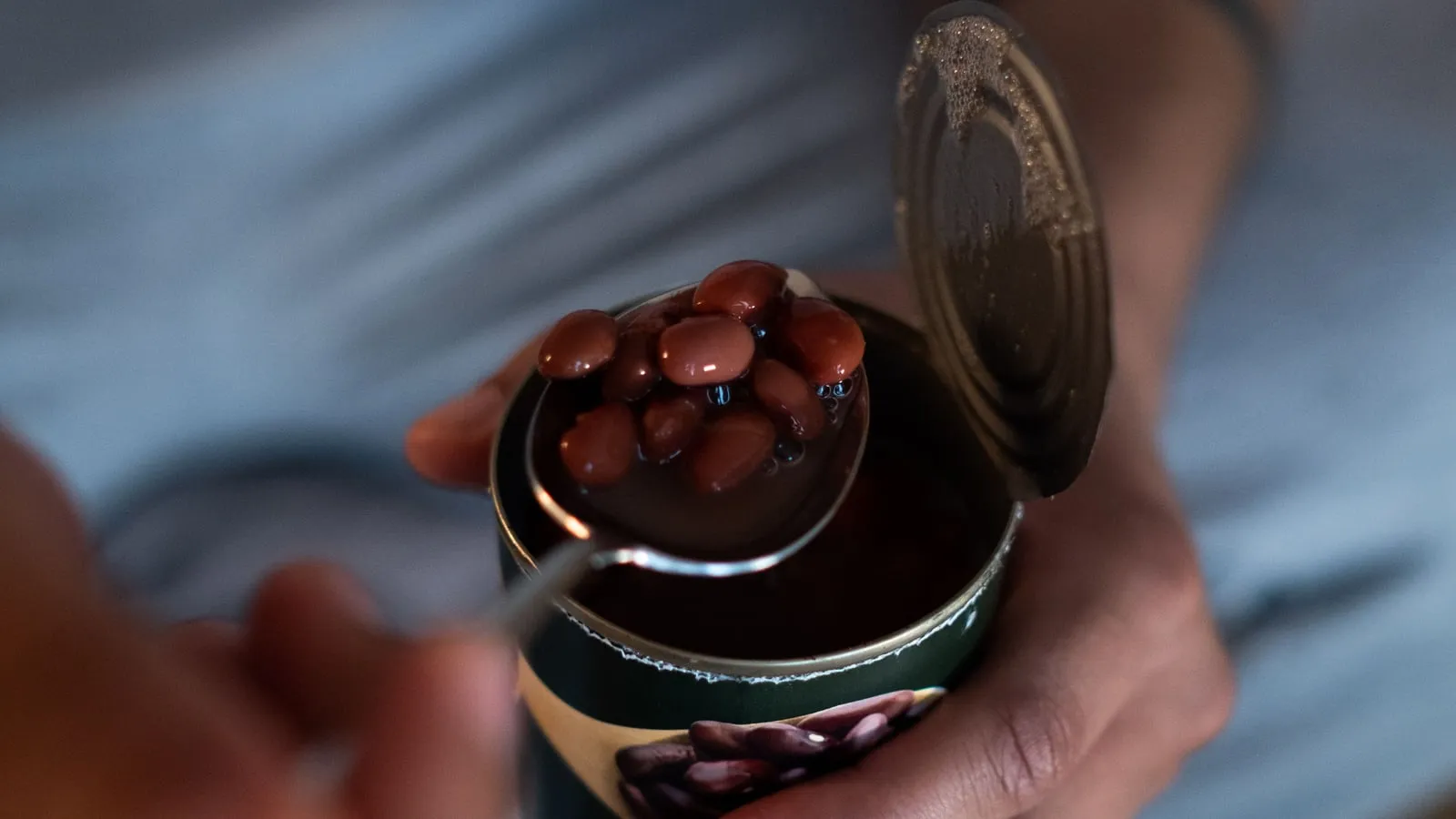
In a grocery store aisle, dry beans and canned beans appear interchangeable: both supply plant-based protein, complex starches, dietary fiber, and shelf stability. In an acute municipal power outage or water grid failure, they represent entirely distinct operational realities. Canned beans are sterile, fully cooked rations ready to be eaten cold straight from the container. Dry beans are raw agricultural commodities requiring substantial potable water, sustained high-heat fuel combustion, and careful thermal processing to eliminate naturally occurring gastrointestinal toxins.
Pantry architecture must be designed around your real utilities. Counting dry beans as emergency rations without calculating the gallons of drinking water and ounces of camping fuel needed to cook them creates a severe, invisible vulnerability during a disaster.
Thermodynamics, water draw, and fuel burn of rehydration
The primary physical mistake in emergency planning is treating dry beans as a zero-water staple. Dry legumes have a moisture content between 10% and 14%. To become digestible, their starch granules must gelatinize, and protein structures must denature—a biochemical process requiring moisture absorption and sustained boiling temperatures above 185°F (85°C).
Worked calculation: cooking 1 lb of dry pinto beans vs. opening three 15-oz cans
Consider the physical resources needed to deliver approximately 1,500 kcal of cooked beans (the equivalent of six 1/2-cup servings) during an urban utility shutdown:
-
Option A: 1 lb (16 oz / 453 g) Dry Pinto Beans:
- Soaking water: Requires 3 to 4 cups (24 to 32 fl oz / 0.71 to 0.95 L) of clean water for an 8-hour cold soak. This water is largely absorbed or drained off with oligosaccharides.
- Cooking water: Requires 4 to 6 cups (32 to 48 fl oz / 0.95 to 1.42 L) of fresh potable water in the pot to maintain liquid coverage during evaporation.
- Total potable water draw: 7 to 10 cups (56 to 80 fl oz / 1.66 to 2.37 L). If household drinking water is rationed at FEMA’s baseline of 1.0 gallon (128 fl oz) per person per day, preparing a single batch of dry beans consumes 44% to 62% of an adult’s entire daily hydration allowance.
- Cooking fuel consumption: Bringing 1.5 liters of water to a boil from 60°F requires approximately 130 kcal (544 kJ) of thermal energy. Maintaining a gentle rolling boil for 75 to 90 minutes on a portable butane or isobutane camp stove (rated at 7,500 BTU/hr / 2.2 kW) burns approximately 110 to 160 grams of pressurized gas. A standard 227-gram (8 oz) butane canister is more than half exhausted by a single pot of beans.
- Net output: 6 cups of cooked beans (approx. 1,480 kcal).
-
Option B: Three 15-Ounce (425 g) Cans of Cooked Beans:
- Potable water draw: 0.0 gallons. The beans are pre-cooked and suspended in water and starches. The packing brine itself is edible and non-toxic, containing dissolved minerals and starches.
- Cooking fuel consumption: 0.0 grams. Canned beans can be eaten at room temperature without any heating. If hot food is desired for psychological comfort, warming them through takes 3 to 4 minutes, consuming less than 10 grams of fuel.
- Net output: 5.5 to 6 cups of edible cooked beans (approx. 1,050 to 1,200 kcal).
For any disruption lasting under two weeks, the water and fuel penalties of dry beans outweigh their compact dry storage volume.
Choose by outage conditions
Evaluate your pantry storage choices against the exact physical limits of your shelter environment:
| Likely Outage Constraint | Dry Beans (Stored Dry) | Canned Beans (Commercial Retort) | Who Should Skip It / Operating Limit |
|---|---|---|---|
| No indoor cooking method | Raw dry beans are completely inedible; raw starches cause intestinal distress. | Ready to eat immediately cold; Iowa State Extension confirms safety directly from the can. | Skip dry beans entirely. Apartments without safe, outdoor-ventilated camp stoves must never store raw dry beans as primary rations. |
| Severely limited water storage | Requires 7–10 cups of potable water per pound for soaking and boiling. | Consumes zero preparation water; packing liquid can be consumed for hydration and minerals. | Skip dry beans if stored water is under 2 gal/person/day. Cooking dry beans cannibalizes basic survival drinking water. |
| Strict weight / bug-out mobility | Extremely lightweight and compact (1 lb dry yields 3 lbs cooked food). | Heavy steel and water mass (3 cans weigh ~3.4 lbs for the same volume). | Skip canned beans for backpack evacuation. Canned food is too heavy for mobile bug-out bags; use dry or freeze-dried pouches. |
| Long-term storage (> 3 years) | Sealed with oxygen absorbers in Mylar, dry beans remain viable for 10 to 25 years. | Commercial can linings degrade; optimal quality window is 2 to 5 years. | Skip canned beans for multi-year bunkers. High-acid can ingredients risk micro-corrosion over decades; dry storage wins long-term. |
| Small household / no cold storage | Measure exact dry portions (e.g. 1/2 cup); unused remainder stays dry and shelf-stable. | Opening a 15-oz or 28-oz can creates leftovers that spoil within 2 hours without a fridge. | Skip large 28-oz cans if living alone. Buy 8-oz or 15-oz cans that can be completely finished in a single meal without leftovers. |
The phytohaemagglutinin (lectin) toxicity boundary
A critical, life-threatening hazard unique to dry legumes—specifically red kidney beans, cannellini beans, and black beans—is the toxic plant lectin phytohaemagglutinin (PHA).
Raw red kidney beans contain exceptionally high concentrations of PHA, measured between 20,000 and 70,000 hemagglutinating units (hau). Ingesting as few as four or five raw or undercooked kidney beans triggers acute gastroenteritis within 1 to 3 hours, causing severe nausea, projectile vomiting, abdominal cramps, and explosive diarrhea.
To destroy PHA, beans must be boiled at a full, rolling boil of 212°F (100°C) for a minimum of 10 to 30 minutes. Lower cooking temperatures present a severe trap: simmering beans at 176°F (80°C)—which frequently occurs when cooking on a weak emergency camp stove or low-heat chafing fuel—does not destroy the lectin. Instead, thermal processing at 176°F increases PHA toxicity five-fold, elevating lectin potency up to 350,000 hau.
Commercial canned beans undergo industrial retort sterilization at 240°F to 250°F (115°C to 121°C) under pressure, completely degrading PHA to undetectable levels (< 400 hau). If you store dry kidney beans, you must have an outdoor-rated propane or butane burner capable of maintaining an authentic 212°F rolling boil.
The “hard-to-cook” defect in aged dry beans
Dry beans do not spoil microbially when kept dry, but they undergo physical deterioration known as the Hard-to-Cook (HTC) defect.
According to Utah State University Extension research on dry bean preservation, storing dry beans in warm (above 75°F / 24°C) or humid (relative humidity > 65%) environments triggers a slow chemical cross-linking of phytate, divalent calcium and magnesium ions, and cell-wall pectin. Over 18 to 36 months, the middle lamella of the bean cotyledon becomes insoluble and impermeable to boiling water.
Beans suffering from the HTC defect refuse to soften. Even after 12 hours of soaking and 4 hours of active boiling, the beans remain hard, gritty, and physically indigestible. Boiling hard-to-cook beans wastes hours of emergency fuel and liters of precious water. To prevent this failure mode:
- Store dry beans in airtight Mylar bags with 300cc oxygen absorbers in a cool closet below 70°F.
- Add 1/4 teaspoon of baking soda (sodium bicarbonate) per quart of soaking water; the sodium ions displace calcium and magnesium ions in the cell walls, accelerating softening.
- Test-cook a 1-cup sample from your dry bean supply every 18 months to verify rehydration performance before an actual disaster occurs.
Can integrity inspection: dents, rust, and botulism boundaries
When relying on canned beans, physical container integrity is your only protective barrier against anaerobic pathogens, specifically Clostridium botulinum.
Inspect every can using standard USDA/FDA food safety criteria:
- End-seam dents: A dent that crosses the top or bottom rim seam compromises the hermetic rubber sealant, drawing in ambient air and microscopic contaminants as the can flexes with temperature changes. Discard immediately.
- Side-wall deep dents: A sharp side dent with pointed creasing often creates microscopic fractures in the interior epoxy lining, exposing steel to acidic brine.
- Bulging or swollen lids: A domed or pressurized can lid indicates active gas production from bacterial fermentation (C. botulinum or thermophilic gas-producers). Never puncture, taste, or heat a bulging can; discard it sealed in a plastic bag.
- Surface rust: Light superficial rust that wipes away with a finger leaves the seal intact. Pitted, rough rust that flakes off indicates structural penetration; discard.
If you are using manual tools, ensure your can opener is physically capable of puncturing modern commercial cans. Keep a heavy-duty mechanical opener such as the OXO Soft-Handled Can Opener stored alongside your canned food reserve, and confirm all household members can operate it without electric assistance.