Chest Freezer vs. Upright Freezer: Measure the Fit
A freezer can fit its capacity into the room and still be awkward to use. Compare the opening, access, and exact model details before choosing a chest or upright layout.
In this guideJump to a section
If a chest freezer will sit beside the garage shelves, you may have enough floor space but not enough room to raise its lid. An upright can solve that opening problem and create a different one: its door needs space in front, and the interior layout determines how you reach a bulky package. Measure the way you will use the appliance, not only the rectangle it occupies.
Compare the opening and the way you retrieve food
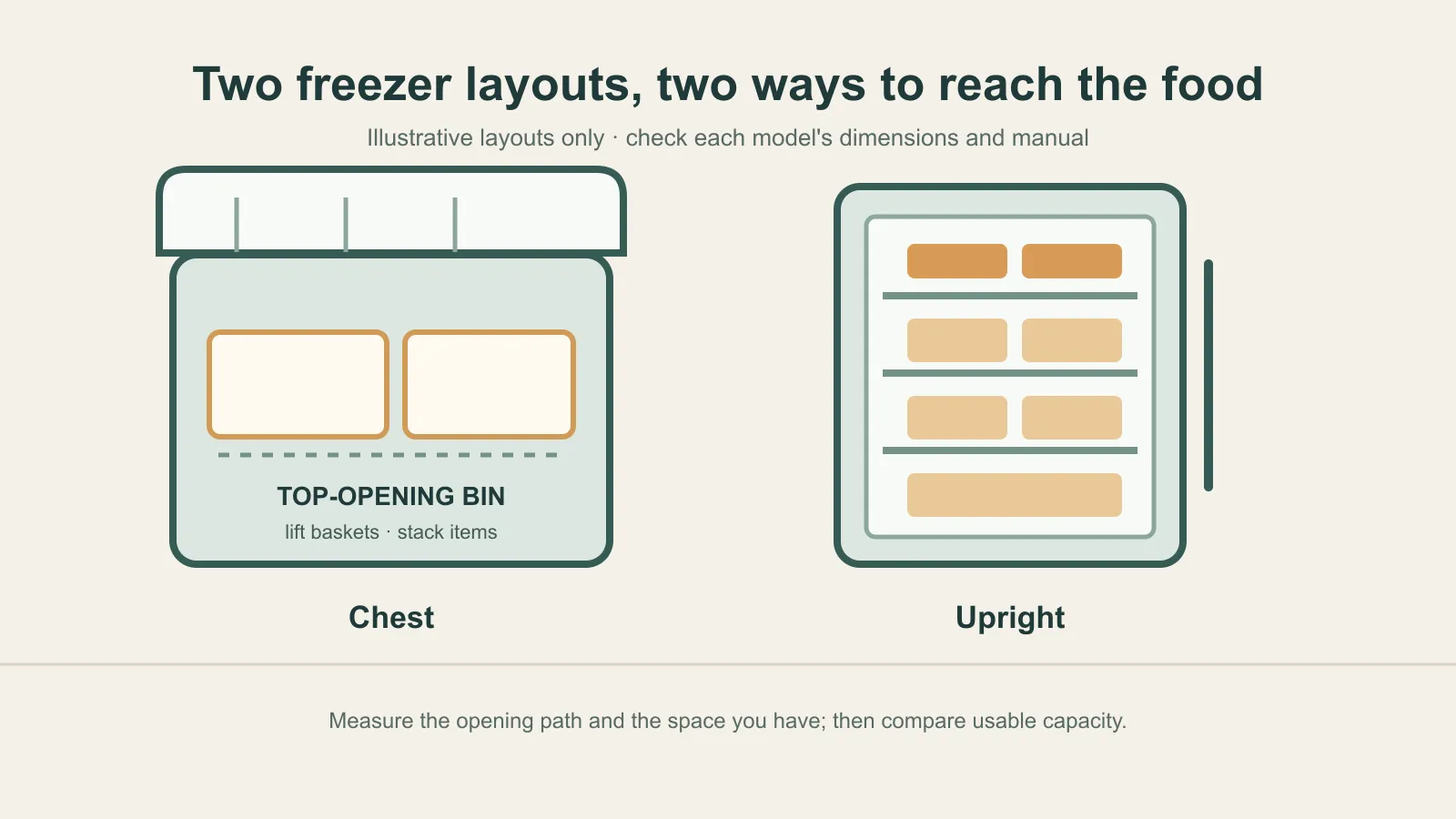
The shapes differ in how they open: a chest freezer opens from above; an upright opens from the front. Check the exact model’s dimensions and the space it needs while open. GE’s manual for its FCM16 and FCM22 chest models describes a lid, removable baskets, and a divider option; its upright model has a front door and shelves. Those are examples from named models, not a promise that every unit has the same layout. Read the installation and owner manuals before treating a product page’s capacity or “garage-ready” label as a fit check.
| Before you choose | Chest layout | Upright layout | Write down |
|---|---|---|---|
| Opening clearance | Raise the lid fully without hitting a shelf, ceiling, or stored items. | Open the door without blocking a walkway, cabinet, or another appliance. | Available height above the freezer or door-swing depth in front. |
| Reaching stored food | Items may sit in layers or baskets; decide how you will lift and find what is underneath. | Shelves and bins may help divide items; check the actual shelf spacing and removable parts. | Your common package shapes and which items you need to reach often. |
| Getting it into place | Measure the path through doors, turns, and stairs for the specific cabinet. | Check the same path and the orientation required by the manufacturer. | Narrowest opening, turns, and any model-specific delivery instructions. |
| Comparing capacity | Use the listed capacity and imagine how your packages fit; a number alone does not show reachability. | Check shelf layout against the large or irregular packages you store. | Capacity and the full model number for each option. |
An upright may make individual packages easier to see, while a chest’s open bin can suit packages that do not fit neatly on shelves. What matters is whether the layout works for your load and your reach. If the freezer will be used by someone who should not lift a full basket or reach deep into a bin, test that access before buying.
Compare energy use by model
ENERGY STAR’s buying page gives broad annual-use averages of about 215 kWh for a certified chest freezer and 395 kWh for a certified upright freezer. Treat those as orientation only, not as a same-size comparison or a promise of savings. The page’s cost examples are also approximate; your rate and the specific appliance change the result.
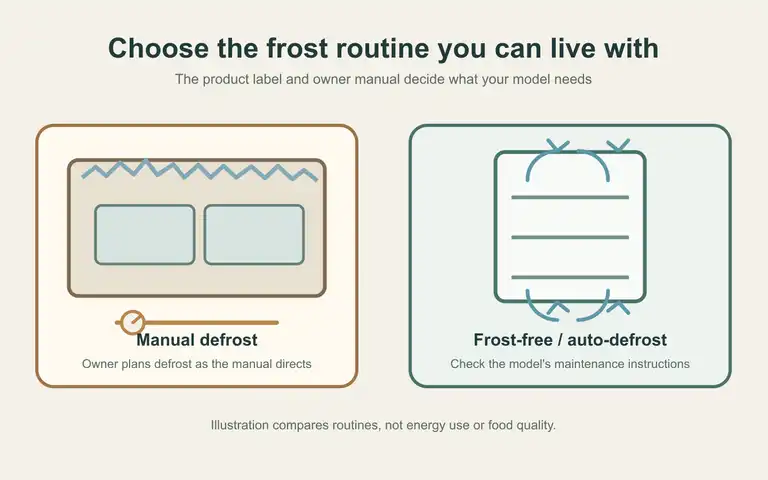
For a real shortlist, compare the exact models in the ENERGY STAR product finder. Record capacity, annual kWh, defrost type, and features for each. If one model has an ice maker or more capacity than another, that is part of the comparison. Do not assume the shape alone predicts the bill. And if you want to consider manual versus automatic defrost as a separate maintenance choice, use the freezer defrost guide.
Fit-and-retrieval worksheet
Bring this short record to the product page or store. Measurements should come from your room and the exact installation guide; this worksheet does not replace either.
- Measure the floor area and the full opening space: lid height above the chest, or door swing in front of the upright.
- Measure the route into place, including the narrowest doorway and any tight turn.
- List three large or awkward packages and the items you need to reach most often.
- For each candidate model, write its full model number, capacity, external dimensions, opening clearance, annual kWh, and defrost type.
- Cross out a model if you cannot open it fully, move it into position as directed, or reach the stored food comfortably.
Then choose between the models that actually fit. For planning what a household will store in that space, return to emergency food storage basics.