Manual Defrost vs. Frost-Free Freezer: Choose Your Routine
The difference between manual defrost and frost-free is mostly about owner upkeep. Decide how often you want to plan a defrost, then compare model-specific energy and maintenance instructions.
In this guideJump to a section
If you are choosing a second freezer, the word “manual” can sound like a minor detail until you picture moving its contents and making time to defrost it. The useful difference is the work the model asks you to do. Decide whether you are willing to plan that interruption, then check the actual freezer model rather than inferring its defrost design from its shape.
Choose the maintenance routine first
| If you would rather… | Manual-defrost design | Frost-free / automatic-defrost design |
|---|---|---|
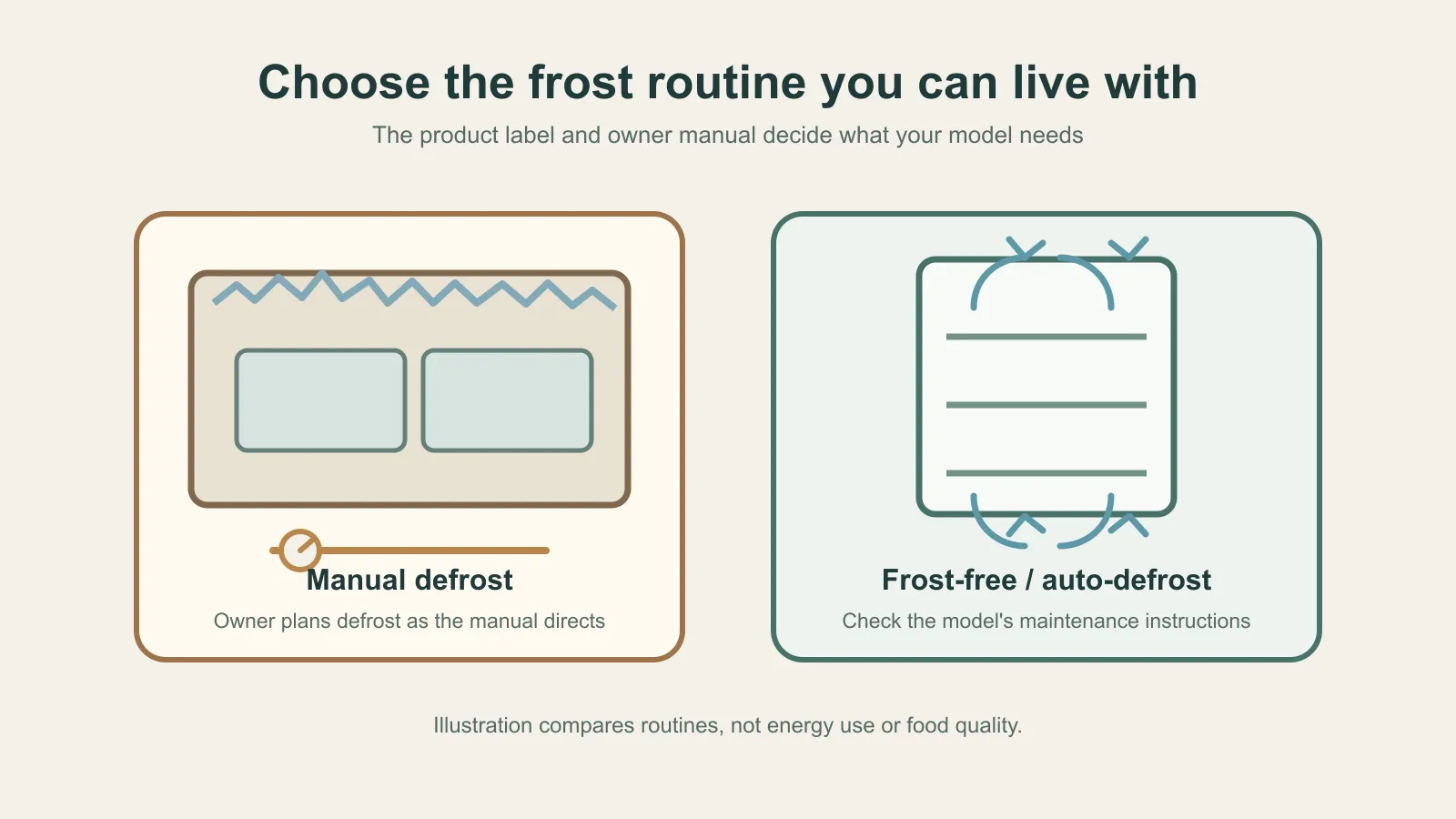
| Avoid a planned defrost day | Expect to defrost and clean according to the exact manual. You may need a cooler or another suitable cold place for the food while the appliance is off. | The model is labeled to avoid routine manual defrosting, though other cleaning and care may still be required. Check the manual. |
| Keep upkeep predictable | Read the manual for the model’s frost trigger, cleaning schedule, safe power-off steps, tools, and food-transfer directions. | Check what the manual says about cleaning, operation, and service; the label does not mean the appliance never needs care. |
| Compare energy use | Compare model-level annual kWh and capacity, not a generic manual-defrost saving. | Compare the same model-level fields and features; an automatic-defrost label is not an energy rating. |
The manuals show why there is no universal defrost calendar. GE’s instructions for its FCM16/FCM22 chest models say that in most climates defrosting may be needed about twice a year and limit frost buildup to about one-quarter inch. Whirlpool manual W11507042B, in its manual-defrost section, says to defrost around one-quarter inch and thoroughly defrost and clean at least annually, with more frequent care in high humidity. Those are examples for those models, not a schedule to copy onto the appliance you own. Follow the complete manual for your exact model.
The practical question is whether you can make room for a future defrost and temporarily move the contents as directed. If the freezer is heavily used every day or a safe place for the food would be difficult to arrange, avoiding that recurring task may matter more than other considerations. If the freezer is opened less often and the manual’s routine fits your household, manual defrost may be acceptable. Neither choice by itself guarantees food quality or safe handling.
Check the freezer section, not just the appliance shape
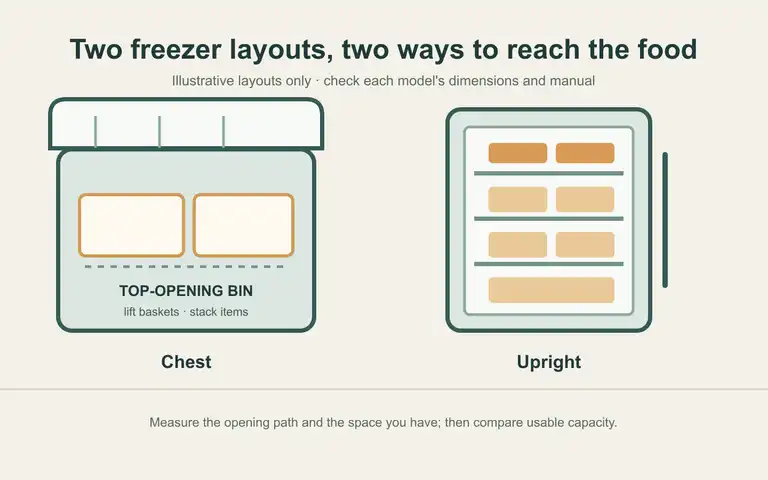
Chest and upright describe how the cabinet opens. Defrost type describes a different product feature. ENERGY STAR’s certified freezer listing keeps form factor and defrost type as separate model fields; it includes chest manual-defrost products, compact upright manual-defrost products, and upright automatic-defrost products. So “chest means manual” and “upright means frost-free” are not reliable shopping rules.
For each candidate, record the full model number, the freezer section’s stated defrost type, its capacity, annual kWh, and any automatic features that affect the comparison. A refrigerator-freezer can use different defrost approaches in its refrigerator and freezer compartments; read the freezer’s information specifically. If your main uncertainty is cabinet access or opening space, use the separate chest-versus-upright fit guide.
Do not assume manual defrost is automatically cheaper to run. ENERGY STAR lists annual energy use for individual certified products and broad averages by freezer type, but those averages do not isolate defrost method in a matched comparison. Compare similar capacity and feature sets in the current product finder. Use the maker’s label and your local electricity rate if you are estimating cost.
Already own a manual-defrost freezer? The separate freezer defrost preparation guide helps match the appliance, food move, water route and restart requirements to its manual.
Defrost-choice record
Before choosing, capture these details side by side:
- Exact model number and compartment being compared
- Manual-defrost or automatic/frost-free wording on that model’s product page and owner manual
- Capacity, listed annual kWh, and features that differ between the models
- Manual instructions for owner defrosting, food transfer, cleaning, and model-specific triggers
- Whether you can schedule the required downtime and follow the stated precautions
If the product page and manual do not agree, ask the manufacturer for that model’s current instructions before buying. This comparison is about maintenance choice; when you need to establish a normal freezer reading or interpret one that has risen, use the refrigerator and freezer temperature guide.