In this guideJump to a section
Basement sewer backups can follow several paths, and the right mitigation depends on which fixtures sit below the public sewer’s relevant flood level, the building drain layout, local rules, and site history. A backwater valve and an overhead sewer are different measures; neither is a guarantee against every backup or flood. FEMA’s Urban Flooding: Guidance for Homeowners and Renters describes both approaches, notes that debris can obstruct check valves, and explains that permits and a plumber-selected configuration apply. The guide focuses on Cook County, Illinois; local requirements vary.
For other water-entry pathways, see the home flood and storm water defense guide.
What a head-pressure example can show
A 15-foot-high static water column corresponds to about 6.5 psi using the USACE static water-head conversion of 0.433 psi per foot: 15 × 0.433 = 6.495 psi. This is an illustrative hydrostatic conversion only. It does not establish the height or pressure of a municipal surcharge at a particular home, account for transient conditions, or show that this pressure will reach a particular fixture. Do not use this example as a design load. A local plumbing professional or authority must assess the actual sewer connection and elevations.
Conceptual comparison only. A licensed plumber must determine the actual configuration, elevations, venting, materials, and code requirements.
How the two approaches differ
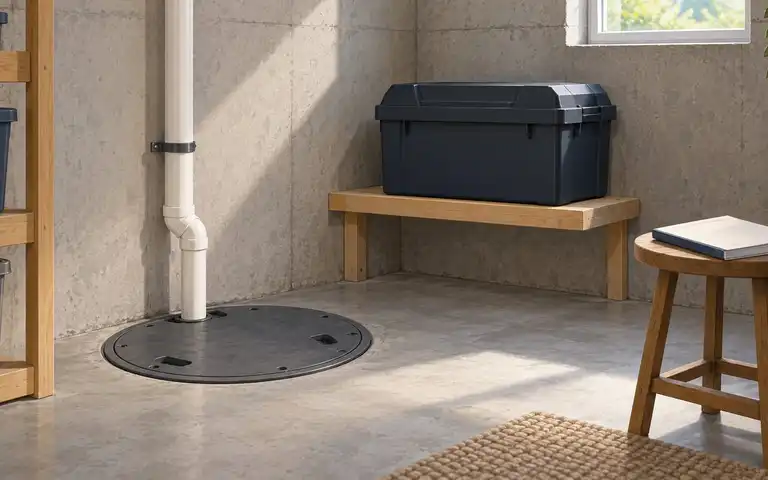
A backwater valve is placed on a building drain or branch serving protected fixtures; the licensed plumber determines its allowed location and protected fixtures under local rules. When reverse flow closes the valve, fixtures connected upstream can no longer drain through it until the valve reopens. Debris can prevent a valve from sealing. FEMA describes access-covered valve pits and some basement-floor installations; have the plumber explain how the selected valve will remain accessible for inspection and service. FEMA describes valve-specific maintenance intervals and recommends asking the plumber for instructions; the right schedule depends on the valve and local requirements, so this page does not set a universal service interval.
An overhead sewer system routes below-grade fixtures to a sewage ejector basin and pump that discharge to the building drain above the affected fixtures. It can remove the direct gravity connection for those fixtures, but still depends on the basin, pump, controls, check and isolation valves, venting, electrical supply, and correct layout. Pump failure, power loss, blockage, improper maintenance, or an event that exceeds system conditions can still cause problems. The system’s exact configuration must follow the manufacturer and locally adopted plumbing code.
| Consideration | Backwater valve | Overhead sewer system |
|---|---|---|
| Basic approach | Limits reverse flow through a protected drain when the valve closes | Pumps below-grade fixture discharge up to the building drain |
| Main dependencies | Correct location and accessible working parts; clean closure; upstream fixtures may not drain during closure | Pump, basin, controls, check/isolation valves, venting, power, and discharge route |
| Failure concern | Debris may obstruct the valve; closure can block normal drainage from connected fixtures | Pump, power, switch, blockage, or installation failures can interrupt discharge |
| Work involved | Drain modification and often access work; scope depends on layout | Plumbing redesign and often excavation/slab or wall work; scope depends on layout |
| Decision owner | Licensed local plumber and authority having jurisdiction | Licensed local plumber, qualified electrician as applicable, and authority having jurisdiction |
This comparison does not rank reliability or predict cost: both vary with site conditions, design, equipment, and local labor. Ask the plumber which fixtures are protected, what happens to normal drainage during a surcharge, how the system behaves during a power outage, and what inspection and maintenance schedule the exact manufacturer requires.
Questions for a licensed plumber
- Which fixtures are below the relevant sewer elevation, and which paths could let sewage enter?
- Does local code permit and require a backwater valve here? Which fixtures would be upstream of it?
- Would an overhead sewer system suit the existing layout and expected use? Where would the basin, vents, valves, and discharge be located?
- What are the exact pump model, required head and capacity, solids handling, electrical requirements, and approved installation instructions?
- What permit, inspection, excavation, and electrical work applies locally?
- What happens to below-grade plumbing during valve closure, pump failure, loss of power, or maintenance?
- What inspection and service interval do the applicable code and exact manufacturer instructions require?
Sewer-backup review record
Use this record to keep the professional assessment and equipment documentation together. It is not an installation or service procedure.
- Review date: [YYYY-MM-DD]
- Licensed plumber / firm and license jurisdiction: [record]
- Mitigation type and protected fixtures: [record]
- Local code section, amendments, permit, and inspection: [professional to record]
- Backwater valve or ejector system manufacturer/model: [record]
- Manufacturer installation and maintenance documents: [record]
- Electrical or backup-power review, if applicable: [qualified professional to record]
- Inspection findings and next service date: [per local requirements and exact manufacturer instructions]
A professional assessment can identify practical ways to reduce sewer-backup risk and the conditions those measures depend on. It cannot promise protection from every public-sewer surcharge or other flooding pathway.