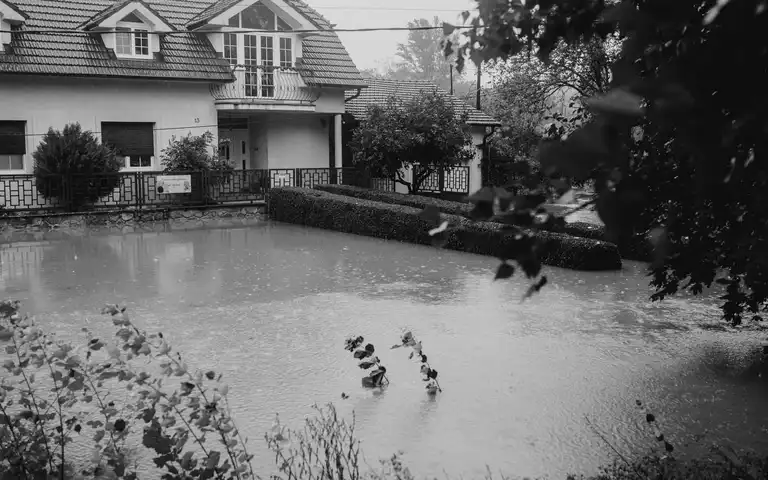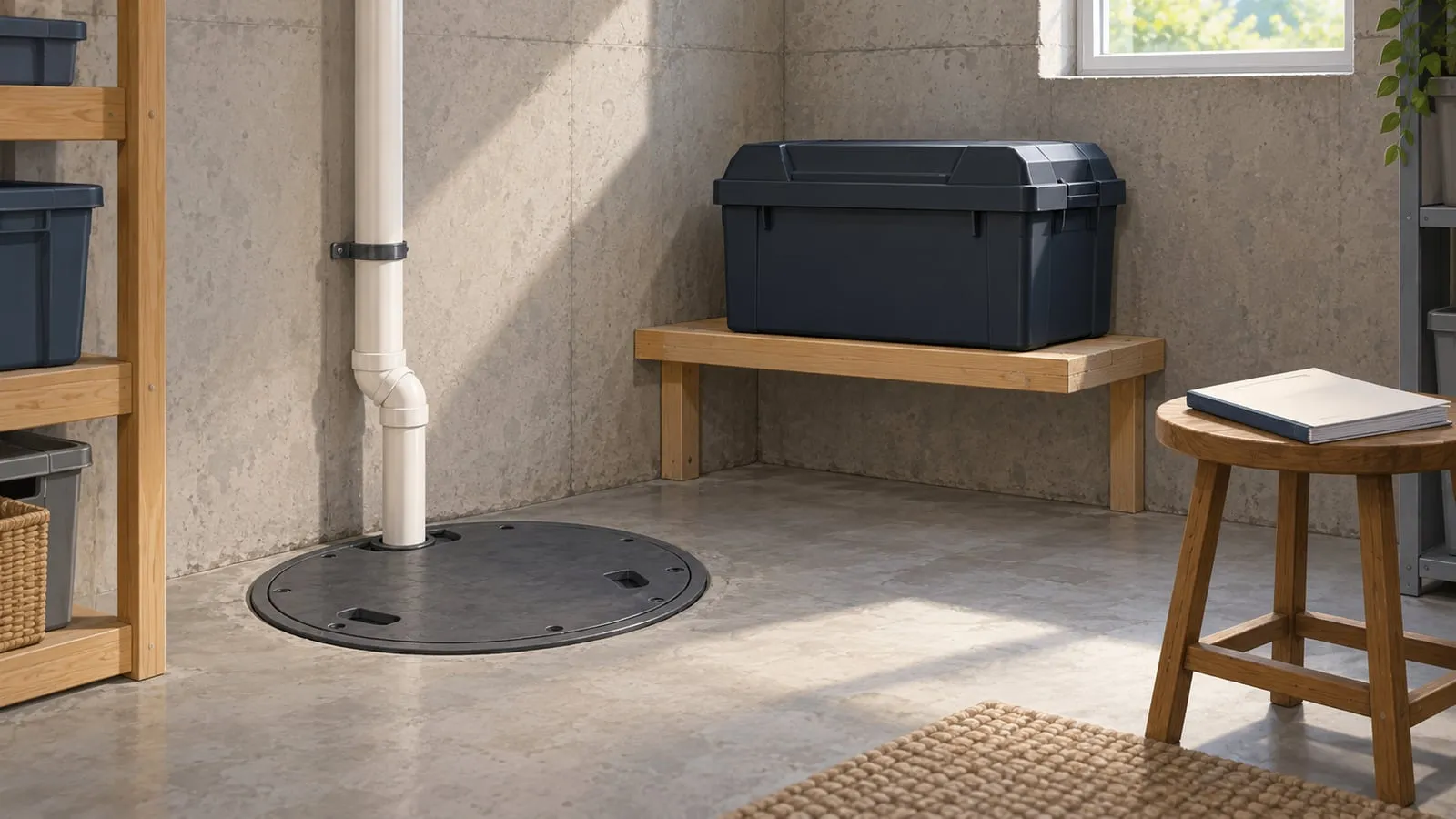
A backup pump is useful only when its flow at the installed system’s head can keep up with water entering the basin, and its battery/controller can support the expected pumping pattern. Neither an open-discharge rating nor battery amp-hours alone answers those questions. FEMA’s floodproofing design guidance likewise calls for considering estimated seepage, pump capacity, head, and electrical power; it warns that seepage can overwhelm a sump system.
For broader property-level options, see the home flood and storm water defense guide.
Read the pump curve at the system head
A manufacturer’s pump curve gives flow at specified total head and supply conditions. Start with the actual water-level-to-discharge elevations and the complete discharge route; friction and fittings add resistance. The resulting operating point is not necessarily the same as a pump’s maximum flow at zero head. Have a qualified sump or plumbing professional calculate the installed system head and compare it with the exact model’s curve and expected inflow. The general principle is supported by FEMA Technical Bulletin 3, which names seepage rate, pump capacity, head, and electrical power as selection considerations.
Five-point sump pump head and capacity assessment sequence
STEP-BY-STEP- Static lift
Measure elevation difference from the bottom of the sump pit to the highest point of the discharge pipe.
- Friction head
Add equivalent length resistance from horizontal pipe runs, 90-degree elbows, and check-valve flow restrictions.
- Curve flow
Locate operating flow (GPM) on the manufacturer pump curve at your calculated total dynamic head.
- Storm inflow
Confirm backup pump GPM at operating head exceeds severe-storm groundwater seepage into the basin.
- Battery Wh
Size deep-cycle battery amp-hours and controller runtime based on storm duty cycle and motor current draw.
A model-specific example is not a universal runtime
Zoeller’s FM3148 manual lists the Aquanot Fit 508-family DC pump at 43 GPM at 5 feet of head, 35 GPM at 10 feet, and 27 GPM at 15 feet when supplied at 12.7 V DC. It describes about 5.5 hours of continuous pumping with a 100+ Ah battery at an 8-foot head, and gives a separate two-day estimate at a 10% duty cycle. These are manufacturer figures for that pump/system and stated conditions, not a promise for another model, battery, head, inflow, or battery age. See the Zoeller manual.
| Question | What the evidence must match |
|---|---|
| How much water can it move? | Exact pump model, published curve, installed system head, and supply voltage |
| How long might it run? | Manufacturer’s runtime conditions, battery model/capacity/condition, controller and pump draw, and actual duty cycle |
| Will it keep up? | Curve flow at the operating head compared with an estimate of inflow; a pump curve alone does not determine seepage |
| Can it be installed here? | Basin space, float movement, discharge configuration, electrical supply, exact manual, and applicable codes |
Battery capacity and runtime
Amp-hours describe charge capacity at a stated voltage and test conditions; they are not a runtime value. A rough charge-use estimate can multiply measured pump current by the fraction of elapsed time the pump actually runs, then by the outage duration. That estimate still omits changing current under load, battery usable capacity and aging, voltage limits, controller losses, temperature, and recharge behavior. Use manufacturer runtime data only for the exact compatible system and stated test conditions. Do not assume a LiFePO4 battery is compatible: the controller, charger, chemistry, voltage, and battery enclosure must allow it.
Zoeller’s manual recommends a 12 V deep-cycle battery for its named Fit system, documents the model-specific pumping curve and runtime conditions, and instructs users to follow its installation and testing requirements. It says electrical wiring/protection must follow applicable national, state, and local rules and calls for inspection/testing at least every three months for that system. Those instructions do not establish a universal battery type or maintenance interval for other products.
Backup-system comparison
| Backup approach | What it can add | Key limit to check |
|---|---|---|
| Battery DC backup pump | A separate pumping option when primary AC power or pump is unavailable | Exact curve, compatible battery/controller, duty cycle, alarm and maintenance instructions |
| Water-powered backup | Can operate without the home’s electric supply when its conditions are met | Local water supply and pressure, applicable backflow rules, and manufacturer data |
| Standby generator | Can power compatible AC equipment when correctly connected and fueled | Qualified electrical installation, generator capacity at load, fuel, and CDC carbon-monoxide precautions |
| Second AC pump | Additional pumping capacity if the basin and discharge are designed for it | Shared failure modes, electrical supply, pit capacity, and exact pump curves |
These are categories for discussion, not a universal recommendation. Water-powered units depend on the available water supply and local requirements; get local authority and licensed-plumber guidance before considering one.
Sump-system review worksheet
Use this list to prepare for a qualified installer’s assessment. It is not a field installation procedure.
- Property and basin location: [describe]
- Water level at pump activation and discharge elevation: [installer to measure]
- Discharge piping route, dimensions, fittings, and check-valve details: [installer to document]
- Estimated inflow or seepage basis and limitations: [professional assessment]
- Primary and backup pump exact model numbers and curves: [attach manufacturer records]
- Battery and controller exact model, chemistry, condition, and compatible capacity: [attach manufacturer records]
- Electrical supply and applicable requirements: [qualified electrician/installer review]
- Maintenance, alarm response, and retest schedule: [exact manufacturer instructions]
Have the installer explain how the selected pump performs at the calculated system head and how that compares with expected inflow. Sump pumping reduces one source of water intrusion; it does not guarantee a dry basement or prevent every flood pathway.