In this guide Jump to a section
- Start with the roof’s timing and application sequence
- What the FORTIFIED Roof designation checks
- Compare written bids on the same scope
- Check grant rules for your state and policy
- Confirm the insurer’s credit in writing
- Calculate simple payback from real bids
- Keep designation term and roof eligibility separate
- Before approving a roofing contract
- Common questions
- Related storm planning
A FORTIFIED Roof can qualify for an insurance incentive in some cases, but neither a credit nor a grant is automatic. Before work starts, confirm the current standard and evaluator process, ask the grant program whether approval must come first, and get insurer requirements in writing. Compare added FORTIFIED work against a standard re-roof using actual bids and the carrier’s stated annual savings.
Start with the roof’s timing and application sequence
If the roof needs replacement, discuss a FORTIFIED scope before selecting materials or signing a contract. Required work must be documented while roof components are visible. Grant programs and IBHS designation have separate application steps. Confirm this sequence for the property:
- Check the current standard and ask an evaluator whether the home may qualify for a new-roof or existing-roof designation.
- Ask the evaluator what must be inspected, photographed, and submitted.
- If applying for a grant, confirm whether selection or written award must occur before contracting, material purchase, demolition, or construction.
- Ask the insurer which designation, certificate status, and documents qualify under the specific policy.
- Obtain comparable written bids that separate ordinary re-roofing, FORTIFIED work, evaluator services, permits, and exclusions.
- Start only after the evaluator, grant program, roofer, insurer, and local permitting sequence is clear.
What the FORTIFIED Roof designation checks
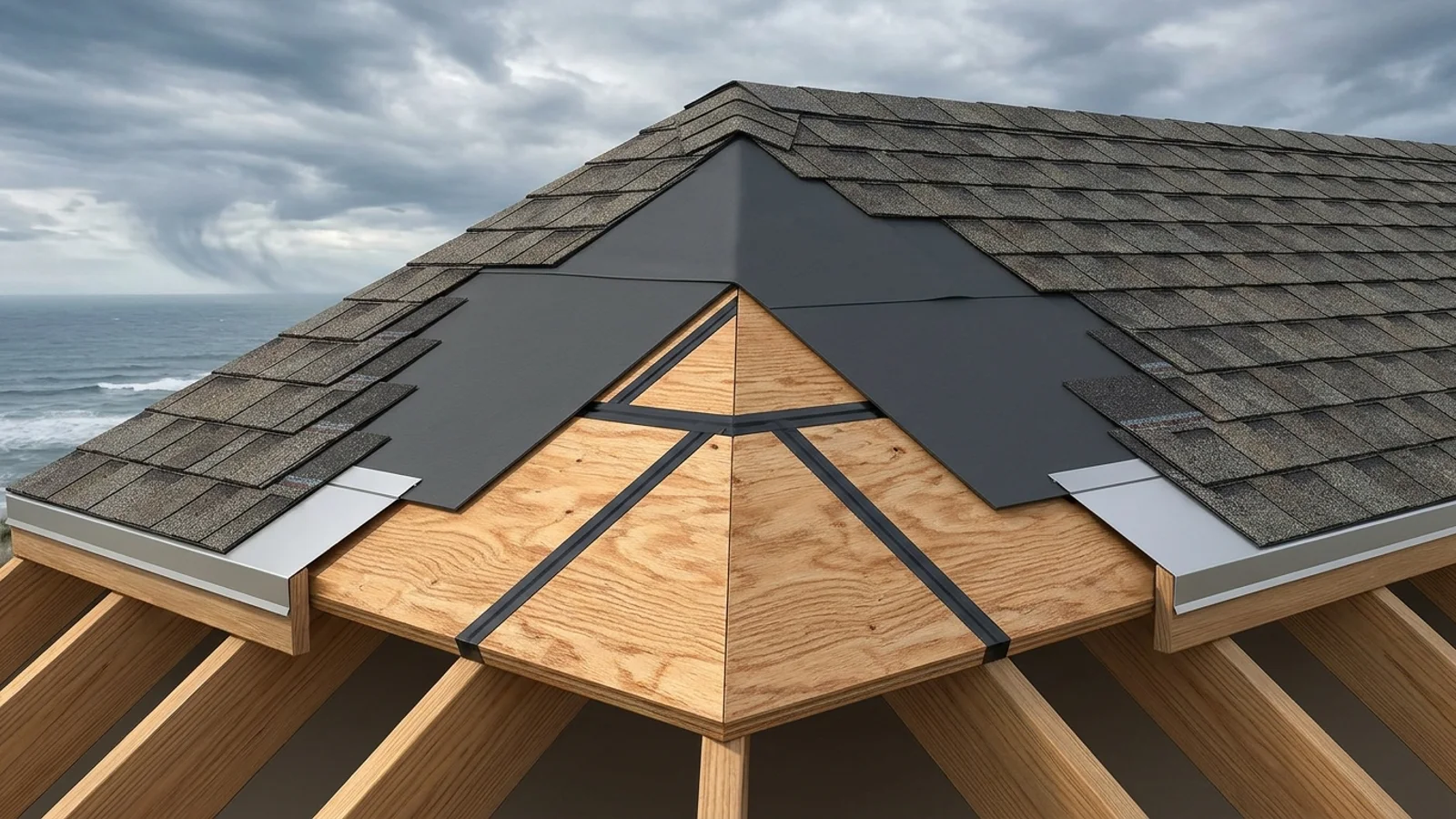
The current IBHS standard addresses construction details beyond the roof covering. Requirements include roof-deck attachment, a sealed roof deck, and roof-edge performance. The exact method depends on the roof assembly, project type, and applicable standard. A contractor’s phrase like “FORTIFIED-ready” does not establish designation. An evaluator documents eligible work and submits the evaluation for review.
FORTIFIED Silver and Gold address additional building components and connections. Ask an evaluator which level is appropriate; do not infer it from a roof-only bid.
Compare written bids on the same scope
Give each bidder the same roof area, tear-off assumptions, covering type, deck condition, and project timing. Ask the evaluator what must be seen before it is covered. Fill this worksheet from actual bids rather than a national average.
| Quote item | Standard re-roof | FORTIFIED project | Verify with |
|---|---|---|---|
| Roof covering, underlayment, tear-off, disposal | Contractor’s itemized quote | ||
| Deck repair or replacement allowance | Contractor inspection and quote | ||
| FORTIFIED-specific materials and labor | Current IBHS standard and quote | ||
| Evaluator visits, documentation, submission | Evaluator’s written scope and fee | ||
| Permit, inspection, flashing, code work | Local authority and contractor | ||
| Grant award and eligible cost | Written program award and rules | ||
| Total and exclusions | Comparable written bids |
Check grant rules for your state and policy
Check the funding round and written approval steps before accepting a bid. These programs differ in who can apply, what work they pay for, and what documentation you will need.
| State and program | What to check before you start |
|---|---|
| Louisiana Fortify Homes | It describes construction grants of up to 10,000 dollars. Lottery selection and an award come before grant-funded work. |
| Strengthen Alabama Homes | IBHS lists up to 10,000 dollars for eligible existing homes when funded. Confirm the current cycle and grant contractor requirements. |
| Strengthen Mississippi Homes | For 2026, the department identifies a Mississippi Windstorm Underwriting Association policy and three consecutive prior policy years as eligibility conditions. Check the rules for your cycle. |
| North Carolina Strengthen Your Roof | NCIUA describes a grant of up to 10,000 dollars for eligible policyholders. Check the applicable program, property location, and policy eligibility. |
| Strengthen Oklahoma Homes | The September 2026 announcement describes up to 10,000 dollars per approved household for the High Wind designation with the Hail Supplement. Confirm the next available application window. |
| My Safe Florida Home | The wind-mitigation grant can cover approved roof work following an inspection. If you also want a FORTIFIED designation, confirm that the bid includes its separate evaluator and documentation requirements. |
Confirm the insurer’s credit in writing
IBHS says some insurers offer a discount for an active designation and directs homeowners to their agent. The credit depends on the carrier, state, policy, designation level, certificate status, and premium basis. Ask:
- Which level and certificate status qualify for this policy?
- Does the credit apply to the total premium or a coverage portion?
- What documents and submission deadline apply?
- Must the designation remain active through renewal?
- When should redesignation begin?
- What is the expected annual dollar change, in writing?
A percentage from another carrier or state is not a reliable estimate for your policy. Do not include a credit in payback math until your insurer gives you a property-specific amount.
Calculate simple payback from real bids
When the roof already needs replacement, compare the incremental FORTIFIED cost, not the full re-roof price. Subtract only a grant actually awarded and allowed for those costs, then divide by the insurer’s written annual savings:
simple payback years = (FORTIFIED bid − standard bid − eligible awarded grant) ÷ confirmed annual premium savings
These inputs are hypothetical arithmetic only, not a market estimate, expected grant, or insurance offer:
| Example input | Roof due, no grant | Roof due, hypothetical 2,000 dollars eligible award |
|---|---|---|
| Standard re-roof written quote | 18,000 dollars | 18,000 dollars |
| FORTIFIED project quote | 21,000 dollars | 21,000 dollars |
| Incremental amount | 3,000 dollars | 3,000 dollars |
| Grant applied to eligible work | 0 dollars | 2,000 dollars |
| Net incremental cost | 3,000 dollars | 1,000 dollars |
| Confirmed annual premium savings | 300 dollars | 300 dollars |
| Simple payback | 10 years | 3.3 years |
The 300 dollars savings and 2,000 dollars award are examples only. Apply the grant scenario only after written award and confirmation of eligible costs. This calculation excludes financing, taxes, maintenance, policy changes, roof life, and the value of the roof work itself. Simple payback is not a return guarantee.
Use the roof payback estimator above to add known redesignation costs to this simple example. Use the written award and insurer quote for your home when you run your own figures.
Keep designation term and roof eligibility separate
IBHS says a designation is generally valid for five years and must be re-designated to remain current. That is the certificate term. Beginning January 1, 2027, IBHS also applies a separate eligibility limit to asphalt-shingle homes. The limit can be up to 15 years under the applicable documentation rules; it does not mean every asphalt roof must be replaced at 15 years. Installation records and roof-cover type matter. Ask an evaluator how current technical guidance applies to the property.
Set a reminder from the certificate’s expiration date. Contact an evaluator and insurer early enough to confirm the inspection, documentation, and policy deadline. Do not assume a past designation or prior insurance credit continues automatically.
Before approving a roofing contract
- Current IBHS standard and project type confirmed with an evaluator.
- Grant sequence checked, including whether award must precede contract or work.
- Insurer’s qualifying designation, documents, renewal timing, and annual savings confirmed in writing.
- Standard and FORTIFIED bids use the same scope and separate evaluator, permit, deck-repair, and grant-eligible costs.
- Evaluator and roofer have agreed on inspection/documentation milestones before work is concealed.
- Award letter, permits, invoices, evaluation, designation certificate, and insurer confirmation will be retained.
- Five-year certificate expiration and applicable asphalt-shingle eligibility date recorded.
Common questions
Does a FORTIFIED Roof guarantee an insurance discount?
No. IBHS says some insurers offer discounts. Confirm your policy’s eligibility, required records, and expected dollar impact with the insurer.
Is a state grant available to every homeowner?
Eligibility depends on the program’s location, application window, available funds, and property and policy requirements. Check the official rules and obtain written approval before treating grant funds as part of your budget.
Can I begin the roof before a grant award?
Do not assume so. Some program rules require approval before work or prohibit reimbursement for independently started projects. Obtain written confirmation of the sequence before contracting or beginning work.
How often must a FORTIFIED designation be renewed?
IBHS generally issues a five-year designation term. A certified evaluator checks the current requirements for redesignation; the certificate’s expiration date and current IBHS guidance control.
Does the 15-year asphalt-shingle rule require replacement at year 15?
No. IBHS describes a designation eligibility limit beginning January 1, 2027, not a universal roof service-life rule. The applicable limit depends on documentation and circumstances; ask an evaluator to review the home’s records.
Related storm planning
For safe observations after a storm, see the post-storm exterior roof and foundation checklist. For California-specific wildfire mitigation records, see the Safer from Wildfires insurance-discount checklist. Alongside structural roof hardening, keep a dedicated county-coded NOAA SAME weather radio plugged in with backup AA cells in Wind-Borne Debris and hail corridors so nocturnal tornado or hurricane warnings wake the household when cell towers fail.
Midland WR120B NOAA Weather Radio
Why it fits Monitors continuous 24/7 National Weather Service broadcasts with county-specific SAME filtering, a 90 dB wake-up siren, and 3-AA battery backup so overnight hurricane, hail, and tornado warnings sound even if cellular service drops.
Key trade-off Requires continuous AC wall power for primary operation; 3 AA backup batteries protect alerting during grid outages.
Specifications & research
County-filtered NOAA SAME severe-wind alert radio. Source records checked on 2026-10-05. Manufacturer research, not hands-on testing.
- Radio bands
- 7 NOAA weather channels (162.400 - 162.550 MHz) · Source checked 2026-10-05
- Weather-alert behavior
- SAME localized county alerts with 85dB siren and visual LED warnings · Source checked 2026-10-05
- Backup cells
- 3 AA alkaline backup batteries prevent power loss during storm blackouts · Source checked 2026-10-05
Manufacturer documentation. Confirm that a useful local signal reaches the place where this receiver will be used.