In this guideJump to a section
Stop first for hazards
Do not start this record during active flooding, an evacuation order, or a rapidly worsening situation. Follow local emergency instructions. Stay out of the basement if water is standing or moving, if you cannot remain on a dry safe surface, if water is near an electrical panel, outlet, appliance, or wiring, if sewage or chemicals may be present, if you smell gas, or if you see shifting, cracking, sagging, or other structural damage. Call the appropriate emergency service, utility, electrician, or building professional from a safe location. The CDC says never to turn power on or off or use an electrical tool or appliance while standing in water; if reaching a switch requires water, do not enter to reach it.
This page is not a reentry clearance. For floodwater or a damaged home, follow the full flood reentry checklist and current local instructions. Do not operate a pump, breaker, or appliance, block a drain, open a wall, or attempt a repair as part of this record.
Basement water incident record
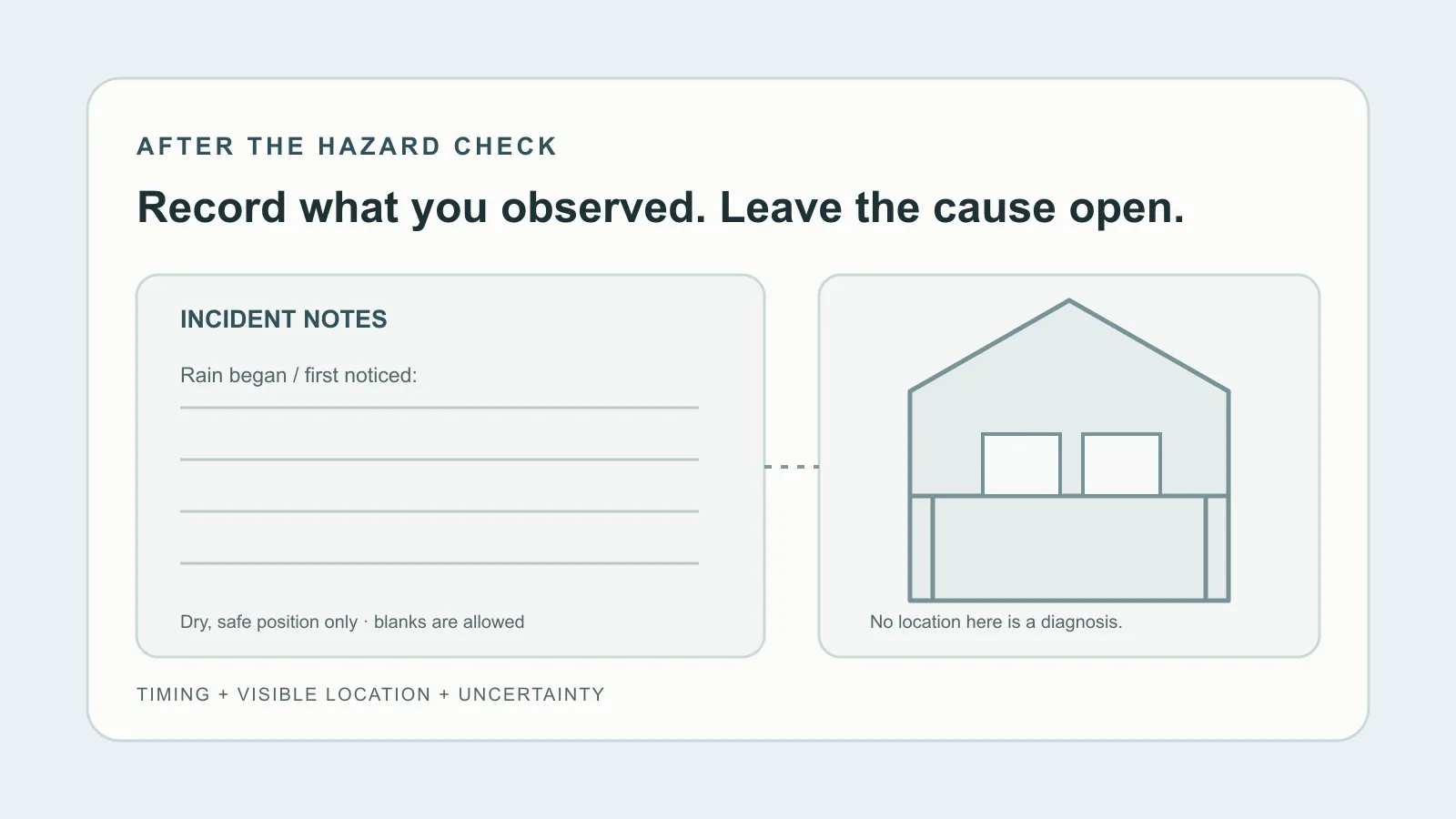
Complete this only after the hazard screen passes and you can observe from an already dry, safe position without entering the basement or going outside during unsafe weather. If doing so would require entry, skip the record and contact a qualified local professional or utility. If you cannot answer something safely, leave it blank.
| Record | What to note |
|---|---|
| Rain and first-noticed time | Approximate when heavy rain began, if known, and when water was first noticed. Do not go out during the storm to check conditions. |
| First visible location | From a dry, safe position, note whether water was seen near a door or window, a wall or wall-floor joint, a floor drain, a plumbing fixture, or somewhere else. Record only what you actually saw. |
| Pattern over time | Note whether the visible area seemed to grow, stay similar, or dry after conditions changed. Do not remain in an unsafe area to monitor it. |
| Other observations | Record visible staining or prior water marks, recent recurrence, and whether you know of a local sewer or flood notice. Do not touch, taste, or smell water to identify it. |
| What remains unknown | Write down any uncertainty about the source, water quality, or building condition rather than filling in a guess. |
| Contact and question | Note whom you contacted and ask what assessment is appropriate for your location and building. |
Use location as a question, not a diagnosis
| What was visible from a safe, dry position | A useful question to ask | What it cannot prove |
|---|---|---|
| Water near a door, window, or other opening | Could surface runoff or an opening be relevant here? | It does not establish failed grading, a seal, gutter, or window well. |
| Dampness or water at a wall-floor joint or crack | Should groundwater, drainage, or the foundation be assessed? | A crack or damp mark alone does not show structural failure or identify an entry path. |
| Water near a floor drain or plumbing fixture | Should the local sewer utility or a plumber assess a backup or plumbing issue? | Rain timing does not establish a sewer backup; local sewer systems differ. |
| Dampness without visible liquid entry | Could indoor humidity or condensation be part of the problem? | Damp surfaces alone do not rule out concealed water entry or another source. |
University of Minnesota Extension describes rain/groundwater, interior moisture, and condensation as different possible sources of basement moisture. The Metropolitan Milwaukee Sewerage District likewise lists several possible locations and mechanisms, but its utility and drainage details are local. These are prompts for an assessment, not a fault-finding chart: the same location can have more than one explanation, and water may travel before it becomes visible.
If a qualified assessment confirms an ordinary clean-water plumbing leak, the separate mold-after-water-leak guide covers that narrower situation. If floodwater, sewage, electrical hazards, or structural damage is possible, keep the area closed and use local emergency, utility, or professional guidance instead.